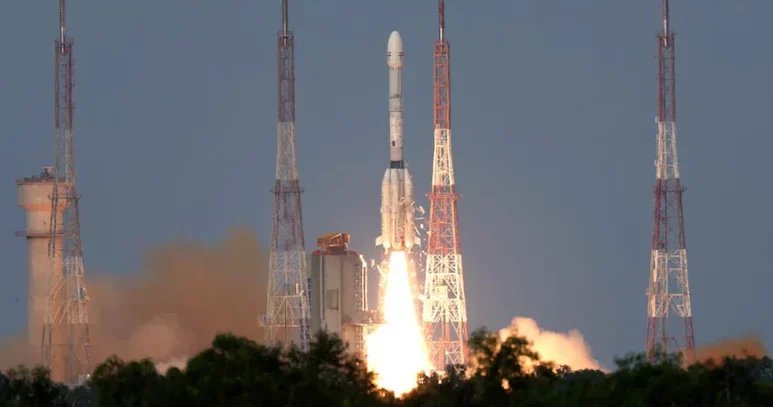
India’s space programme, spearheaded by the Indian Space Research Organisation (ISRO), has evolved from humble beginnings into a global symbol of technological excellence and frugal innovation. From launching its first small-scale rockets in the 1960s to achieving precision lunar landings, interplanetary missions, and human spaceflight, ISRO has become a crucial driver of national development. Today, the organisation’s satellites and missions are not only advancing scientific understanding but are deeply intertwined with the daily lives of millions of Indians. Whether enabling ATM transactions, supporting farmers with crop forecasts, assisting disaster management, or inspiring a new generation of students, ISRO has demonstrated how space technology can be harnessed to directly touch lives and contribute to India’s broader economic and social development. As Parliament debates the critical role of space programmes for a “Viksit Bharat” by 2047 and commemorates India’s first astronaut aboard the International Space Station, it is clear that ISRO’s impact extends far beyond scientific achievement, positioning India for a future where indigenous innovation powers both the economy and society.
From Thumba to the Moon: Milestones in India’s Space Journey
ISRO’s journey began in a small church in the fishing village of Thumba, Kerala, where scientists launched the Nike-Apache sounding rocket in 1963. Over the decades, this modest initiative grew into a globally respected organisation, combining limited resources with cutting-edge technology to achieve feats that have placed India on the world space map. The Chandrayaan-3 mission’s successful landing near the Moon’s South Pole on August 23, 2023, marked a new zenith in India’s lunar exploration. The mission demonstrated not only precision landing capabilities but also advanced deep-space navigation and engineering, with the Vikram lander performing a hop experiment and the propulsion module maneuvered into Earth orbit for extended operations. These achievements underscore ISRO’s growing expertise in complex space technologies and its ability to execute missions that were once considered exclusive to a handful of spacefaring nations.
India’s human spaceflight programme also advanced significantly with Mission Akash Ganga, part of the multinational Axiom-4 flight. Group Captain Shubhanshu Shukla, India’s most recent astronaut, spent 20 days in space, orbiting Earth 282 times and covering over 12 million kilometres. Conducting seven India-specific experiments aboard the International Space Station, he symbolised the new frontier of Indian human spaceflight. This mission lays the foundation for the indigenous Gaganyaan programme, which aims to launch an Indian astronaut aboard an Indian rocket from Indian soil by 2027, marking India’s entry into the elite group of nations with independent human spaceflight capabilities alongside Russia, the United States, and China.
The Chandrayaan series has cemented India’s reputation in lunar science. Chandrayaan-1 discovered water molecules on the Moon in 2008, transforming global understanding of lunar geology. Chandrayaan-2 provided independent imaging of Apollo mission artefacts, and Chandrayaan-3’s South Pole landing positioned India at the forefront of lunar exploration, targeting regions considered rich in scientific value and potential resources. Upcoming missions, such as Chandrayaan-4, aim to return lunar samples, further consolidating India’s role as a leader in space science. Interplanetary missions such as Mangalyaan, India’s Mars orbiter launched on its maiden attempt, and the ongoing Aditya-L1 solar observation mission, demonstrate ISRO’s expanding footprint beyond Earth orbit, contributing to both planetary and solar science.
Economic, Social, and Strategic Impacts of India’s Space Programme
ISRO’s impact extends far beyond exploration and technology—it has become a central driver of India’s economic, social, and strategic development. According to a 2024 Novaspace study commissioned by ISRO, India’s space sector has contributed $60 billion to the national economy over the past decade, supported 4.7 million jobs, and generated $24 billion in tax revenues. These figures highlight the tangible socio-economic benefits of space applications, which touch everything from agriculture to communications. Satellites provide critical services such as weather forecasting, cyclone alerts, navigation support, and crop monitoring, benefiting millions of citizens daily. Over 8,00,000 fisherfolk rely on satellite data for safe operations, while forecasts and disaster alerts reach nearly 1.4 billion people, saving lives and protecting livelihoods.
India’s spy and reconnaissance satellites, with 25 cm resolution, have bolstered national security, allowing authorities to monitor sensitive regions and enhance strategic preparedness. The deployment of indigenous satellite constellations and advanced Earth observation systems like the NASA-ISRO Synthetic Aperture Radar (NISAR) satellite—launched aboard the GSLV F-16 in July 2025—demonstrates India’s increasing capability in global space collaboration. NISAR, weighing 2,392 kg, monitors climate change, natural disasters, soil moisture, ice-sheet movements, and infrastructure stress with unparalleled precision. Its dual-frequency SAR payloads from NASA and ISRO enable detection of surface changes as small as a centimetre, making it a vital tool for disaster management and resource planning. Chairman Dr V Narayanan emphasised NISAR’s role as a “lifesaving satellite,” exemplifying the combination of technological mastery and societal utility that characterises India’s space programme.
India’s 100th rocket launch in January 2025, deploying a navigation satellite, symbolised the maturity of the nation’s cryogenic engine technology and highlighted the strategic depth of its launch capabilities. In addition to satellites for national development, India has orbited 433 foreign satellites, offering three different commercial launch vehicles for hire, creating a significant revenue stream while bolstering global space collaboration. The Indian satellite constellation, valued at roughly Rs 50,000 crore, supports sectors including urban planning, communications, navigation, and disaster management, reflecting the multi-faceted utility of space infrastructure in everyday life.
ISRO’s approach to innovation and collaboration extends to the private sector. Over 300 space start-ups in India, including Agnikul Cosmos, Skyroot Aerospace, and Pixxel Aerospace, are advancing sub-orbital rockets, high-resolution imaging satellites, and satellite constellations, driving domestic growth and global competitiveness. Financial studies suggest that every dollar invested in Indian space technology generates a return of $2.52, highlighting the high efficiency and socio-economic value of India’s space expenditure. With a current annual budget of $1.6 billion compared to NASA’s $25 billion, ISRO has consistently achieved results that rival much larger space agencies, demonstrating exceptional resource management and innovation.
The broader roadmap for India’s space ambitions is both visionary and strategic. Prime Minister Narendra Modi has outlined goals including the establishment of the Bhartiya Antariksha Station by 2035 and a manned lunar mission by 2040. Precursor missions, such as the planned 2028 space module launch, will pave the way for permanent Indian presence in space, ensuring that India joins an elite group of nations capable of independent, sustained operations in orbit. Beyond scientific exploration, these initiatives are designed to inspire youth, foster innovation, and integrate space-based solutions into the national development agenda.
The socio-economic impact of ISRO’s programmes also extends to education, employment, and technological skill development. India’s growing cadre of space engineers, scientists, and technicians benefit from cutting-edge research and applied innovation, enhancing human capital and positioning India as a global hub for space technology. Students across the country are inspired by missions such as Gaganyaan and Chandrayaan-3, with educational initiatives linked to ISRO encouraging interest in STEM fields and promoting a culture of scientific inquiry.
ISRO’s story is one of resilience, vision, and the ability to achieve transformative outcomes with limited resources. From launching a 715 kg Nike-Apache rocket from Thumba in 1963 to deploying the 6,40,000 kg Launch Vehicle Mark-3 (LVM-3) in recent years, the organisation has continuously pushed boundaries. Its satellites, rockets, and human spaceflight programmes reflect a commitment to indigenously developed technologies, sustainable innovation, and broad societal impact. This journey illustrates how space programmes can simultaneously advance national security, economic growth, and social welfare, embedding science and technology into the everyday lives of citizens.
As India approaches its 100th year of independence in 2047, ISRO’s roadmap reflects a vision of a nation where space is a key driver of development. With plans for an Indian flag on the Moon, a space station orbiting Earth, and a thriving domestic space economy, the organisation embodies the potential of homegrown innovation to catalyse national progress. ISRO’s initiatives underscore that space is not just a frontier for scientific exploration—it is an instrument for economic empowerment, societal well-being, and strategic advancement. By touching lives, enabling growth, and inspiring citizens, ISRO demonstrates that India’s journey in space is intrinsically linked to its journey toward becoming a Viksit Bharat.