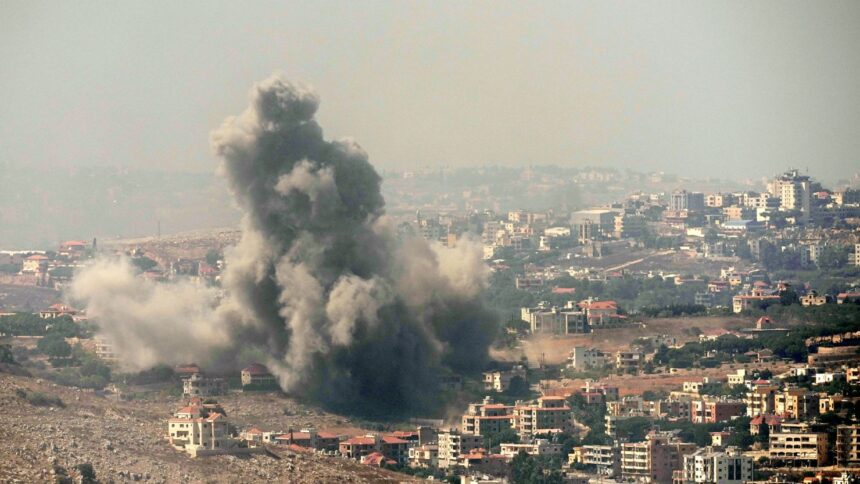
The fragile peace between Israel and Lebanon has once again come under severe strain after the Israeli military launched a series of heavy airstrikes on southern Lebanon on Thursday, targeting what it claimed were Hezbollah military installations. The attacks, which followed evacuation orders for several border towns, have raised fears of a renewed large-scale conflict despite a ceasefire agreement signed a year ago. According to early reports, one person was killed and another wounded in the bombings, as smoke and debris filled the skies over several Lebanese villages.
The Israeli military justified the airstrikes as necessary to prevent Hezbollah from rebuilding its military capabilities, accusing the group of re-establishing weapon storage sites and operational bases in the border region. Lebanon’s health ministry confirmed the casualties and described the strikes as an alarming escalation that threatens to unravel the relative calm maintained since the 2024 ceasefire.
Evacuation Orders and Renewed Bombings Shake Southern Lebanon
The new wave of violence began around 3 p.m. local time, when Israeli military spokesperson Avichay Adraee issued evacuation orders for multiple southern Lebanese villages via social media. The announcements targeted Aita al-Jabal, Al-Tayyiba, and Tayr Debba—areas ranging from just four kilometers from the Israeli border to about 24 kilometers north. Residents were instructed to stay at least 500 meters away from designated locations, while Lebanon’s civil defense units scrambled to assist civilians in leaving their homes.
Roughly an hour after the orders, Israeli fighter jets launched airstrikes on these regions, hitting suspected Hezbollah sites and nearby civilian infrastructure. Plumes of thick smoke rose across the horizon, prompting widespread panic among residents who had only recently begun to rebuild their lives after years of intermittent conflict.
Lebanese officials described the attacks as a serious violation of the ceasefire and warned that such aggression could destabilize the entire region. The Lebanese army said in a statement that Israel’s latest actions represented “a continuation of the enemy’s destructive approach aimed at undermining Lebanon’s stability and widening destruction in the south.”
Among the worst-hit areas was the town of Abbasiyeh, where an ironworks shop was reduced to rubble. The shop owner, Ahmad al-Kayyal, said the strike had destroyed his livelihood and affected several families dependent on the small business. “This shop was supporting five to six households. What does a blacksmith make? Chairs, doors, windows—these are not weapons,” he lamented.
Mayor Farid Nahnouh of Tayr Debba voiced deep concern about the situation, saying, “We are in a very dangerous situation; if things keep heading this way, then all hope is lost. No one knows where the consequences of these matters will lead.” His comments reflected growing anxiety in southern Lebanon, where residents fear that Israel may be preparing for a full-scale aerial offensive similar to the 2023–24 campaign that left vast areas devastated.
Israeli officials, however, defended the strikes, insisting that Hezbollah had violated the ceasefire by attempting to rebuild its military infrastructure in the south. Government spokesperson Shosh Bedrosian told reporters that Israel “will continue to defend all of its borders” and remains committed to ensuring “the full enforcement of the ceasefire agreement.” Bedrosian emphasized that Israel would not allow Hezbollah to regain the strength it lost during the previous war, calling its rearmament “a direct threat to Israel’s national security.”
Hezbollah, UN, and Lebanese Government React to the Escalation
Hezbollah, in a rare official statement, responded that it remained committed to the ceasefire agreement but reserved its “legitimate right to resist Israeli aggression.” The group, which is backed by Iran, denied obstructing Lebanese army operations in the south and claimed it had not engaged in cross-border attacks since the truce was implemented. The statement was intended to project restraint, even as Israeli strikes continued throughout the day.
The United Nations Interim Force in Lebanon (UNIFIL) condemned Israel’s actions, stating that the airstrikes were clear violations of UN Security Council Resolution 1701, which was adopted in 2006 to maintain peace along the Lebanon-Israel border. In a public statement, UNIFIL urged Israel to immediately cease all hostilities and called on Lebanese groups to avoid retaliatory actions that could further inflame tensions. “We call on Israel to immediately cease these attacks and all violations of resolution 1701. Likewise, we urge Lebanese actors to refrain from any response that could escalate the situation,” the statement read.
Lebanon’s caretaker government echoed these concerns, warning that the airstrikes risked undoing months of progress made by the Lebanese army in dismantling Hezbollah’s weapons depots in the south. The cabinet convened an emergency meeting on Thursday to receive a briefing from army commander General Rodolphe Haykal, who reported ongoing operations to confiscate arms caches and restore full state authority across the region.
According to senior security officials, the Lebanese army has made “significant monthly progress” in reducing non-state weapons presence and expects to clear southern Lebanon of illegal arms by the end of the year. However, the latest Israeli bombings have jeopardized this fragile progress and renewed questions about the effectiveness of the ceasefire framework.
Despite the ongoing disarmament operations, Israeli authorities argue that Hezbollah’s continued presence near the border violates the spirit of the ceasefire. The strikes, they claim, were limited to specific targets linked to the group’s rebuilding efforts. However, local witnesses reported that several civilian structures, including homes and small businesses, were damaged in the bombings—raising concerns about disproportionate use of force.
The renewed hostilities have deepened fears that the border region could once again become a flashpoint in the broader Israel-Iran rivalry. Analysts suggest that Israel’s strikes are intended not only to cripple Hezbollah’s military potential but also to send a message to Tehran that any regional attempt to strengthen the group will be met with decisive action.
Meanwhile, humanitarian organizations in Lebanon are preparing for a potential escalation. Civil defense teams and local NGOs have begun relocating vulnerable families from high-risk areas, while hospitals in Tyre and Nabatieh have been placed on high alert. Reports from the ground suggest that hundreds of families have already fled border towns to safer locations farther north.
The timing of the Israeli airstrikes—coinciding with Lebanon’s internal political and economic crisis—has further strained the country’s stability. The government, already grappling with severe inflation, power shortages, and widespread unemployment, now faces the additional challenge of managing displacement and reconstruction in the south. Political commentators warn that renewed conflict could derail Lebanon’s fragile recovery efforts and plunge the country into deeper instability.
The escalation also threatens to destabilize diplomatic efforts aimed at preserving peace in the region. International observers, including the European Union and several Middle Eastern governments, have called for restraint and urged both sides to uphold the terms of the ceasefire. However, with both Israel and Hezbollah standing firm on their respective positions, the prospect of de-escalation remains uncertain.
The Israeli strikes mark a dramatic turn in what had been a tense but relatively stable year along the border. Although skirmishes and isolated incidents had occurred since the 2024 truce, the scale and coordination of Thursday’s airstrikes suggest a deliberate escalation by Israel. Analysts believe the strikes may have been triggered by intelligence reports indicating Hezbollah’s renewed military activities in the region.
For residents of southern Lebanon, however, the reality is grim. Many fear that these bombings could be the beginning of another prolonged conflict similar to the 2006 and 2023 wars. With reconstruction from previous conflicts still incomplete, communities in the south now face yet another cycle of destruction and uncertainty.
Diplomatic efforts are expected to intensify in the coming days, as the United Nations and regional mediators seek to prevent further escalation. However, with both Israel and Hezbollah locked in a tense standoff, the situation along the border remains precarious—and the threat of a wider conflict looms large once again over Lebanon and the Middle East.