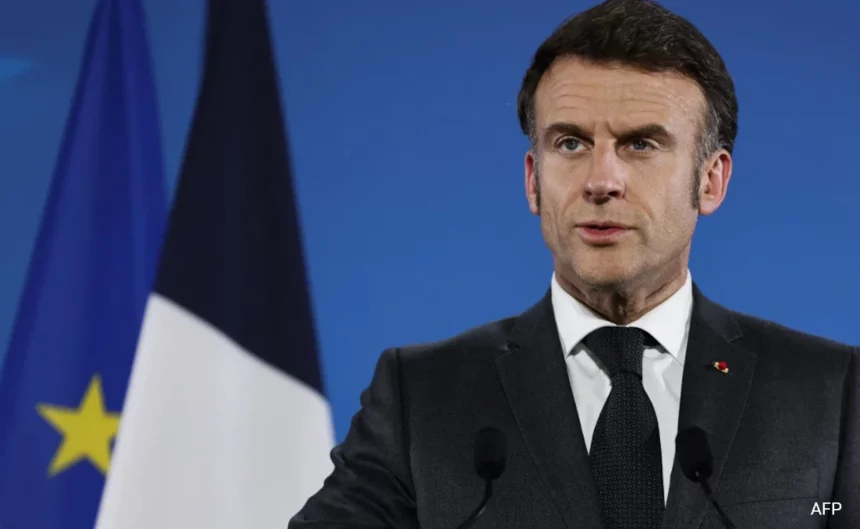
France’s announcement to recognise a Palestinian state at the upcoming United Nations General Assembly has ignited sharp reactions from Israel and the United States while fuelling cautious hope for reviving the two-state solution amid the prolonged Middle East conflict. French President Emmanuel Macron’s decision, described as a step towards a “just and lasting peace,” comes at a critical moment when the region remains tense following Israel’s ongoing war in Gaza and rising global divisions over the Palestinian issue.
Macron shared the decision publicly through a letter to Palestinian Authority President Mahmoud Abbas, affirming France’s commitment to formally recognise Palestine during the UNGA session in September while encouraging other nations to consider the same path. France, home to Europe’s largest Jewish and Muslim populations, would be the first major Western power to take this step, potentially shifting the global conversation around Palestinian statehood, which has largely seen support from smaller nations so far.
Israel and US React Strongly Against France’s Plan
The announcement drew immediate condemnation from Israel, with Prime Minister Benjamin Netanyahu criticising the move as “rewarding terror” and accusing France of risking Israel’s security by supporting what he termed a potential “launch pad” for attacks against Israel rather than a peaceful coexistence. Netanyahu argued that the Palestinians do not seek a state alongside Israel but rather in place of it, reflecting Israel’s long-standing stance against unilateral recognition of Palestine.
Israeli Defence Minister Israel Katz echoed the sentiment, calling France’s move “a disgrace and a surrender to terrorism,” asserting that Israel would not permit the formation of a Palestinian entity that could compromise Israeli security and existence.
The United States also voiced its disapproval, with Secretary of State Marco Rubio labelling France’s decision as “reckless” and accusing it of bolstering Hamas propaganda while undermining prospects for peace. Rubio further criticised the plan as an insult to victims of Hamas’ October 7 attacks, highlighting the complex backdrop against which France has chosen to move forward with its decision.
Canada, while not supporting unilateral recognition, reiterated its support for a two-state solution and criticised Israel’s handling of the humanitarian crisis in Gaza. Canadian Prime Minister Mark Carney urged Israel to respect the territorial integrity of Gaza and the West Bank while calling for an immediate ceasefire and the release of hostages held by Hamas.
Macron’s Push for a Two-State Solution Amid Global Divisions
Macron’s intention to recognise Palestine follows months of internal discussions within France and among its diplomatic partners, as Paris seeks to revive momentum for a two-state solution that has been losing traction internationally. French officials had initially planned to announce the move during a United Nations conference co-hosted with Saudi Arabia in June, aiming to set a framework for peace that balanced Palestinian aspirations with Israel’s security concerns.
However, the conference faced delays due to the Israel-Iran air conflict and US pressure, leading to its rescheduling as a ministerial-level event later in July, followed by a heads-of-state meeting on the sidelines of the UNGA in September, where Macron intends to make the formal announcement.
Macron’s team believes the decision will provide a framework for working with other nations considering recognising a Palestinian state, especially ahead of the UN meetings. However, the move has faced resistance from allies such as Britain and Canada, reflecting the broader international hesitation around the recognition of Palestinian statehood outside of a negotiated settlement.
Diplomats have noted that Israel has lobbied aggressively to prevent France’s recognition, warning of potential repercussions, including reduced intelligence sharing and complications in regional cooperation. Some Israeli officials have even hinted at the possibility of annexing parts of the West Bank in retaliation, underscoring the potential diplomatic fallout of France’s decision.
Israel maintains that recognising a Palestinian state under current conditions would effectively reward Hamas, which it accuses of prioritising violence over negotiations, particularly after the militant group’s attack on Israel in October 2023 that escalated the Gaza conflict.
Palestinian Authority Welcomes France’s Support
On the other hand, the Palestinian Authority has welcomed Macron’s decision, viewing it as a sign of France’s commitment to international law and the Palestinian right to self-determination. Vice President Hussein Al Sheikh expressed gratitude on behalf of the Palestinian Authority, noting that France’s step represents support for establishing an independent Palestinian state, a goal long sought by Palestinians amid stalled peace talks and continued Israeli settlement expansions.
While France’s move is largely symbolic at this stage, it could add momentum to the broader push for Palestinian recognition within the international community, challenging the existing diplomatic status quo where many major Western powers have refrained from taking this step unilaterally.
The United States, in diplomatic cables earlier this year, reiterated its opposition to unilateral recognition of Palestine, arguing it could counter American foreign policy interests and destabilise ongoing diplomatic efforts. Former President Donald Trump had also expressed scepticism about the viability of a two-state solution, instead proposing controversial measures such as a potential US takeover of Gaza, which drew condemnation from rights groups and Arab states as “ethnic cleansing.”
Despite the external pressures, Macron has remained inclined towards recognising Palestine, viewing it as a necessary step to keep the two-state solution alive. French officials believe that the move could help break the deadlock and encourage renewed dialogue, even as the region remains engulfed in tensions and the humanitarian crisis in Gaza continues to worsen.
France’s decision, if formally announced in September, could reshape discussions around the Israeli-Palestinian conflict within the United Nations, potentially pushing other nations to reconsider their stance on Palestinian recognition, while testing France’s diplomatic relations with Israel, the United States, and its European allies in the process.