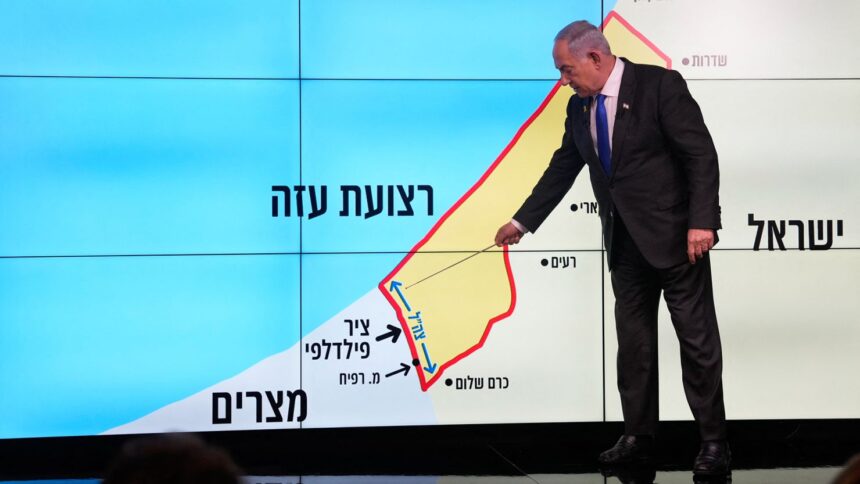
Israel has declared that it will not withdraw its forces from the Gaza-Egypt border, a key requirement of the second phase of the ceasefire agreement with Hamas. Despite sending a delegation for negotiations, Israeli officials have made it clear that they will not relinquish control over the Philadelphi Corridor, a 14-kilometer strip along the border, citing security concerns.
An Israeli source, speaking to CNN, emphasized that allowing Hamas to regain access to the corridor would pose a severe threat to Israel’s security. “We will not allow Hamas murderers to roam again with trucks and rifles on our borders, and we will not let them strengthen themselves again through smuggling,” the source stated. The firm stance comes just days before the first phase of the ceasefire agreement expires, and mere hours after Hamas released the last of the hostages under the initial terms of the deal.
Hamas, in response, has accused Israel of violating the agreement and deliberately obstructing the negotiation process. In a statement, the group said that Israel’s refusal to withdraw from the border amounts to a clear breach of the ceasefire terms, warning that such actions would only lead to further complications in the already fragile negotiations.
The ceasefire, which was initially agreed upon for 42 days, has entered a critical juncture as mediators seek to extend it into a second phase. However, talks on this next stage have been delayed for over three weeks. As tensions continue to rise, Israel has also witnessed a violent attack on its own soil. On Thursday, a car-ramming incident in central Israel left at least nine people injured, with two in serious condition and one critically wounded. Israeli police have identified the attacker as a 53-year-old Palestinian man, who was shot and killed by security forces. Authorities are treating the incident as a terrorist attack.
Meanwhile, Israel has intensified its military operations in the occupied West Bank, leading to the deaths of dozens of Palestinians and the displacement of thousands since the ceasefire took effect. This escalation further complicates the ongoing negotiations, with both sides expressing deep mistrust.
As part of efforts to extend the ceasefire, Israeli Prime Minister Benjamin Netanyahu has dispatched a negotiating team to Cairo. However, it remains unclear whether the delegation will address the complete withdrawal of Israeli forces from Gaza, as required under phase two of the agreement, or simply seek an extension of the current truce without making any significant concessions. Egypt, which is playing a key role as a mediator alongside Qatar and the United States, has confirmed that discussions are underway to determine the next steps in the fragile peace process.
Notably, Israel’s Strategic Affairs Minister Ron Dermer, who leads the country’s negotiation team, has opted not to travel to Cairo, signaling that high-level talks may not take place at this stage. The first phase of the ceasefire, which has so far resulted in the release of 38 hostages held by Hamas, as well as thousands of Palestinian prisoners detained by Israel, is set to expire on Saturday.
Netanyahu’s government is reportedly focused on extending the first phase of the truce for as long as possible, aiming to secure the release of additional hostages without committing to a full withdrawal from Gaza. Critics, including opposition leader and former military chief Benny Gantz, have accused Netanyahu of prioritizing political interests over national security. Gantz has called for a more decisive approach, stating that Israel should push for the release of hostages in one coordinated exchange rather than prolonging the truce in incremental phases.
Hamas, on the other hand, has insisted that the second phase of the agreement should proceed as originally planned. According to Hamas official Mahmoud Mardawi, Israel’s withdrawal from the Philadelphi Corridor was supposed to begin on the 42nd day of the ceasefire, with a complete withdrawal from Gaza by March 9.
Israel’s military took control of the border area in May, and Netanyahu has repeatedly stressed that maintaining control over the corridor is essential for preventing Hamas from rearming itself. The second phase of the ceasefire agreement requires Israel to withdraw its forces completely from Gaza, including the Egyptian border, in exchange for the release of all remaining living hostages held by Hamas.
Hamas has reiterated its commitment to the agreement following the release of four deceased hostages overnight on Thursday. However, the group has warned that any attempts by Netanyahu’s government to renege on the terms of the deal could lead to further suffering for prisoners and hostages alike.
With the ceasefire deadline fast approaching and negotiations hanging in the balance, all eyes are on Cairo as diplomats work to prevent a collapse of the truce. The outcome of these talks could determine whether Israel and Hamas move toward a long-term de-escalation or plunge back into conflict.