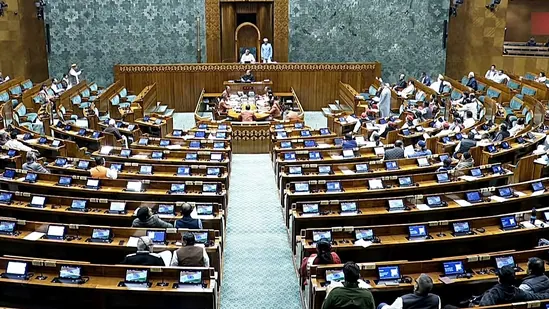
The winter session of Parliament on Wednesday unfolded as one of the most confrontational days of the season, with heated arguments, sharp political jibes and escalating tensions between the treasury benches and the opposition. The proceedings centred around the Special Intensive Revision of electoral rolls, allegations of voter fraud and the political messaging around Vande Mataram. The day witnessed multiple flashpoints, including a walkout by opposition parties during Home Minister Amit Shah’s speech, a series of counter-attacks between Shah and Congress leader Rahul Gandhi and renewed debate over the neutrality of the Election Commission. What began as a routine morning session soon transformed into a storm of accusations, rebuttals and high political drama that stretched across both Houses.
Debate Over Electoral Integrity Dominates the Lok Sabha as Shah and Gandhi Clash
The Lok Sabha’s sharpest confrontation of the day emerged from the debate on the ongoing Special Intensive Revision (SIR) of electoral rolls. The discussion, intended to address concerns over alleged discrepancies, quickly turned into an intense showdown between senior leaders of the ruling BJP and the Congress. Amit Shah, opening his remarks on SIR, insisted that the exercise was entirely within the constitutional mandate of the Election Commission and had been conducted several times in the past, including during the tenures of Jawaharlal Nehru and Indira Gandhi. By invoking history, Shah positioned the current SIR as neither unprecedented nor politically motivated, asserting that previous Congress governments had overseen similar exercises in 1952, 1957, 1961, 1965–66 and 1983–84.
He criticised the opposition for what he described as creating an impression that the government was avoiding debate, emphasising that the BJP-led National Democratic Alliance had never shied away from parliamentary accountability. His tone shifted when he addressed the allegations of voter fraud raised by Rahul Gandhi. Shah dismissed the claims of “vote chori” as an attempt to justify electoral defeats, pointing out that the NDA had won three Lok Sabha elections and forty-one state elections since 2014, while the Congress had also won thirty state elections in the same period. He argued that if elections were rigged, the Congress could not have secured any victories at all.
His comments sharpened further when he accused the opposition of raising the SIR issue to keep what he described as “illegal infiltrators” on the voters’ list. According to Shah, the government’s policy was clear: detect unauthorised entrants, delete their names from electoral rolls and deport them. The opposition, he alleged, sought to normalise infiltration for political gain. The intensity grew when he cited instances of what he termed historical “vote chori,” referring to past controversies involving Jawaharlal Nehru, Indira Gandhi and Sonia Gandhi. Shah claimed that Nehru’s ascension to prime ministership despite receiving fewer votes from the Congress Working Committee was itself an example. He added that Indira Gandhi had granted herself immunity after her election was set aside by a court, and that a pending dispute in a civil court raised questions about Sonia Gandhi allegedly being a voter before becoming a citizen.
Rahul Gandhi countered the assertions sharply, arguing that Shah had not responded to the core issues he had raised. Gandhi insisted he had asked for a transparent voter list and details of the Electronic Voting Machine’s architecture, but received no answers. He characterised the home minister’s response as defensive and frightened. The clash reached a peak when Gandhi reiterated his allegation that Haryana had nineteen lakh fake voters, challenging the government to debate his press conference in detail. Shah, however, clarified examples cited by the opposition, including a case of a voter in Bihar whose incorrect age entry had triggered controversy and another case in Haryana where 501 voters were registered in a large joint family residence.
The verbal duel culminated in an opposition walkout as Shah intensified his remarks on infiltration, asserting that their walkout was itself evidence of their discomfort with the removal of unauthorised entrants from voter lists. The Lok Sabha was eventually adjourned till the following morning after Shah concluded his strongly worded address.
Upper House Debates Vande Mataram, Electoral Reforms and Political Conduct Amid Heightened Tensions
While the Lok Sabha grappled with SIR-related confrontations, the Rajya Sabha turned its attention to cultural and historical questions surrounding Vande Mataram. The debate, which coincided with the 150th anniversary year of the composition, saw divergent interpretations of its political symbolism. Congress leader Jairam Ramesh accused the ruling party of weaponising the debate to malign the legacy of Jawaharlal Nehru and other Congress-era leaders. He argued that the discussion was less about honouring the national song and more about rewriting history. In a pointed remark, he called BJP members “distorions” rather than historians, criticising them for misrepresenting historical narratives.
On the other side, BJP and allied MPs maintained that invoking Vande Mataram was a tribute to national pride and unity. Rajya Sabha MP Kartikeya Sharma suggested institutionalising the singing of Vande Mataram before Parliament sessions, noting that similar practices in schools and cinema halls had strengthened respect for national symbols. His proposal sparked discussions about the role of cultural traditions in parliamentary processes, though it did not receive unanimous support.
Back in the Lok Sabha, other MPs brought additional perspectives on SIR and the state of electoral reforms. Congress MP Imran Masood criticised the Election Commission over recent mayoral elections in Saharanpur, alleging police excesses against voters from Dalit and Muslim communities and calling for a return to paper ballots. Shiv Sena (UBT) and RJD leaders expressed support for Rahul Gandhi’s demands for transparency, while some BJP members used the opportunity to challenge the opposition’s credibility. Kangana Ranaut, addressing the House, argued passionately that Prime Minister Narendra Modi did not require manipulation of voting systems because he had “hacked the hearts of the people.” She condemned daily disruptions by opposition MPs as traumatic and unproductive, criticising their conduct in the House.
The day also highlighted broader political anxieties. A Shiv Sena (UBT) MP declared that the NDA was too small in front of West Bengal chief minister Mamata Banerjee, signalling regional confidence amid national-level confrontations. Congress MPs reiterated that the Election Commission must function as a neutral agency, and Samajwadi Party members called for a nationwide return to paper ballots, reflecting growing debates about public trust in the electoral system. Earlier in the day, an AAP MP had sought an adjournment motion to discuss Delhi’s pollution crisis, a reminder of the numerous governance challenges competing for parliamentary attention.
Even issues unrelated to electoral reforms found their way into the discourse. Karthi Chidambaram flagged the economic fallout of the IndiGo crisis, drawing attention to the far-reaching impact of large-scale flight cancellations. Tejasvi Surya of the BJP referred to Gandhi as a “non-resident Indian politician,” adding another layer of political sparring to the already charged atmosphere. Engineer Rashid, meanwhile, praised the Election Commission’s conduct of elections in the valley, reflecting differing regional assessments of the institution’s credibility.
As proceedings moved into the evening, the cumulative tensions across both houses created an atmosphere where ideological disagreements, historical debates, procedural questions and personal attacks seamlessly intertwined. What emerged from the day was not merely a debate on SIR or Vande Mataram but a snapshot of the deep political divide shaping India’s parliamentary discourse. The live blog documenting the day’s developments closed with a succinct message: the session had ended, but the issues it raised would continue to resonate in the days ahead.