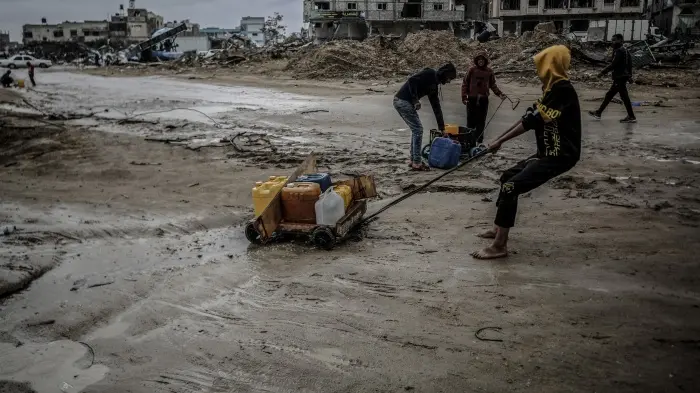
The Indonesian government is actively working on detailed plans to provide medical treatment for 2,000 Palestinians from war-torn Gaza, in a highly sensitive initiative that balances humanitarian commitment with political and legal considerations. With the escalating conflict in Gaza causing widespread destruction and overwhelming local healthcare facilities, Indonesia has proposed a temporary medical assistance program to support affected Palestinians. Officials have been holding inter-ministerial meetings to examine logistical feasibility, medical readiness, legal frameworks, and the broader implications for Indonesia’s foreign policy. While the plan reflects Indonesia’s longstanding support for Palestinian statehood, it also raises questions about the rights of Palestinians to return home, regional diplomacy, and the potential domestic and international controversies that could emerge from implementing such a complex operation.
As Southeast Asia’s most populous Muslim-majority nation, Indonesia has consistently voiced support for Palestine in international forums and has avoided formal diplomatic engagement with Israel. This historical context informs the sensitive nature of the government’s Gaza assistance plan. The discussions around the initiative are focused not only on providing care to civilians affected by the conflict but also on ensuring that the temporary relocation aligns with international humanitarian law and preserves the principle of the right to return for Palestinians. The initiative, while exploratory, signifies Indonesia’s strategic engagement in humanitarian diplomacy and demonstrates the country’s intent to respond to global crises with a coordinated, multi-agency approach.
Exploring Logistics, Sites, and Medical Infrastructure for Temporary Palestinian Care
The government has identified several potential locations for the temporary medical program, with Galang island emerging as a primary option. Located south of Singapore, Galang was historically used to host Vietnamese refugees and most recently served as a site for a pandemic hospital, making it a plausible location for accommodating patients from Gaza. Other facilities in West Java and Central Java are also under consideration due to their proximity to major hospitals, logistical hubs, and transportation networks. Indonesian officials are exploring all operational details, including patient intake, hospital readiness, transportation logistics, and coordination with international humanitarian organizations to ensure medical services are efficiently delivered.
Deputy Chair of Parliament’s Commission I, Dave Laksono, explained that the inter-ministerial meetings involve the coordinating security ministry as well as the ministries of health and foreign affairs. “These discussions have focused on logistical feasibility, medical readiness, and legal frameworks,” he said. The commission has also been briefed on the strategic and foreign policy implications of temporarily hosting Palestinians. One aspect under consideration is the potential use of large military hospitals in Jakarta, which could supplement capacity if civilian infrastructure proves insufficient. Another option raised during discussions is collaboration with Jordan, a country with which Indonesia has cultivated strong bilateral ties, providing an alternative or supplementary site for medical treatment if Galang or mainland Indonesian facilities face constraints.
Officials have emphasized that these measures are being considered with a temporary framework in mind. Coordination with international agencies such as UNRWA and the International Committee of the Red Cross is planned to establish proper documentation, medical records, and protocols for eventual repatriation to Gaza. The goal is to provide urgent care while maintaining adherence to humanitarian norms and ensuring the Palestinians’ eventual return home once conditions stabilize in Gaza. The program is therefore carefully structured to prevent any perception of permanent resettlement, which could be politically and socially sensitive in Indonesia.
Legal, Political, and Diplomatic Considerations in Hosting Palestinians
While the initiative underscores Indonesia’s humanitarian commitment, it also introduces significant legal and political complexities. Abdul Kadir Jailani, Director General for Asian, Pacific, and African Affairs at Indonesia’s Ministry of Foreign Affairs, highlighted the importance of upholding international humanitarian law and ensuring respect for the right to return. “One of the issues is how to make sure the right to return of the Palestinians can be respected because we know that many are worried that this kind of policy can be interpreted in other ways,” he said. The government has acknowledged concerns expressed by national Islamic leaders who caution that hosting Palestinians without robust guarantees could be politically sensitive or misinterpreted.
Another crucial factor is regional diplomacy. Indonesia’s initiative occurs in the broader context of international efforts to address humanitarian needs in Gaza, following extensive discussions involving countries such as Jordan, and international agencies coordinating relief efforts. The government’s careful inter-ministerial planning ensures that all steps are aligned with foreign policy goals, regional stability, and bilateral relationships. The proposal to temporarily host Palestinians also reflects Indonesia’s balancing act between humanitarian responsibilities and domestic political sensitivities. While public awareness of the plan remains limited due to multiple concurrent global issues, the government is keenly aware that media and civil society scrutiny could intensify once the plan moves toward implementation.
Indonesia has already demonstrated its capacity for humanitarian action in Gaza through two recent airdrops, facilitated with coordination from Jordan, delivering essential aid directly to affected populations. These operations have established operational links and trust with neighboring countries and international humanitarian agencies, laying the groundwork for the more complex effort of hosting patients on Indonesian soil. Officials stress that while Indonesia’s plan is ambitious, it is being approached methodically to mitigate risks, ensure medical readiness, and maintain political legitimacy.
The logistical aspects of the program are particularly intricate. Transporting patients from Gaza to Indonesia involves navigating international airspace, health screenings, and coordination with medical teams both in Gaza and in the destination facilities. Indonesian authorities are analyzing the capacity of local hospitals, medical staffing requirements, and the availability of specialized equipment to treat a range of war-related injuries, including trauma care and emergency surgeries. Each potential site, whether Galang island, facilities in Java, or military hospitals, is being evaluated for infrastructure suitability, patient security, and integration with broader health networks.
Furthermore, the government must manage diplomatic sensitivities with Israel, Palestinian authorities, and regional actors. Reports indicate that Israeli officials have approached other countries, seeking solutions for Palestinian evacuations, with Indonesia identified as a receptive country for temporary assistance. While Indonesia maintains a policy of no formal diplomatic relations with Israel, engagement with Palestinian authorities and coordination with neighboring countries like Jordan are central to maintaining legitimacy and ensuring compliance with international norms. The inter-ministerial discussions therefore integrate legal, logistical, humanitarian, and diplomatic considerations to craft a plan that is both operationally feasible and politically sound.
The political narrative within Indonesia is also an essential consideration. Analysts suggest that public reaction is currently muted due to multiple concurrent global crises dominating media coverage. Nevertheless, the government remains vigilant about potential criticisms regarding sovereignty, security, and political legitimacy. Any permanent relocation or perceived compromise on the right to return could trigger domestic debates among political and religious groups. Indonesian officials have reiterated that the plan is strictly temporary, humanitarian in nature, and designed to support Palestinians without altering the country’s longstanding policy stance on the Israel-Palestine conflict.
The initiative reflects Indonesia’s evolving approach to international humanitarian crises. By combining inter-ministerial coordination, international cooperation, and careful planning, Indonesia seeks to project itself as a responsible global actor capable of providing timely assistance without compromising domestic or foreign policy principles. The careful calibration of sites, medical infrastructure, diplomatic engagement, and public messaging demonstrates the government’s awareness of the complexities involved. Stakeholders, including Palestinian authorities, international organizations, and regional governments, will continue to play a critical role in determining the final structure and implementation of the program.
This approach underscores a broader principle in contemporary humanitarian policy: that medical and relief interventions, even temporary, must be carefully coordinated across multiple dimensions, including legal frameworks, political sensitivities, logistical feasibility, and ethical considerations. Indonesia’s plan to host 2,000 Palestinians highlights the challenges of addressing urgent human suffering while navigating complex international and domestic political landscapes. As planning continues, authorities are also reviewing scenarios for repatriation, patient tracking, and post-treatment support, ensuring that the initiative remains fully aligned with international humanitarian obligations and respects the rights of displaced populations.
The discussions around Galang island, other potential sites, and international coordination illustrate Indonesia’s commitment to detailed, evidence-based planning. Lawmakers, government officials, and relevant ministries are engaged in iterative discussions, reviewing historical precedents, existing infrastructure, security arrangements, and medical readiness to ensure that any eventual operation is executed efficiently, safely, and ethically. The effort to provide temporary medical care is therefore not merely a logistical exercise but a demonstration of Indonesia’s broader diplomatic, humanitarian, and strategic capacities.
Indonesia’s plan, still in the exploratory stage, reflects an understanding that humanitarian initiatives cannot be separated from geopolitics. Hosting Palestinians from Gaza involves navigating the expectations of regional allies, international agencies, and domestic stakeholders. By prioritizing transparency, legality, and alignment with international norms, Indonesia aims to avoid misinterpretation of the initiative while delivering tangible assistance to civilians affected by one of the world’s most pressing humanitarian crises. The balance between providing aid, respecting the right to return, and managing political sensitivities exemplifies the complexities inherent in modern humanitarian diplomacy.