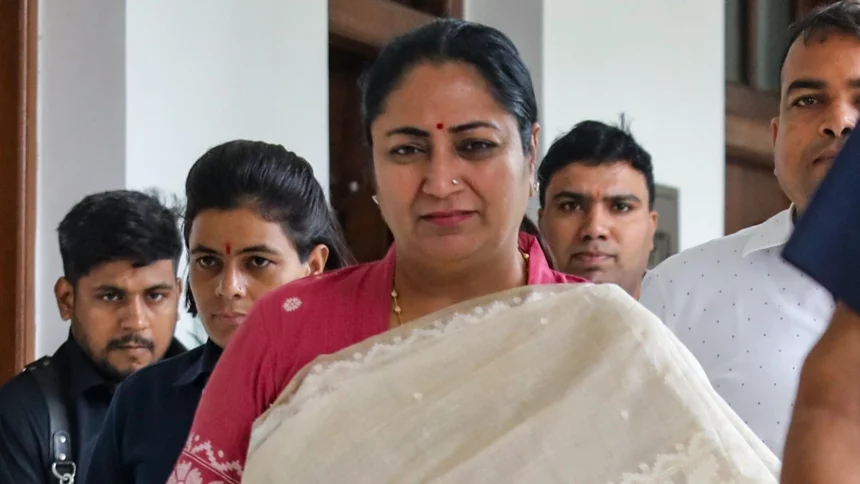
The shocking assault on Delhi Chief Minister Rekha Gupta during the ‘Jan Sunvai’ at her Civil Lines residence on August 20 has sent ripples across the national political and administrative landscape. The attacker, Rajesh Khimji, allegedly slapped the Chief Minister and pulled her hair in an unprecedented breach of security at the official residence. Following the incident, police investigations have intensified, and authorities have now detained a friend of the accused from Rajkot who is suspected of transferring money to him. The attack has not only raised serious questions about the safety protocols surrounding high-profile officials but also triggered a broader investigation into potential accomplices and premeditation behind the assault.
CCTV footage has emerged revealing that Khimji conducted a detailed recce of the Chief Minister’s residence the day before the attack, spending at least 11 minutes moving in and out of the premises. The shocking level of planning, including knowledge of the Jan Sunvai timings and the location of CM Gupta’s official residence, has left law enforcement officials scrutinizing all possible angles, including the involvement of friends, relatives, and associates who may have supported the attacker financially or logistically. With Delhi Police teams now stationed in Rajkot and coordination with Gujarat authorities underway, the investigation is rapidly expanding, reflecting the gravity of the attack on a sitting Chief Minister in the national capital.
Detention of Accomplices and Financial Links
As the probe deepens, Delhi Police have detained one of Khimji’s friends from Rajkot, suspected of transferring money to facilitate the assault. Police officials confirmed that several of the accused’s friends and relatives are being interrogated as part of efforts to map the full network that may have supported the attack. The detained friend is expected to be brought to Delhi for further questioning by the evening. Law enforcement authorities are meticulously verifying Khimji’s statements during interrogation, cross-checking financial transactions, travel details, and any communication that could reveal the planning and motivation behind the attack.
Investigators are particularly focused on understanding whether the money transfer played a critical role in facilitating Khimji’s travel, accommodation, or preparations for the assault. Delhi Police officials emphasized that while Khimji has been arrested and is in custody, the investigation into potential accomplices, financial backers, and logistical support remains ongoing. The inquiry aims to determine if this was a lone act or part of a broader conspiracy, ensuring that any other individuals involved are identified and held accountable under the law. The cooperation with Gujarat Police is also seen as crucial, given Khimji’s origins in Rajkot and his prior criminal record, which includes five registered cases, with one case still pending trial.
Premeditation and Security Breaches: CCTV Footage and Reconnaissance
The emerging details of Khimji’s movements prior to the assault paint a disturbing picture of premeditation. CCTV footage dated August 19 shows Khimji arriving at the Chief Minister’s Shalimar Bagh residence via cycle rickshaw, recording videos, and moving in and out of the premises for at least 11 minutes, appearing to conduct a detailed recce. During this time, staff at the residence inadvertently provided him with a slip containing the Chief Minister’s Civil Lines residence details and Jan Sunvai timings, which Khimji later exploited.
This surveillance footage has become central to understanding the level of planning involved in the attack. Law enforcement authorities are analyzing every frame, seeking clues about possible external support or information leaks that may have enabled Khimji to plan his actions with such precision. The attack itself occurred during the Jan Sunvai event, a public grievance hearing intended to facilitate citizen interaction with the Chief Minister. Khimji allegedly used the opportunity to approach CM Gupta, assaulting her physically in a highly publicized and unprecedented security breach.
Following the incident, Delhi Police registered a case under the Bharatiya Nyaya Sanhita for attempted murder and secured a five-day remand for interrogation. The assault has prompted immediate upgrades to the Chief Minister’s security, with CM Gupta now receiving ‘Z category’ protection, including deployment of a Central Reserve Police Force (CRPF) team. This heightened security reflects the seriousness with which authorities are treating the breach and their determination to prevent any recurrence of similar incidents.
Khimji’s background has become a focal point of the investigation. A 41-year-old from Rajkot, he reportedly arrived in Delhi by train on the morning of August 19, marking his first visit to the national capital. He stayed at Room No. D-5 on the second floor of the Gujarati Bhavan in Civil Lines before making his way to Shalimar Bagh. During this time, Khimji allegedly communicated with a friend about his plans to visit the Chief Minister’s residence, suggesting a level of openness or confidence that investigators are now scrutinizing.
The attack has also led to closer examination of Khimji’s criminal record in Gujarat. While four of the five registered cases at Bhaktinagar Police Station have resulted in acquittals, one case remains pending, with a hearing scheduled for September 9. Authorities are coordinating with Gujarat Police to obtain additional information about his past conduct, associates, and potential motives. This coordinated approach underscores the seriousness with which the Delhi Police are treating the incident, ensuring that no aspect of the investigation is overlooked.
The broader implications of the attack are significant, highlighting vulnerabilities in security arrangements for high-profile officials. The Jan Sunvai platform, designed for accessibility and citizen engagement, has now become the setting of a high-profile assault, raising questions about procedural lapses and potential failures in screening and monitoring visitors. The use of publicly available details, including timing and location, by Khimji emphasizes the need for stricter security protocols at official residences and during public interactions.
The detention of the accused’s friend and scrutiny of financial transactions signal a shift from viewing the attack as an isolated incident to considering the possibility of a larger conspiracy. Investigators are piecing together travel itineraries, communications, and financial records to determine whether others had foreknowledge or involvement in planning the attack. The results of these inquiries will be critical in shaping the subsequent legal proceedings and preventive measures to secure high-ranking officials.
The Delhi Police are also reviewing the role of staff and administrative protocols in inadvertently providing sensitive information to the attacker. The investigation extends to understanding how Khimji could gain access to residence layouts, timings of official events, and public hearing schedules without raising suspicion. Lessons learned from this breach may influence future policy regarding the management of public interactions and the safety of political leaders in the national capital.
The attack on CM Rekha Gupta has also sparked discussions across political, administrative, and civil society forums. Analysts note that beyond the immediate legal ramifications, the incident highlights the intersection of accessibility, public engagement, and security. Maintaining open channels for citizen grievances while ensuring the safety of officials is a challenge that authorities must now address in light of this unprecedented assault.
Coordination between Delhi Police and Gujarat authorities has proven essential in tracing the accused’s movements, associates, and financial activities. By detaining a friend linked to Khimji and questioning his relatives and contacts, investigators aim to uncover any network that may have facilitated the assault. The use of modern investigative techniques, including digital forensics, CCTV analysis, and financial tracing, is playing a critical role in reconstructing the chain of events leading to the attack.
The Delhi Police have assured the public that all leads are being thoroughly pursued and that security measures around the Chief Minister’s residence and public engagements will be continuously evaluated. The incident has prompted a review of the Jan Sunvai format and protocols to ensure that such platforms remain safe for both citizens and officials.
This unprecedented attack on a sitting Chief Minister during a public engagement underscores the evolving nature of security threats in India’s capital and the necessity for proactive measures to prevent similar incidents. Authorities continue to investigate every facet of the case, from the premeditated reconnaissance conducted by Khimji to the financial and logistical support that may have enabled the assault.
The detention of a friend who allegedly transferred money to Khimji highlights the expanding scope of the probe, signaling that investigators are leaving no stone unturned in identifying potential co-conspirators. The interplay of personal history, criminal record, and current actions is being carefully analyzed to construct a comprehensive understanding of the motive and planning behind the attack.
As the investigation continues, security experts and law enforcement officials are assessing lessons from this incident to strengthen protective measures for all high-ranking public officials. Enhanced surveillance, better vetting of visitors, and stricter internal protocols are among the measures being considered to prevent any recurrence.
The assault on Chief Minister Rekha Gupta is a reminder of the vulnerabilities that public officials face, even in controlled environments, and the critical need for continuous review of security arrangements. Investigators are meticulously piecing together evidence to ensure accountability, prevent further threats, and maintain public confidence in the safety of elected representatives.