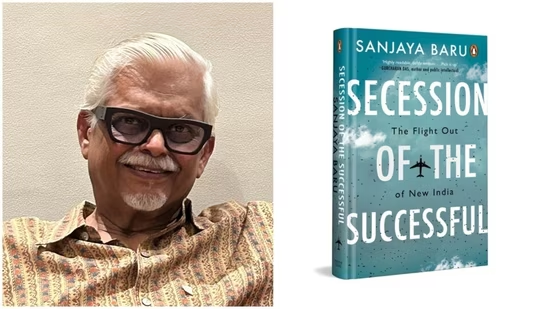
In recent years, India has witnessed an extraordinary wave of emigration among its wealthiest and most talented citizens, a trend that is reshaping the country’s social and economic fabric. While migration has long been a part of India’s history, the current scale and character of this exodus are unprecedented. Sanjaya Baru, veteran journalist, policy commentator, and author of the book Secession of the Successful: The Flight out of New India, argues that the nation has transformed emigration from a practical choice into a status symbol — a powerful aspiration woven into the psyche of its elite. Drawing on historical comparisons, economic data, and political observations, Sanjaya Baru warns that this shift is not just a matter of geography, but of ideology, identity, and long-term national capacity. His message is as much a diagnosis as it is a cautionary note: if India continues to normalize and even encourage this outflow of its most capable minds, the dream of becoming a developed economy by 2047 could be at risk.
The Normalization of Emigration and the Rise of Aspirational Migration
Sanjaya Baru traces the origins of India’s “brain drain” debate back several decades, when economists like Jagdish Bhagwati first brought attention to the export of human capital. In the 1970s and 1980s, the idea that skilled Indians leaving the country might harm national development was widely discussed, and proposals such as a “brain drain tax” were even considered, though ultimately dismissed as impractical. Over time, however, public concern waned. In the last 25 years, the exodus of India’s best and brightest has not only become an accepted fact of life, but in some circles, a point of pride. Government officials speak glowingly of the achievements of the Indian diaspora abroad, often positioning them as proof of India’s soft power. Initiatives like the “Global Access for Talented Indians” programme, launched by the foreign ministry, symbolise this encouragement — even though India remains a capital-deficit economy, lacking not only financial resources but also the highly trained professionals necessary to fuel innovation and sustain growth.
The numbers are striking. According to a Kotak Bank report, one in five ultra-high-net-worth individuals (UHNIs) is either in the process of migrating abroad or has concrete plans to do so. Over the last decade alone, more than 23,000 millionaires have left India. These departures are not confined to the rich; they also include academics, scientists, entrepreneurs, and other professionals whose expertise is vital for India’s economic ambitions. For many among this group, the pull of first-world living standards, particularly in global hubs like Dubai and Singapore, is irresistible. As Sanjaya Baru notes, their attitude is blunt: “Why wait until 2047 to live in a developed economy if you can do so today?”
Sanjaya Baru describes this phenomenon as a form of “secession of the successful” — not merely a physical departure, but a psychological withdrawal from the project of building India. The elite, he argues, are not just emigrating; they are detaching themselves from the idea of India as their primary arena of responsibility and investment. This trend mirrors similar movements in countries like Brazil, South Africa, and Turkey, but Sanjaya Baru is concerned with its specific consequences for India. In a country that remains low-income and developing, the loss of its most skilled citizens has a far greater proportional impact than in wealthier nations.
The normalization of elite migration has also been shaped by shifts in the aspirations of India’s upper and middle classes. Economic liberalization, rapid growth in certain sectors, and increased exposure to global lifestyles have all played a role. For the children of politicians, bureaucrats, business leaders, academics, and military officers, studying abroad and settling overseas have become almost default ambitions. As economist Devesh Kapur has observed, this pattern spans professions and generations, cutting across ideological and political divides. In such a climate, staying in India can even be seen as a lack of ambition, while moving abroad is a sign of having “made it.”
Political, Economic, and Social Drivers of the Elite Exodus
Sanjaya Baru identifies both economic and political factors behind the acceleration of this trend since 2014. On the economic side, a growing number of Indians can now afford the costs of relocation, whether through purchasing foreign citizenship, acquiring property overseas, or financing education for their children at prestigious international institutions. These opportunities, once available to only a tiny fraction of the population, are now within reach for a significant slice of the upper class. Simultaneously, the global market for high-net-worth migrants has become more competitive, with countries actively courting wealthy foreigners through investment-linked visas and tax incentives.
Politically, Sanjaya Baru points to a climate of uncertainty and apprehension among India’s wealthy and influential. Concerns about aggressive tax enforcement, intrusive compliance requirements, and the threat of harassment from investigative agencies like the Enforcement Directorate have contributed to a sense of insecurity. Promises such as the “ease of living mission” announced by Prime Minister Narendra Modi have yet to materialize in ways that meaningfully reduce bureaucratic burdens. Instead, the proliferation of “know your customer” documentation demands and other regulatory hurdles has made day-to-day life for the affluent more cumbersome, prompting some to see emigration as a path to greater personal and financial freedom.
The interplay between diaspora politics and domestic political agendas also complicates the picture. While overseas Indians often cheer political leaders at large public events and loudly proclaim their pride in “Bharat Mata,” many have no intention of returning to contribute directly to the country’s development. Sanjaya Baru views this as partly performative and partly a consequence of the government’s growing tendency to use diaspora engagement for domestic political influence. This politicisation is not without risks: diplomatic tensions have already arisen in countries like Canada, the UK, and the US due to conflicts among Sikh, Khalistani, and Hindu groups in their Indian-origin communities. A Singaporean diplomat once questioned Sanjaya Baru directly about whether India’s approach to politicising its diaspora might damage bilateral relations — a concern he believes is valid.
Historically, the pattern was different. In the years after independence, many of India’s most accomplished individuals who studied or worked abroad chose to return, sometimes at the personal urging of leaders like Jawaharlal Nehru. Figures such as Homi Bhabha and Vikram Sarabhai made foundational contributions to India’s scientific and technological capacity despite the relatively modest living conditions of the time. In recent decades, however, such high-profile returns have become rare and often short-lived. Even those who did return, like former Reserve Bank of India Governor Raghuram Rajan, have tended to leave again after a brief period. Sanjaya Baru dates the end of this sustained return migration trend to the 1980s, noting that India has not since cultivated the combination of leadership and conditions necessary to inspire significant numbers of its diaspora to come back.
Despite this, Sanjaya Baru does not believe the opportunity is entirely lost. He points to the example of other countries, such as China, Taiwan, and South Korea, which experienced large-scale emigration in earlier decades but saw waves of return migration once they reached developed-economy status. India could similarly benefit if it were able to create an environment that offered professional opportunities, institutional quality, and living standards competitive with those abroad. For instance, with 22,000 Indians currently serving as professors in the United States, attracting even a small percentage back to teach in Indian institutions could have an outsized impact on higher education and research. Some private universities, including the Indian School of Business, Ashoka University, and O.P. Jindal Global University, have had some success in drawing talent from abroad, but these efforts remain limited in scale.
Ultimately, Sanjaya Baru’s central argument is that India must recognise the gravity of its talent outflow and resist the temptation to treat it as a harmless or even desirable phenomenon. In a labour-surplus, capital-deficit economy, retaining both financial and human capital is essential. Yet last year, for the first time, outward foreign direct investment by Indians exceeded inward FDI, a telling indicator of where the country’s wealth and entrepreneurial energy are going. By failing to address the underlying political, economic, and institutional factors driving this exodus, India risks not only slowing its progress toward its 2047 development goals but also hollowing out the very class of people most capable of helping it get there.