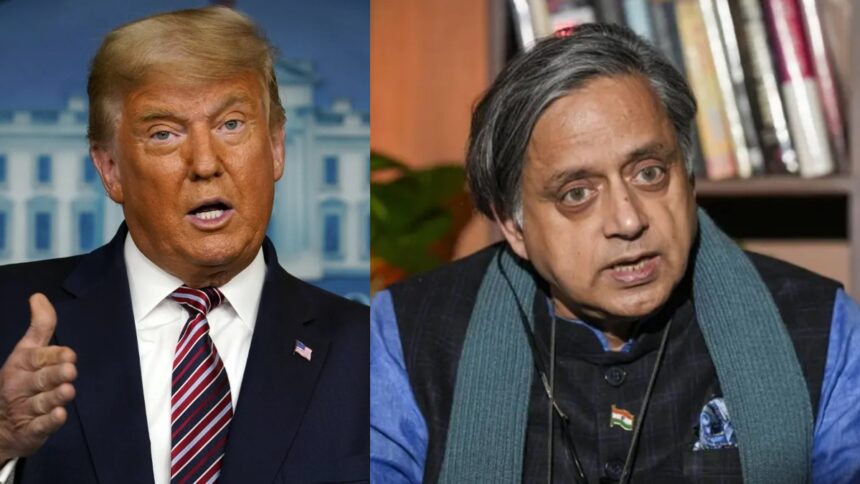
In a sharp rebuttal to repeated assertions made by US President Donald Trump, senior Congress leader and Member of Parliament Shashi Tharoor has categorically stated that the ceasefire between India and Pakistan in May 2025 was not the result of American mediation, but rather the outcome of India’s decisive and successful military strikes. Speaking at the launch of a new book on India-Pakistan relations, Shashi Tharoor underscored that the turning point came when Indian forces launched “Operation Sindoor” in retaliation to a deadly terror attack in Pahalgam, forcing Pakistan’s military to seek de-escalation. His remarks not only dismissed Donald Trump’s claims but also provided an in-depth narrative of how the chain of events unfolded, reshaping the fragile dynamics of the subcontinent’s most volatile relationship.
Operation Sindoor and the Reality Behind the Ceasefire
Shashi Tharoor’s remarks came against the backdrop of a heated debate triggered by Donald Trump’s repeated public statements, where he claimed credit for preventing what he described as an imminent “nuclear war” between India and Pakistan in May 2025. According to Donald Trump, his intervention was critical in diffusing tensions after escalating hostilities along the border. However, Shashi Tharoor rejected this narrative outright, arguing that India’s military resolve and the precision of its response were the real factors that compelled Pakistan to call for peace.
At the heart of his argument was Operation Sindoor, a calculated military action launched by Indian forces in early May 2025. The operation targeted Pakistan-based terror camps and infrastructure, directly responding to the April 22 Pahalgam attack, in which 26 civilians lost their lives. According to Shashi Tharoor, the operation marked a crucial shift in India’s posture—sending a powerful signal that the country would not remain a passive victim of cross-border terrorism.
“The turning point,” Shashi Tharoor explained, “was the night of May 9–10, when India executed successful strikes on terror launch pads and followed it up with a strong defensive response. On the morning of May 10, when Pakistan attempted to retaliate by sending missiles towards Delhi, India intercepted them effectively. This combination of offensive strikes and defensive preparedness left Pakistan with no choice but to seek de-escalation.”
He further clarified that it was only after these strikes that Pakistan’s Director General of Military Operations (DGMO) reached out to his Indian counterpart. This outreach, Shashi Tharoor emphasized, was a direct acknowledgment of India’s superior position on the battlefield, not the result of Donald Trump’s alleged behind-the-scenes diplomacy. The ceasefire declaration came on May 10, shortly after Operation Sindoor, making it clear, in Shashi Tharoor’s view, that India’s actions had dictated the outcome.
Drawing a historical parallel, Shashi Tharoor also pointed to the Balakot airstrikes of 2019, where India had similarly demonstrated its willingness to take bold military action against terror infrastructure. “India has sent a very clear message with Balakot and now Operation Sindoor,” he said. “We will not sit quietly if terror is unleashed on us.” His words reflected not only his support for the operation but also his conviction that India’s consistent military stance had redefined the rules of engagement with Pakistan.
Beyond the battlefield, Operation Sindoor also had significant diplomatic reverberations. Shashi Tharoor himself led a cross-party parliamentary delegation to several countries, including the United States, Panama, Guyana, Brazil, and Colombia, to explain India’s position. This outreach was part of a broader effort to ensure that India’s actions were understood not as unilateral aggression but as a legitimate defensive response to terrorism. By taking the debate to the international stage, Shashi Tharoor and his colleagues sought to neutralize any misperceptions and reinforce India’s credibility as a responsible global player.
Donald Trump’s Narrative and Congress’ Counterpoint
While Shashi Tharoor set the record straight on what he described as the “real” reasons behind the ceasefire, the political discourse in both India and the United States took a different turn. Donald Trump, who has often portrayed himself as a peacemaker on the global stage, repeated claims that he had personally intervened to prevent a nuclear confrontation between India and Pakistan. His comments suggested that Washington played a decisive role in brokering peace, casting himself as the architect of stability in South Asia.
This version of events, however, was swiftly contradicted not only by Shashi Tharoor but also by the Indian government, which has consistently maintained that the ceasefire was a bilateral decision between New Delhi and Islamabad. For India, acknowledging Donald Trump’s claims would mean undermining its own military successes and diplomatic outreach, something it has been unwilling to do.
Congress, meanwhile, seized the opportunity to raise questions in Parliament. Party leader Rahul Gandhi demanded clarity from Prime Minister Narendra Modi, urging him to directly address Donald Trump’s remarks. Gandhi argued that India’s credibility was at stake and that the Prime Minister needed to reassure the nation that decisions of such gravity were not influenced or dictated by foreign leaders.
Shashi Tharoor, known for his eloquence and sharp articulation, took the debate further by recounting his own role in shaping the discourse after the Pahalgam attack. He revealed that just days after the attack, he had written an opinion piece advocating for a robust military response. “You can imagine my satisfaction and semi-disbelief,” he said with candor. “I didn’t realize anyone in Delhi would be reading my op-ed. Which is why I was such an enthusiastic supporter of Operation Sindoor—it followed exactly the course of action I had advised.”
This disclosure added a personal dimension to his narrative, suggesting that his strategic thinking and advocacy for strong action had, in some measure, resonated with decision-makers in Delhi. While Shashi Tharoor stopped short of claiming direct influence, his sense of vindication was evident.
Donald Trump’s claims, on the other hand, were seen by many observers as part of his broader political style, where dramatic assertions often overshadow nuanced realities. For a domestic American audience, portraying himself as the savior who prevented nuclear war was a compelling story. But in the Indian context, where memories of Pahalgam and the subsequent strikes were still raw, such assertions rang hollow.
The controversy also highlighted the delicate balance between domestic politics and international diplomacy. For India, projecting strength in the face of terrorism was essential for national morale and deterrence. For Donald Trump, positioning himself as a global peacemaker served his political ambitions. Shashi Tharoor’s intervention, therefore, was not just a rebuttal of Donald Trump but also a reaffirmation of India’s agency in shaping its own destiny.