The United States and Iran are entering another critical moment in their long-running nuclear standoff, as President Donald Trump signals indirect involvement in high-stakes negotiations set to take place in Geneva, against a backdrop of military pressure, regional instability, and fragile diplomatic expectations.
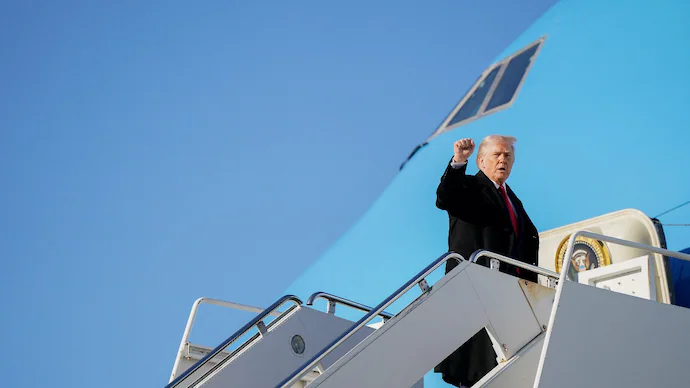
The prospect of renewed dialogue between United States and Iran over Tehran’s nuclear programme has once again brought global attention to one of the most volatile fault lines in international politics. Speaking to reporters aboard Air Force One, President Trump indicated that while he would not be directly present at the negotiating table, he would remain closely involved in shaping the talks and their outcome. His remarks reflect a strategy that blends behind-the-scenes political direction with overt military signalling, a combination that has characterised Washington’s approach to Iran during periods of heightened tension. As diplomats prepare for discussions, the stakes extend far beyond nuclear centrifuges, touching on regional security, global energy markets, and the credibility of international non-proliferation efforts.
Diplomacy Under Pressure as Trump Balances Negotiation and Military Deterrence
President Trump’s assertion that he would be involved “indirectly” in the talks underscores the personalised nature of U.S. foreign policy decision-making during his administration. By positioning himself as an influential but not front-facing actor, Trump appears intent on maintaining strategic flexibility. His comments suggest confidence that Iran has been pushed, through a combination of sanctions and military action, into a more conciliatory posture. According to Trump, Tehran’s leadership has learned from past confrontations that refusing to compromise can carry severe consequences.
The context surrounding the upcoming talks is defined by escalating military readiness. The United States has moved a second aircraft carrier into the Middle East, reinforcing an already significant naval presence in the region. U.S. officials have indicated that the military is preparing contingency plans for a sustained campaign should diplomacy fail. This posture sends a clear message to Tehran that while Washington is open to dialogue, it is equally prepared to escalate if negotiations collapse.
Trump’s recollection of last summer’s strikes on Iranian nuclear facilities serves as a reminder of how quickly diplomacy can give way to force. Referring to the deployment of B-2 stealth bombers, he suggested that a diplomatic agreement could have avoided military action altogether. The implication is that the burden now lies with Iran to demonstrate reasonableness and avoid a repeat of such confrontations. At the same time, Trump’s tone marked a subtle shift from his more confrontational remarks days earlier, when he openly entertained the idea of regime change in Iran and expressed frustration over decades of unsuccessful negotiations.
This oscillation between hardline rhetoric and conditional optimism reflects the inherent contradictions in U.S. policy towards Iran. On one hand, Washington seeks to project strength and deterrence, believing that pressure creates leverage. On the other, it recognises that a durable resolution to the nuclear issue can only be achieved through negotiation. Trump’s suggestion that Iran “does not want the consequences of not making a deal” encapsulates this dual approach, framing diplomacy as an opportunity for Tehran to avoid further isolation and potential conflict.
For U.S. allies and partners in the region, this strategy carries both reassurance and risk. Gulf states, whose security and economic stability are closely tied to developments in Iran, have repeatedly called for diplomacy to prevent escalation. At the same time, they remain wary of any agreement that might empower Iran economically or strategically without addressing broader regional concerns. Trump’s indirect involvement signals that the White House intends to keep tight control over the negotiating process, even as diplomats handle the formal discussions.
Iran’s Red Lines, Nuclear Uncertainties, and the Wider Regional Fallout
From Iran’s perspective, the renewed talks come amid intense scrutiny and unresolved questions about its nuclear activities. Iranian Foreign Minister Abbas Araqchi has framed Tehran’s participation as an effort to secure a “fair and equitable deal,” while firmly rejecting what he describes as submission to threats. His statements reflect Iran’s longstanding position that negotiations must be conducted on the basis of mutual respect and tangible incentives, particularly the lifting of economic sanctions.
A central point of contention remains uranium enrichment. Washington has consistently demanded that Iran forgo enrichment on its own soil, arguing that the capability to enrich uranium constitutes a pathway to developing nuclear weapons. Tehran, however, views enrichment as a sovereign right under international agreements and insists that any deal allowing zero enrichment is unacceptable. This fundamental disagreement stalled previous rounds of talks and continues to loom as a major obstacle.
Compounding the challenge are unresolved issues related to Iran’s uranium stockpile and inspection regime. The International Atomic Energy Agency has repeatedly called on Iran to clarify the status of a significant quantity of highly enriched uranium following joint Israeli-U.S. strikes on key nuclear sites last year. Inspectors have also sought full access to facilities such as Natanz, Fordow, and Isfahan, where damage from the strikes has raised questions about the integrity of Iran’s nuclear infrastructure and the accuracy of its disclosures.
Iran’s reluctance to fully comply with inspection demands has fuelled suspicion in Washington and among European powers. For U.S. policymakers, transparency is non-negotiable, as any ambiguity undermines confidence in Iran’s intentions. Tehran counters that inspections must be part of a reciprocal arrangement that includes sanctions relief, arguing that compliance without economic benefit would amount to unilateral concession.
Beyond the nuclear file, Washington has sought to broaden the scope of negotiations to include Iran’s missile programme and regional activities. U.S. officials argue that Iran’s ballistic missile arsenal poses a direct threat to regional stability and should be addressed alongside nuclear restrictions. Tehran has categorically rejected this approach, insisting that its missile capabilities are defensive and not subject to negotiation. This divergence highlights the difficulty of crafting a comprehensive agreement that satisfies both sides’ security concerns.
The regional implications of a breakdown in talks are profound. Iran has repeatedly threatened to close the Strait of Hormuz in retaliation for any attack, a move that would disrupt roughly a fifth of global oil flows and trigger sharp spikes in energy prices. Recent Iranian military drills in the strait underscore its willingness to leverage this chokepoint as a strategic tool. For energy-importing nations and global markets, the mere possibility of such disruption adds urgency to diplomatic efforts.
U.S. Secretary of State Marco Rubio has tempered expectations by acknowledging the difficulty of reaching a deal with Tehran. While recognising an opportunity for diplomacy, Rubio has cautioned against overstating the prospects for success, pointing to ideological factors that complicate negotiations. His remarks reflect a broader scepticism within the U.S. political establishment about Iran’s willingness to compromise meaningfully.
As talks approach, both sides appear to be testing each other’s resolve. The United States is signalling readiness to escalate militarily if necessary, while Iran is asserting its red lines and warning of severe consequences for further pressure. In this environment, diplomacy operates under the shadow of force, with each concession weighed against the risk of appearing weak.
The upcoming discussions in Geneva thus represent more than a technical negotiation over centrifuges and enrichment levels. They are a test of whether sustained pressure can coexist with genuine compromise, and whether decades of mistrust can be bridged even partially. President Trump’s indirect involvement adds another layer of complexity, ensuring that the talks will be closely watched not only by diplomats, but by global markets, regional actors, and populations whose lives could be affected by the outcome.
In the absence of an easy resolution, the negotiations are likely to proceed incrementally, marked by cautious statements and carefully calibrated moves. Whether this process can produce a durable framework or merely postpone further confrontation remains uncertain, but the convergence of diplomacy and deterrence ensures that the consequences of failure would resonate far beyond the negotiating room.