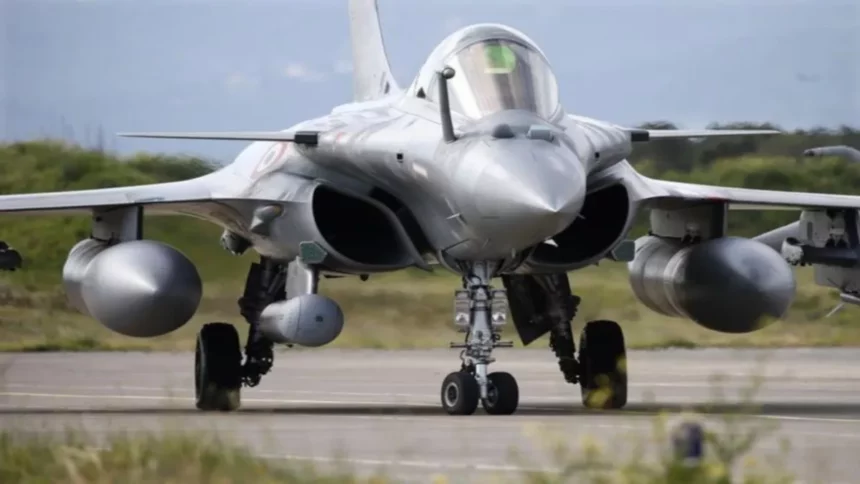
As tensions escalate between India and Pakistan following the Pahalgam terror attack, India launched a series of precision strikes under ‘Operation Sindoor’, targeting terrorist infrastructure across Pakistan and Pakistan-occupied Kashmir (PoK). A key component of India’s military response was the deployment of Rafale fighter jets, which were pitted against Pakistan’s F-16s. But how do these two fighter jets compare? Let’s take a closer look.
The Basics: Rafale vs F-16
India’s Rafale jets are manufactured by Dassault Aviation of France, while Pakistan’s F-16 Fighting Falcons are developed by General Dynamics and Lockheed Martin in the United States. The Rafale is a 4.5-generation fighter jet, while the F-16 belongs to the fourth generation of fighters.
The Rafale is powered by twin engines, while the F-16 is a single-engine aircraft.
Electronics and Weapons Systems
The Rafale boasts advanced features that set it apart from the F-16. One of the standout features is its semi-stealth airframe, which allows it to have low radar observability. The Rafale is equipped with a highly advanced AESA radar (RBE2-AA) that enhances its combat capabilities. In addition, the Rafale is armed with Scalp (Storm Shadow) missiles and HAMMER precision bombs, both of which allow for long-range, accurate strikes.
The Rafale’s SPECTRA Electronic Warfare (EW) suite is also among the best in class. It offers active jamming, threat identification, radar decoys, and countermeasures against surface-to-air missiles and enemy radar. This system can detect up to 40 targets from a range of 145 kilometers and can jam and replicate enemy radar, making it more difficult for the F-16s to lock onto it.
Additionally, the Rafale is equipped with the X-Guard fiber-optic towed decoy system, allowing it to evade air-to-air and surface-to-air missiles effectively.
On the other hand, the F-16 is equipped with AIM-120C5 Advanced Medium Range Air-to-Air Missiles (AMRAAM) and Joint Direct Attack Munitions (JDAMs). While the F-16 can carry out dogfights with its lighter airframe and high thrust-to-weight ratio, it faces a challenge when it comes to closing the distance with the Rafale.
Combat Performance: BVR and Dogfights
The Rafale is widely considered superior in Beyond Visual Range (BVR) combat. Its Meteor missile, with a range of 120 kilometers, has the largest ‘no-escape zone’, meaning that targets within this range are nearly impossible to evade. In comparison, the AMRAAM on the F-16 has a range of 100 kilometers.
In a dogfight, the F-16 may have an edge due to its lighter airframe and higher thrust-to-weight ratio. However, the Rafale’s superior maneuverability, electronics, and stealth provide it with a distinct advantage, especially in prolonged engagements.
The Rafale’s AESA radar allows it to detect and engage targets first, giving it a crucial advantage over the F-16. This capability makes it difficult for the F-16 to get a clear shot at the Rafale.
Maintenance and Operational Readiness
Another significant factor in the comparison is the operational readiness and maintenance of the fighter jets. Pakistan’s fleet of F-16s, comprising approximately 75 aircraft, faces challenges due to maintenance issues and financial constraints. The U.S. has placed strict conditions on how Pakistan can use its F-16s, limiting their operations to defensive roles.
India, in contrast, faces no such limitations with its Rafale fleet. The Rafale jets are part of India’s strategic capabilities, and their maintenance is handled without the constraints faced by Pakistan’s F-16s.
A Clash of Titans
While both the Rafale and F-16 are formidable aircraft in their own right, the Rafale’s superior technology, longer-range missile capabilities, advanced radar systems, and electronic warfare features give it a distinct advantage over the F-16, especially in BVR combat.
In terms of operational readiness, India’s Rafales are equipped with modern technologies and have been consistently upgraded to meet current defense needs. On the other hand, Pakistan’s F-16s are hindered by maintenance challenges and limitations on their usage.
Although both jets have never directly faced each other in combat except during NATO exercises, the possibility of a confrontation between the two fighters in the ongoing tensions between India and Pakistan is something the world is closely watching.