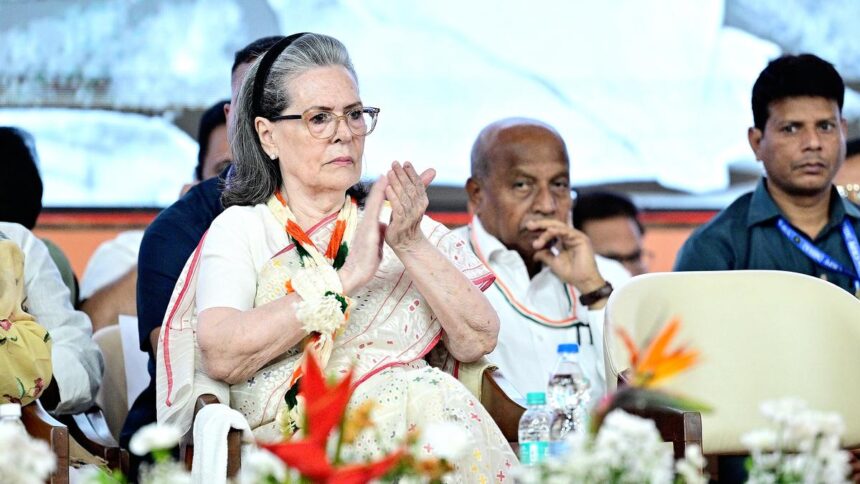
In a sharp and deeply emotional critique, Congress Parliamentary Party leader Sonia Gandhi has questioned Prime Minister Narendra Modi’s silence over the humanitarian crisis in Gaza, accusing him of abandoning India’s historical commitment to justice and global peace. Through a powerful article published in a leading Hindi daily, Gandhi urged the Prime Minister to speak up boldly and clearly against what she described as a “genocidal campaign” by Israel against Palestinians. Her piece reflects the growing unease within sections of Indian politics over New Delhi’s reluctance to take a firm stance on the Gaza tragedy.
In the article titled “Gaza sankat par mookdarshak Modi sarkaar” (Modi government a mute spectator amid Gaza tragedy), Sonia Gandhi accused the Prime Minister of displaying “shameful silence” in the face of mass civilian deaths and destruction in Gaza. “This silence,” she wrote, “is not just disappointing — it is a cowardly betrayal of our constitutional values.”
Revisiting India’s Legacy of Palestinian Solidarity
Gandhi invoked India’s historical relationship with Palestine, tracing it back to the era of her mother-in-law, former Prime Minister Indira Gandhi. Under Indira Gandhi’s leadership, India became the first non-Arab nation to recognize the Palestine Liberation Organization (PLO) as the legitimate representative of the Palestinian people in 1974. Later, in 1988, India was among the first countries to recognize the State of Palestine.
“India has always stood with oppressed people,” Sonia Gandhi reminded, pointing to India’s proud legacy in global anti-colonial and anti-apartheid struggles. She lamented that in the face of the Gaza crisis, a government that represents this same India has chosen silence over justice.
According to her, the Gaza crisis is not merely a distant geopolitical conflict, but a test of India’s moral responsibility and global leadership. Gandhi stressed that the Global South is once again looking toward India to take a moral stand — one that reflects its constitutional values and commitment to peace.
She acknowledged that Hamas’s attacks on Israel on October 7, 2023, and its continued holding of hostages are indefensible. However, she emphasized that these actions do not justify Israel’s large-scale military reprisals against innocent civilians in Gaza. Gandhi argued that the disproportionate response by Israel — including bombings, blockades, and forced starvation — is nothing short of a crime against humanity.
Mass Casualties and the Collapse of Civilian Life in Gaza
Gandhi highlighted the staggering human cost of Israel’s military campaign in Gaza. She cited figures of over 55,000 Palestinian deaths, including 17,000 children, since the latest wave of violence began nearly two years ago. Entire neighborhoods and residential areas have been wiped off the map, she wrote, leaving the social fabric of Gaza in shambles.
The Israeli Defense Forces, Gandhi noted, have imposed a harsh military blockade on the region, cutting off access to food, fuel, and medical supplies. “This is a strategy of forced starvation,” she argued, “which clearly constitutes a crime against humanity.”
She strongly criticized the international community’s inability to hold Israel accountable, calling out its failure to enforce United Nations resolutions and the International Court of Justice’s order against acts of genocide.
Not holding back, Gandhi suggested that the Israeli offensive is driven not just by political motives but also by “a colonial mindset and the vested interests of greedy real estate tycoons.” She alluded to statements by Israeli Prime Minister Benjamin Netanyahu and former U.S. President Donald Trump that hint at plans to depopulate Gaza and redevelop it into a luxurious zone — an idea that, she said, reveals the chilling intentions behind the ongoing violence.
Gandhi also pointed to recent international actions that contrast India’s muted stance. She lauded South Africa for taking Israel to the International Court of Justice and noted that Brazil has also joined this legal effort. France, she said, has recognized Palestine as a state, while countries like Britain and Canada have imposed sanctions on Israeli leaders.
Against this backdrop, Gandhi questioned why India — a nation that once stood as a beacon of justice and non-alignment — has chosen silence over leadership.
She also recalled India’s Directive Principles of State Policy, which urge the government to foster international peace and respect for international law. According to her, the current administration has disregarded these principles in favor of political expediency.
Referring to India’s long-standing support for the two-state solution, she reminded readers that New Delhi once played a pivotal role in promoting peaceful coexistence between Israel and Palestine. Gandhi wrote that India’s past approach to international conflict was always rooted in empathy, justice, and moral clarity.
But today, as innocent lives are being “brutally slaughtered” in Gaza, she warned that India’s silence amounts to an abandonment of those very values. “It is a blot on our national conscience,” she wrote, “a disregard for our historical contributions, and a cowardly betrayal of our constitutional values.”
Gandhi’s article is one of the most scathing criticisms yet from the Congress party regarding the Modi government’s foreign policy approach to the Gaza conflict. A month earlier, an unsigned piece in the Congress’s official publication also described the government’s handling of the crisis as a “failure on several levels.”
Her daughter, Priyanka Gandhi, who serves as a Lok Sabha member, has also been vocal in calling for peace in Gaza, further signaling the Congress party’s attempt to sharpen its ideological contrast with the ruling BJP on matters of international diplomacy and human rights.
Sonia Gandhi’s remarks arrive at a time when geopolitical tension in the Middle East is rising, and global pressure is mounting on countries to clarify their positions. While many nations have taken decisive steps in defense of international law and human rights, India’s continued abstention and diplomatic reticence have drawn increasing criticism.
By publishing this article, Sonia Gandhi appears to be making a renewed appeal — not just to the Indian government, but to the Indian public — to remember the values that once defined the nation’s moral compass on the world stage.