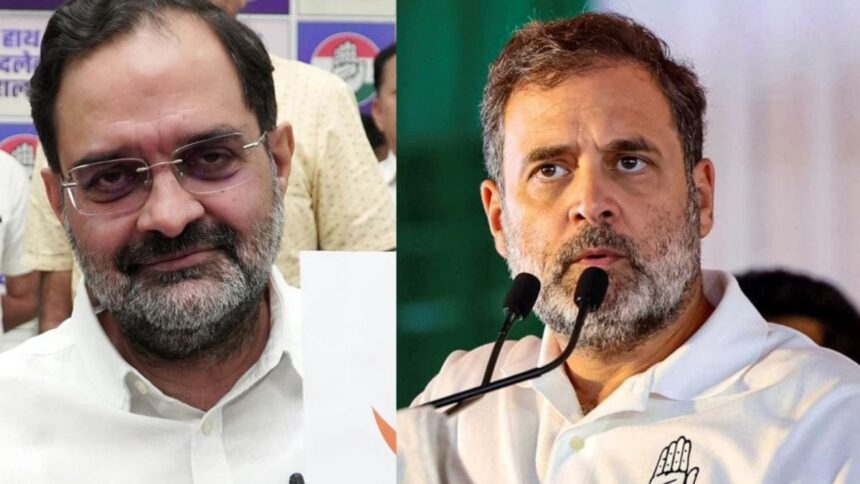
Rahul Gandhi is set to participate in the ‘Sadbhav Yatra’ led by former Hisar MP Brijendra Singh in Gurugram on May 8, a move that has generated major political attention in Haryana amid continuing factional tensions within the state Congress unit.
Rahul Gandhi’s participation in the outreach march is being viewed as a significant political signal from the Congress leadership at a time when the party continues to grapple with internal divisions following its disappointing performance in the 2024 Haryana Assembly elections.
According to the programme schedule released by Brijendra Singh’s media team, Rahul Gandhi will join the yatra during the evening in Gurugram and walk alongside party workers, supporters and local leaders for nearly two hours before addressing a public gathering.
Congress workers across multiple districts have intensified preparations for the event, anticipating a large turnout due to Rahul Gandhi’s presence. Security arrangements and organisational coordination have also been strengthened ahead of the high-profile programme.
The ‘Sadbhav Yatra’ has gradually evolved into one of the most visible political mobilisation campaigns within the Haryana Congress since the Assembly election defeat. Launched by Brijendra Singh in October last year, the campaign was aimed at reconnecting with citizens across the state and highlighting public grievances involving unemployment, farmers’ distress, corruption, urban infrastructure and law-and-order issues.
Since its launch, the yatra has reportedly covered 81 out of Haryana’s 90 Assembly constituencies, making it one of the most extensive political outreach exercises undertaken by a Congress leader in the state in recent years.
Political observers believe Rahul Gandhi’s decision to join the yatra reflects the Congress leadership’s attempt to revitalise the party’s grassroots structure and encourage sustained public engagement in Haryana.
Brijendra Singh Emerges as Active Congress Face in Haryana
Brijendra Singh, a former Indian Administrative Service officer and son of veteran Congress leader Birender Singh, joined the Congress ahead of the 2024 Lok Sabha elections after resigning from the Bharatiya Janata Party.
His political shift was viewed as significant because he had previously been regarded as one of the BJP’s prominent Jat leaders in Haryana.
After joining the Congress, Brijendra Singh contested the 2024 Assembly election from Uchana Kalan, a constituency closely associated with his family’s political influence. However, he lost the election by a narrow margin of just 32 votes.
Singh later challenged the result before the Punjab and Haryana High Court, where the matter remains under judicial consideration.
Despite the defeat, Brijendra Singh continued political outreach through the Sadbhav Yatra and attempted to position himself as a grassroots-oriented leader focused on public concerns rather than electoral setbacks.
Throughout the campaign, he consistently raised issues involving unemployment, agrarian distress, sewage infrastructure, governance failures and alleged corruption in government departments.
Political analysts believe the yatra helped Brijendra Singh remain politically relevant while also energising Congress workers disappointed by the party’s inability to form the government despite a stronger electoral performance compared to previous elections.
The campaign additionally allowed Singh to establish direct communication with voters across multiple districts and social groups.
Rahul Gandhi’s Participation Seen as Political Endorsement
Rahul Gandhi’s decision to personally participate in the yatra is widely being interpreted as an endorsement of Brijendra Singh’s outreach efforts and political positioning within the Haryana Congress.
Party insiders suggest the move is aimed at strengthening cadre morale while simultaneously reinforcing the Congress leadership’s emphasis on grassroots mobilisation and direct public interaction.
Rahul Gandhi has consistently attempted to project himself as a leader focused on padyatras, public engagement campaigns and people-centric politics. His participation in the Sadbhav Yatra aligns with the Congress party’s broader strategy of reconnecting with voters through direct interaction instead of relying solely on traditional rallies and organisational meetings.
Political experts also believe the event may significantly enhance Brijendra Singh’s stature within the Congress hierarchy because Rahul Gandhi’s involvement gives the yatra national-level visibility and political legitimacy.
Supporters of Brijendra Singh view Rahul Gandhi’s participation as recognition of the yatra’s growing influence and organisational success.
Hooda Camp Remains Distant From Yatra
At the same time, the Sadbhav Yatra has exposed continuing factional divisions within the Haryana Congress.
Several senior leaders associated with former Haryana chief minister Bhupinder Singh Hooda have stayed away from the campaign since its launch.
Hooda had earlier publicly stated that the yatra was not an official Congress programme and declared that he would not participate in it.
The absence of Hooda and his loyalist legislators triggered widespread speculation regarding internal leadership tensions and competing political ambitions within the Haryana Congress.
State Congress president Rao Narendra and several leaders aligned with the Hooda camp have similarly maintained distance from the campaign.
Political analysts note that Haryana Congress politics has historically been shaped by multiple leadership centres, caste equations and regional influence networks. The Sadbhav Yatra, though initially positioned as a public outreach initiative, has gradually evolved into a platform highlighting Brijendra Singh’s independent political identity within the party.
Senior Congress Leaders Extend Support to Campaign
Despite the boycott by the Hooda faction, several prominent Congress leaders have openly supported the yatra.
Kumari Selja, Member of Parliament from Sirsa, participated in the campaign and praised Brijendra Singh for reviving confidence among Congress workers after the Assembly election setback.
Randeep Singh Surjewala, former Assembly speaker Kuldeep Sharma and former minister Captain Ajay Yadav also joined different phases of the yatra and appreciated its outreach efforts.
Their participation demonstrated that significant sections of the Congress leadership consider the campaign politically valuable for rebuilding organisational strength in Haryana.
Political observers believe the yatra has increasingly become a test of influence, leadership positioning and grassroots support within the Congress party.
Internal Criticism Reflects Growing Leadership Competition
The growing visibility of the Sadbhav Yatra has also triggered criticism from rival factions within the Congress.
Gokul Setia, a Congress legislator considered close to Bhupinder Singh Hooda, recently mocked Brijendra Singh and suggested he was attempting to project himself as “the Rahul Gandhi of Haryana.”
Setia argued that Brijendra Singh had previously enjoyed political power within the BJP and only launched the yatra after allegedly being sidelined politically.
The remarks highlighted continuing tensions within the Haryana Congress regarding leadership ambitions and political positioning ahead of future electoral contests.
Despite such criticism, Brijendra Singh has consistently maintained that the yatra is focused on social harmony, public welfare and citizen engagement rather than personal ambition.
He has repeatedly stated that the objective of the campaign is to strengthen communication with ordinary people and raise issues affecting daily life across both rural and urban Haryana.
Congress Looks to Rebuild Ahead of Future Elections
The Congress party has been attempting to regain momentum in Haryana after narrowly missing the opportunity to form the government in the 2024 Assembly elections.
Although the party improved its electoral performance significantly, internal disagreements and organisational coordination issues continued affecting its overall campaign strategy.
The Sadbhav Yatra has therefore evolved into more than a political march. It now represents a larger contest involving leadership influence, organisational rebuilding and future positioning within the Haryana Congress.
Rahul Gandhi’s participation has further elevated the political importance of the campaign and transformed the Gurugram programme into a significant event for the party’s state unit.
Political experts believe the event may influence future leadership discussions within Haryana Congress, particularly if the yatra generates strong public participation and media attention.
As Congress workers prepare for Rahul Gandhi’s arrival in Gurugram, the event is expected to shape political conversations in Haryana over the coming weeks.
Whether the yatra ultimately helps reduce internal divisions or intensifies factional competition within the Congress remains uncertain, but its impact on Haryana politics is already becoming increasingly visible.