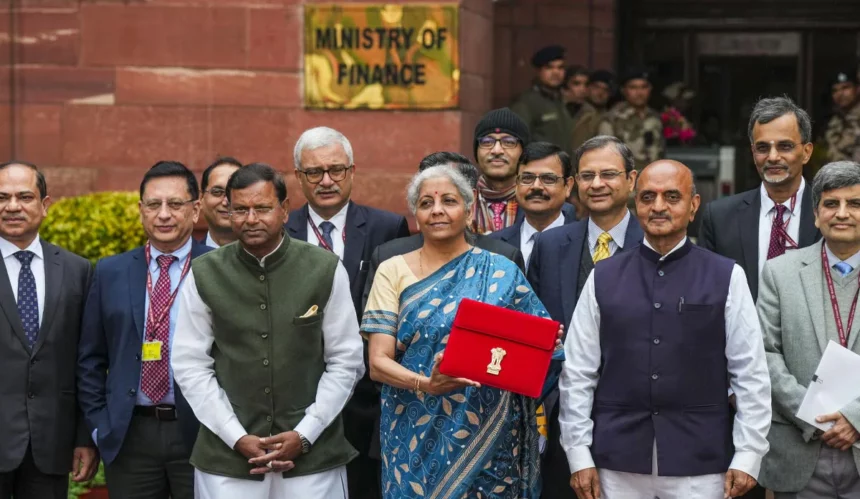
India’s Finance Minister Nirmala Sitharaman is facing a critical decision as she prepares to present the national budget for the fiscal year 2025-26 on February 1. With the Indian economy experiencing a slowdown, rising global uncertainties, and mounting pressure to maintain fiscal discipline, the government is walking a fine line between stimulating growth and reducing the fiscal deficit. Economists are predicting that the government may prioritize deficit reduction over aggressive spending aimed at reviving the economy, making the upcoming budget one of the most closely watched in recent years.
According to analysts at investment bank UBS, the Indian government is expected to lower its fiscal deficit target by 50 basis points to 4.4% of GDP for the fiscal year 2025-26, down from the 4.9% target for the current fiscal year. Additionally, the government is likely to set a nominal GDP growth target of 10.5% for the next fiscal year. While the country’s economic growth has been robust in recent years, the current fiscal year has seen a significant slowdown, with the economy growing at a slower pace than anticipated.
The upcoming budget will be the first full-year budget for the coalition government, which assumed power in June 2024. The budget comes against the backdrop of weak domestic demand, a depreciating rupee, and global economic uncertainties that have left India’s growth prospects under pressure. Factors such as unseasonal rainfall, fiscal tightening, and sluggish credit growth in the private sector have contributed to the economic slowdown. The Reserve Bank of India’s measures to curb unsecured lending growth have also had an impact on economic activity.
Goldman Sachs, in its report, anticipates that the budget will focus on stimulating job growth in the labor-intensive manufacturing sector. The government is likely to continue promoting rural housing programs and introduce measures to control price volatility. Additionally, experts predict that there will be an emphasis on “fine-tuning” existing measures to boost medium-term demand. Senior economist at DBS, Radhika Rao, noted that tax relief, particularly for middle-income households, could be a key feature of the budget, although any reduction in personal income tax rates is expected to benefit a small portion of the population.
While the government is likely to prioritize fiscal discipline, there is speculation that personal income tax cuts could help boost domestic consumption. The government is also expected to continue its focus on infrastructure development, particularly in upgrading the country’s roads, railways, airports, and highways.
The Indian government has made significant progress in reducing its fiscal deficit in recent years, following a sharp increase to 9.2% of GDP during the pandemic. In 2023, S&P Global Rating upgraded India’s sovereign rating outlook to “positive” from “stable,” citing the country’s robust economic expansion and the government’s commitment to fiscal consolidation. Finance Minister Nirmala Sitharaman had pledged to reduce the fiscal deficit to 4.9% of GDP for the current fiscal year and to 4.5% in the next fiscal year. The government has made significant strides in this direction, and experts believe that it will continue its fiscal discipline in the coming years.
One of the key factors that have helped the government in reducing the fiscal deficit is a record $25 billion dividend received from the Reserve Bank of India. This windfall, along with a sharp underspend in capital expenditure, has played a crucial role in reducing the budget deficit for the current fiscal year. However, UBS analysts predict that public expenditure will shrink further in the coming years, potentially slowing to 3.2% of GDP in fiscal year 2025-26. This fiscal discipline is expected to remain a drag on growth, and it is believed that the fastest growth pace in public capital expenditure may have already been achieved.
India’s economy, which has long been one of the world’s fastest-growing major economies, has experienced a downturn. The government has already revised its GDP growth forecast for the current fiscal year, with the growth outlook being cut three times since October. The revised forecast of 6.4% for the current fiscal year marks the slowest growth in four years. As a result, experts suggest that the government may target a nominal GDP growth rate of 10.3% for the next fiscal year, which would be an improvement from the 9.7% target for the current year.
Despite these efforts, it is unlikely that Finance Minister Sitharaman will announce a large fiscal stimulus package to address the economic slowdown. Shilan Shah, deputy chief emerging markets economist at Capital Economics, noted that while some tax and spending measures could be introduced, they are likely to be incremental rather than transformational. The budget is expected to focus on carefully calibrated measures that aim to support growth without derailing fiscal consolidation efforts.
In terms of monetary policy, the Reserve Bank of India (RBI) has kept interest rates unchanged since February 2023. While the central bank has room to ease monetary policy in response to slowing economic growth, the depreciating rupee poses a challenge. Any rate cuts could put additional pressure on the currency, leading to inflationary pressures and potential capital outflows. India’s consumer price inflation has remained within the RBI’s tolerance ceiling of 6%, providing some flexibility for the central bank to lower rates.
The budget will also be closely scrutinized for any changes to the government’s divestment and asset monetization goals. Reports suggest that the government may cut its disinvestment target by 40% for the current fiscal year, as divestment receipts have lagged behind expectations. UBS analysts expect the government to lower its divestment target to around ₹300 billion ($3.47 billion) for the next fiscal year, down from the ₹500 billion target for the current year.
As the Indian government prepares for the budget presentation, there is a growing sense that it will continue its focus on fiscal consolidation while taking steps to address the economic slowdown. With a delicate balance to strike between boosting growth and maintaining fiscal discipline, the upcoming budget will play a crucial role in shaping the country’s economic trajectory in the years to come. The decisions made by Finance Minister Sitharaman will likely have significant implications for India’s growth prospects, fiscal health, and ability to navigate the global economic challenges ahead.