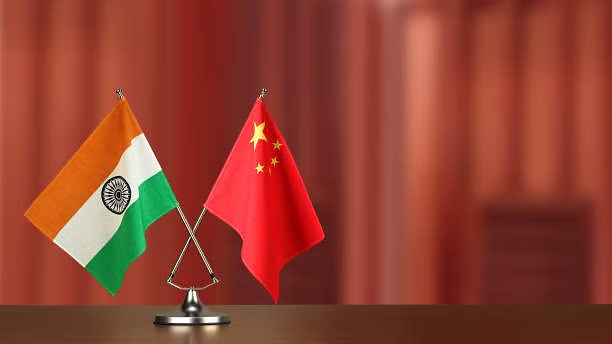
India faces a unique challenge in balancing its security concerns with China while maintaining extensive economic ties. Although China is identified as India’s primary adversary by the U.S. Defence Intelligence Agency, it remains India’s top trading partner, underscoring the paradox of their relationship. Despite political tensions and border disputes, bilateral trade between the two nations continues to grow, reflecting a complex interdependence that shapes India’s economic and strategic policies.
Trade Dominance Despite Tensions
According to recent data, bilateral trade between India and China reached approximately $118.4 billion in the fiscal year 2024, marking a 4% increase from the previous year. China has reclaimed its position as India’s largest trading partner, surpassing the United States after a two-year interval. China accounts for over 15% of India’s total imports, with goods ranging from infrastructure materials to consumer electronics. India imported goods worth $101.74 billion from China in FY24, while exporting $16.65 billion in return. This trade imbalance highlights how deeply India depends on China for various commodities and manufacturing inputs.
Despite these extensive trade links, geopolitical tensions persist. India’s government has tightened foreign direct investment (FDI) rules to curb Chinese investments in sensitive sectors and banned several Chinese mobile applications citing security concerns. China ranks 22nd among countries investing in India, with a cumulative FDI inflow of $2.5 billion since 2000, reflecting cautious engagement amid the larger strategic rivalry.
Navigating Strategic Rivalry and Economic Interdependence
Officials acknowledge the complexity of the relationship, emphasizing that the economic interdependence is not just resilient but systemic. The Narendra Modi administration has prioritized “Atmanirbhar Bharat” (self-reliant India) to reduce reliance on Chinese imports by boosting domestic manufacturing and supply chains. However, this transition is gradual and requires significant capability-building in manufacturing, research, and infrastructure.
An official involved in these strategic decisions explained, “We are in a position where our so-called adversary is also our supplier.” This reality necessitates a nuanced approach balancing national security with economic growth. The government continues to manage border disputes and geopolitical competition cautiously, while simultaneously fostering trade ties that benefit India’s economy.
This dual approach reflects the intricate nature of India-China relations, where economic necessity and strategic caution coexist in a delicate balance, shaping India’s future economic and security landscape.