The question of when India conducted its first surgical strike across the Line of Control (LoC) remains a subject of intense political debate. Congress leader Shashi Tharoor recently reiterated that the first such strike took place in 2016, a claim supported by official statements from the Indian Army. However, the Congress party disputes this, asserting that similar operations were conducted earlier under the Manmohan Singh-led UPA government but were kept under wraps. This divergence in narratives highlights ongoing political disagreements about the country’s military history and national security approach.
Army’s Official Position on Surgical Strikes
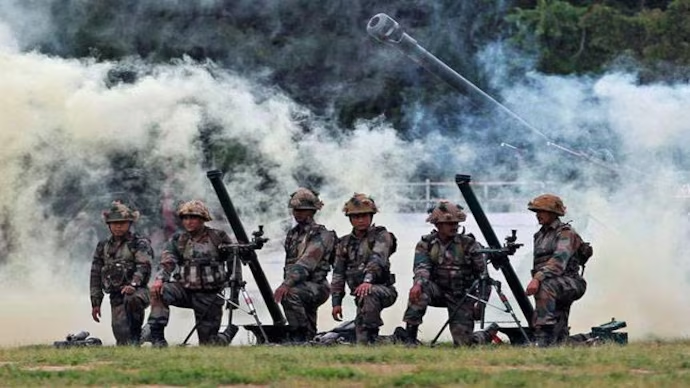
In 2016, following the surgical strikes carried out after the Uri terror attack, the Indian Army clearly stated that this was the first time India had crossed the LoC for such operations. Lt Gen Ranbir Singh, then Northern Command Chief, reaffirmed in 2019 that these strikes marked an unprecedented move. Additionally, a 2018 Right to Information (RTI) response from the Director General of Military Operations (DGMO) confirmed that the Army has no record of surgical strikes before September 29, 2016. This official stance contradicts the Congress’s claims of prior covert operations during the UPA era between 2004 and 2014.
Political Reactions and Contentions
The Congress party has challenged Tharoor’s remarks, labeling them factually incorrect and highlighting a media report quoting former Foreign Secretary S Jaishankar’s October 2016 statement to a parliamentary committee. Jaishankar reportedly acknowledged earlier “target-specific, limited-calibre, counter-terrorist operations” across the LoC. However, such parliamentary committee briefings are confidential and lack public documentation. Congress spokesperson Pawan Khera has demanded that Tharoor retract his statements made during an all-party delegation abroad.
BJP spokesperson Pradeep Bhandari dismissed Congress’s objections, emphasizing that the Army’s RTI reply substantiates the 2016 strikes as the first of their kind. Bhandari criticized the UPA government for inaction following the 2008 Mumbai attacks, underscoring the significance of the 2016 surgical strikes in marking a new chapter in India’s counter-terrorism efforts.
Meanwhile, Congress leader Udit Raj mocked Tharoor’s stance, sarcastically suggesting that he be appointed External Affairs Minister for defending the government better than BJP representatives. Tharoor remains firm, focusing on holding not just perpetrators but also those who support and finance terrorists accountable, reiterating this message in an address from Panama.
This ongoing debate over India’s surgical strike history reflects broader political tussles surrounding national security narratives and the legacy of past governments.