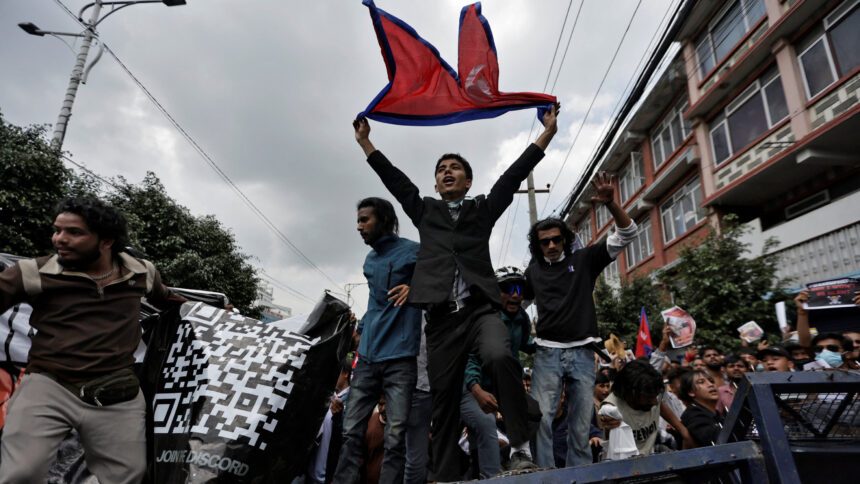
As Nepal continues to reel under the fury of the youth-led Gen Z protests, stories of stranded tourists have begun to emerge, exposing the alarming spread of violence beyond political centers. Among the most striking accounts is that of Indian tourist Upasana Gill, who posted a desperate video appeal for help after her hotel in Pokhara was set ablaze by protesters, forcing her to run for her life. Her testimony highlights how the escalating unrest has engulfed not just government buildings and political leaders’ homes but also private businesses and visitors who had little to do with the demonstrations.
An Indian tourist caught in the middle of chaos
In the now-viral video, Gill identified herself as an Indian national stranded in Pokhara. According to her, she had traveled to Nepal to host a volleyball league, only to find herself in the crosshairs of violent mobs who had torched the hotel where she was staying. She recounted in vivid detail that her belongings, including luggage and personal documents, were destroyed in the blaze. While at a spa nearby, she realized the danger was far more immediate than she could have imagined: protesters armed with large sticks were chasing her, leaving her no choice but to flee through the chaotic streets of Pokhara.
“My name is Upasana Gill, and I am sending this video to Praful Garg. I request the Indian embassy to please help us. All those who can help us, please help. I am stranded here in Pokhara, Nepal. I had come here to host a volleyball league, and currently, the hotel where I was staying has been burned down. All my luggage, all my belongings, were in my room, and the entire hotel was set on fire. I was in the spa, and people were running behind me with very large sticks, and I barely managed to escape with my life,” Gill said in her message, her voice shaking with fear.
The fear expressed in her appeal was compounded by her observation that the mobs were indiscriminate. Tourists, she claimed, were not spared from attacks. The protests that began over the Nepal government’s controversial ban on social media had rapidly transformed into an anti-establishment uprising, targeting symbols of governance and wealth but also ordinary citizens, businesses, and visitors.
“The situation here is very bad. Fires are being set on roads everywhere. They are not sparing tourists here. They don’t care if someone is a tourist or if someone has come here for work. They are setting fires everywhere without thinking, and the situation has become very, very bad here. We don’t know how long we will stay in another hotel. But I just request the Indian embassy that please, this video, this message, should be delivered to them. With folded hands, I request all of you, please help us. There are many people with me here, and we are all stranded here,” Gill added in the same appeal.
Her words painted a harrowing picture of the ground reality in Nepal’s popular tourist destination, turning what should have been a peaceful sporting event into a nightmare of survival.
Nepal’s Gen Z protests and political fallout
The Gen Z protests in Nepal did not erupt overnight. Initially sparked by Prime Minister KP Sharma Oli’s decision to ban social media platforms, the movement quickly transformed into an all-out youth-led uprising against corruption, political apathy, and entrenched elite dominance. With tens of thousands of young Nepalese on the streets, the protests morphed into violent clashes that resulted in dozens of deaths and widespread destruction of public property.
On the second day of escalating demonstrations, Oli resigned under immense public pressure, acknowledging that his administration had lost its grip on both governance and credibility. His resignation, however, did not stem the anger on the streets. Protesters continued storming government buildings, torching parliament, and setting fire to the homes of senior leaders. The death toll climbed to at least 19, with many more injured, underscoring the volatility of the situation.
The protests also revealed a generational shift in Nepal’s politics. University students, first-time voters, and young professionals who had grown disillusioned with traditional parties rallied under the banner of the Gen Z movement, signaling a desire for radical change in how politics and governance function in the Himalayan nation. Their anger was not limited to policy decisions but reflected deep frustrations with unemployment, corruption scandals, and a lack of opportunities for the youth.
The wave of violence has also disrupted Nepal’s economy, heavily dependent on tourism. Pokhara, a city often described as the “gateway to the Himalayas” and a hub for trekkers heading to the Annapurna region, now resembles a battleground. Shops remain shuttered, streets are littered with debris from arson, and curfews have been enforced intermittently. With Kathmandu airport shut and roads unsafe, thousands of visitors remain stranded.
Indian response and advisory for citizens in Nepal
As reports of stranded tourists grew, the Indian Embassy in Kathmandu issued an urgent advisory, requesting all Indian nationals to defer non-essential travel to Nepal until stability returns. The embassy also provided emergency contact numbers to assist citizens in distress. In a post shared on X, formerly known as Twitter, the embassy wrote: “All Indian nationals in Nepal are hereby requested to note the following telephone numbers from the Embassy of India, Kathmandu, for contact, in case they are facing any emergency situation or require assistance: 977 – 980 860 2881, 977 – 981 032 6134.”
India’s Ministry of External Affairs echoed the embassy’s caution, advising Indian citizens already in Nepal to shelter in their current places of residence, avoid venturing outdoors, and exercise extreme vigilance. “In view of the developing situation in Nepal, Indian citizens are advised to defer travel there until the situation has stabilized. Indian citizens presently in Nepal are advised to shelter in their current places of residence, avoid going out onto the streets and exercise all due caution,” the MEA stated in its official advisory.
The statement also urged Indian citizens to follow local safety advisories issued by Nepalese authorities and assured them that the Indian mission in Kathmandu was monitoring the situation closely. Helpline numbers were circulated with the assurance that assistance could be provided via direct calls or WhatsApp in urgent cases.
Meanwhile, the India-Nepal border crossing at Sonauli in Uttar Pradesh’s Maharajganj district witnessed heavy movement as hundreds of Indian tourists cut short their trips and returned home. For many, the return was abrupt and chaotic.
Pramila Saxena, a pilgrim from Bhopal, described how her group of 60 senior citizens had to abandon their journey to Kathmandu’s Pashupatinath Temple after their flight was cancelled. “We were going to Pashupatinath Temple in Nepal, from Bhopal. We had boarded the flight, but it was cancelled. So, we deplaned. The situation is tense there. We are not being allowed to cross. The airport is closed. So, we have come back. We were a group of 60 people—all senior citizens. We are returning from the airport,” she said.
Another tourist, Ashok, echoed the ordeal. “We were going to Kathmandu, to Pashupatinath Temple. But the flight was cancelled. We stayed in a lodge overnight and now we are returning home,” he recounted. Their experiences mirror those of hundreds of Indians who had planned pilgrimages, trekking expeditions, or leisure trips, only to be caught in a wave of unrest they had neither anticipated nor prepared for.
Nepal’s President Ram Chandra Paudel attempted to calm the situation by appealing to the protesters to pursue dialogue rather than destruction. On Tuesday, he called on citizens to seek a peaceful resolution, stressing that while the grievances of the youth deserved recognition, violence would only deepen Nepal’s crisis. His words, however, did little to stop the fires already burning across the country.
For India, the crisis in Nepal carries multiple dimensions: the immediate responsibility of ensuring the safety of its citizens, the long-standing political ties with Kathmandu, and the broader challenge of dealing with instability in a neighboring country that shares deep cultural, economic, and security linkages. The Indian government’s immediate priority remains to evacuate stranded citizens and prevent further casualties, but the larger political ramifications of the Gen Z movement in Nepal are likely to resonate in regional geopolitics for months to come.