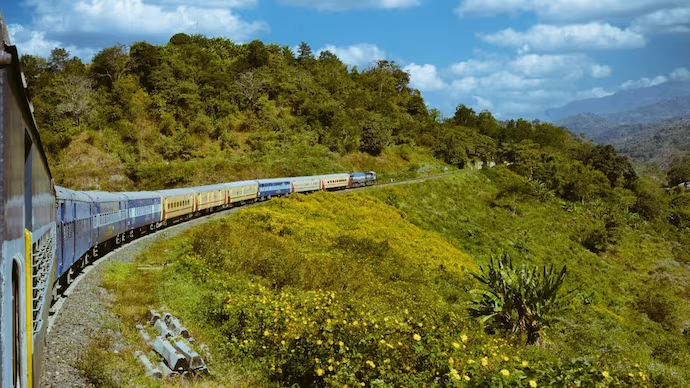
Six decades after Guwahati was first linked by rail, India is on a mission to connect every Northeastern capital, redefining the region’s place on the national map beyond the strategic Siliguri Corridor, famously known as the “Chicken’s Neck.” With tunnels slicing through mountains, bridges towering over deep gorges, and routes cutting across landslide-prone terrain in Seismic Zone-V, the Indian Railways is steadily weaving Mizoram’s capital Aizawl into the network, after linking Agartala and Itanagar, signalling a transformative moment for the region’s connectivity, trade, security, and tourism potential.
When the Saraighat Bridge was inaugurated across the Brahmaputra in 1962, it placed Guwahati on India’s rail map, reconnecting the Northeast with the rest of the country after the Partition had severed key routes. This moment became a cornerstone for the region’s development and integration, ending years of isolation imposed by geography and political shifts. Now, India is building on that legacy, extending the rail grid deeper into the hills and valleys of the Northeast.
Connecting Aizawl: A New Milestone
Mizoram’s capital Aizawl is the latest to prepare for its rail link, with the Bairabi-Sairang railway line awaiting final approvals after a safety inspection. The 51.38-km line, built at a cost of Rs 5,021 crore, stretches from Bairabi near the Assam border to Sairang, a satellite town around 20 kilometres from Aizawl. This project, crossing the challenging terrain of the Lushai Hills, involved building 48 tunnels and 55 major bridges, including a pier that stands 42 metres taller than the Qutub Minar.
Despite the region’s prolonged monsoons, landslides, and tough terrain, the project has been designed to withstand heavy rains and ensure operational durability for over a century. With this, Aizawl will become the fourth Northeast capital connected to the national railway network after Guwahati, Itanagar, and Agartala, cutting travel time to Assam by three to four hours and providing a faster route for troop movements in the strategically sensitive region.
A Broader Push for Northeast Connectivity
The rail connectivity mission in the Northeast is not just about laying tracks; it is about addressing the region’s historical isolation, enhancing trade and tourism, and strengthening national security. After Partition disrupted direct rail connections as routes passed through what is now Bangladesh, the Northeast was left dependent on the narrow Siliguri Corridor for its land link to India, creating vulnerabilities and hindering economic growth.
The landmark Saraighat Bridge in 1962 reconnected Guwahati, and decades later, similar efforts are extending these benefits across the region. Arunachal Pradesh was brought onto the rail map in 2014 with the Harmuti-Naharlagun line near Itanagar, enabling daily trains to Guwahati and even direct services to Delhi. The line has also operated Vistadome coaches, offering travellers panoramic views of the Brahmaputra basin and the Eastern Himalayas, making the journey as scenic as it is strategic.
Tripura’s Agartala joined in 2016 with a broad-gauge line replacing the older metre-gauge track, integrating the capital seamlessly into the national network and connecting it directly to cities like Kolkata, Guwahati, and Delhi. The Agartala railway station itself, inspired by the Ujjayanta Palace, stands as a symbol of the region’s rich heritage blending with modern connectivity.
Meanwhile, the Northeast Frontier Railway has begun exploring ways to preserve parts of the old metre-gauge routes as heritage lines, acknowledging the nostalgia of slow, scenic journeys while prioritising the speed and efficiency needed for regional growth.
Looking Ahead: The Next Capitals on Track
The Ministry of Railways aims to connect all Northeastern capitals by 2030, with projects in various stages of execution. The Dimapur-Zubza line will bring the railhead closer to Nagaland’s capital Kohima, while the Jiribam-Tupul line is nearing completion to link Manipur’s capital Imphal. In Meghalaya, the Tetelia-Byrnihat project aims to extend towards Shillong, and in Sikkim, the Sivok-Rangpo line will eventually reach Gangtok, moving further towards the Nathu La border with China.
These projects are engineering feats in themselves, with the Sivok-Rangpo line set to run over 80% of its route through tunnels, reflecting the complexity of bringing rail to the Himalayan foothills and beyond. The completion of these routes will not only open up economic and tourism opportunities but will also fortify the region’s strategic readiness, a crucial factor given the Northeast’s proximity to international borders.
Recently, the Indian Railways also celebrated the historic connection of the Kashmir Valley with the national network, linking Srinagar through tunnels and bridges including the iconic Chenab Bridge, the world’s highest. This mirrors the ambitions for the Northeast, where infrastructure is not just about transport but about national integration and regional empowerment.
From the Saraighat Bridge that reconnected Guwahati in 1962 to the imminent rail link for Aizawl, the journey of bringing the Northeast onto India’s rail map has been long but determined. As the Indian Railways continues to push beyond the Chicken’s Neck, capital by capital, it is not only transforming the region’s connectivity but also its economic and strategic landscape, laying down tracks for a more integrated, secure, and vibrant Northeast.