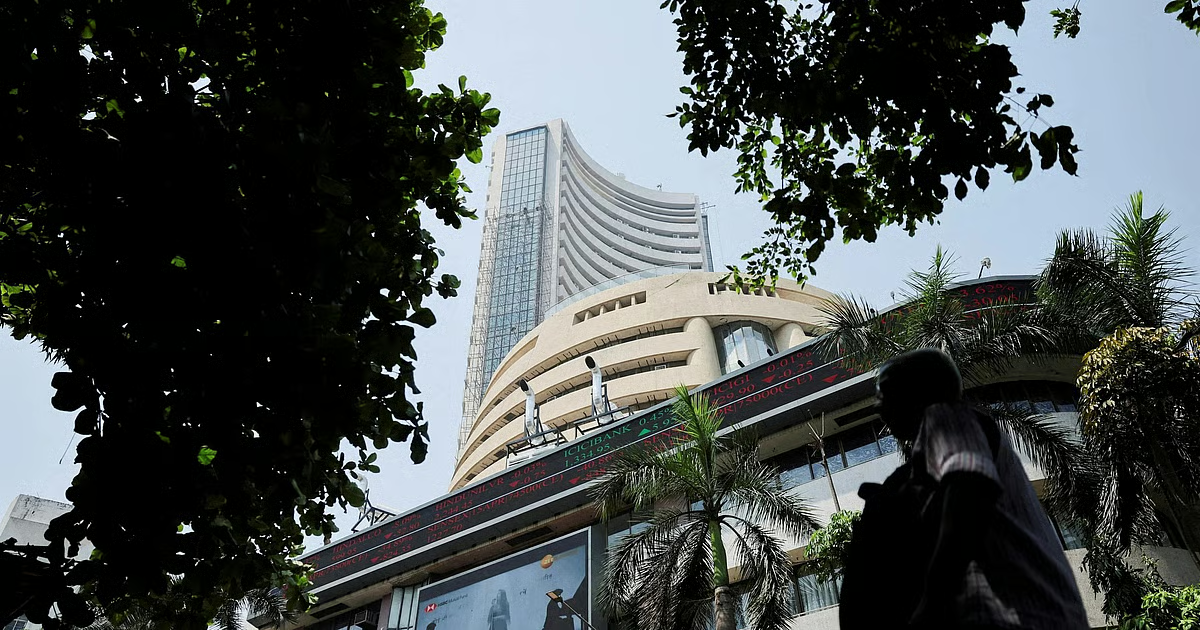
Indian equity markets closed higher for the second consecutive session on Wednesday, buoyed by optimism surrounding the newly signed India-European Union Free Trade Agreement and strong domestic institutional support, even as global cues remained mixed.
Benchmark indices ended firmly in the green on January 28, 2026, with the BSE Sensex settling at 82,344.68, up 487 points, while the Nifty 50 gained 167 points to close at 25,342.75. The rally followed Tuesday’s positive close and reflected sustained investor confidence in India’s medium- to long-term economic prospects, particularly after the conclusion of a landmark free trade agreement between India and the European Union.
Market participants largely attributed the upbeat sentiment to expectations that the FTA will boost exports, improve market access for Indian companies, and attract long-term foreign investment. Despite continued selling by foreign institutional investors, heavy buying by domestic institutions helped absorb the pressure and pushed benchmarks higher.
India-EU free trade agreement lifts investor confidence
A major catalyst for the market’s upward momentum was the formalisation of the long-awaited India-EU Free Trade Agreement, concluded after nearly 18 years of negotiations. The agreement was announced during the 16th India-EU Summit, marking a significant milestone in India’s trade and diplomatic relations with the 27-nation European bloc.
Union Minister Piyush Goyal described the India-EU FTA as a strong and independent deal, underlining its strategic and economic importance. India, currently the world’s fourth-largest economy, and the European Union, the second-largest, together account for roughly 25 percent of global GDP and nearly one-third of total world trade. Investors believe the agreement will open new opportunities across manufacturing, services, technology, and green energy, while also strengthening supply chains.
Markets responded positively to the announcement, with buying interest seen across key sectors that are expected to benefit from improved trade access and regulatory cooperation. The deal is also being viewed as a vote of confidence in India’s economic reforms and growth trajectory, reinforcing the country’s position as a preferred investment destination.
The gains on Wednesday extended the positive trend seen a day earlier, when markets closed higher on January 27, with Sensex rising 319 points to 81,857 and Nifty adding 126 points to end at 25,175. The back-to-back gains suggest that domestic investors remain optimistic despite external uncertainties.
Global cues mixed; domestic institutions provide support
While Indian markets advanced, Asian equities showed a mixed trend. South Korea’s KOSPI was trading higher, while Japan’s Nikkei Index edged lower. Hong Kong’s Hang Seng Index posted strong gains, and China’s Shanghai Composite Index also traded in positive territory. Overnight, US markets presented a mixed picture, with the Dow Jones Industrial Average closing lower, while the Nasdaq and S&P 500 ended with gains.
Foreign Institutional Investors continued to remain cautious. On January 27, FIIs sold shares worth ₹3,068 crore, extending their selling trend seen over recent months. In December 2025 alone, FIIs had offloaded equities worth ₹34,350 crore, reflecting concerns over global interest rates, currency movements, and valuation pressures.
However, Domestic Institutional Investors once again emerged as a stabilising force for the markets. On January 27, DIIs bought shares worth ₹8,999 crore, significantly offsetting foreign selling. In December 2025, DIIs had purchased equities worth ₹79,620 crore, underlining strong domestic confidence and the growing role of local capital in supporting Indian markets.
Market analysts noted that sustained DII inflows, coupled with positive structural developments like the India-EU FTA, are helping Indian equities remain resilient amid volatile global conditions. While short-term fluctuations may persist due to global cues and foreign fund flows, the broader sentiment continues to favour equities, especially in sectors linked to exports, infrastructure, and domestic consumption.
As the January series nears its end, investors are expected to closely track further details on the implementation of the India-EU trade agreement, upcoming corporate earnings, and global macroeconomic signals. For now, the second straight session of gains has reinforced confidence that Indian markets are well positioned to navigate external headwinds while capitalising on long-term growth opportunities.