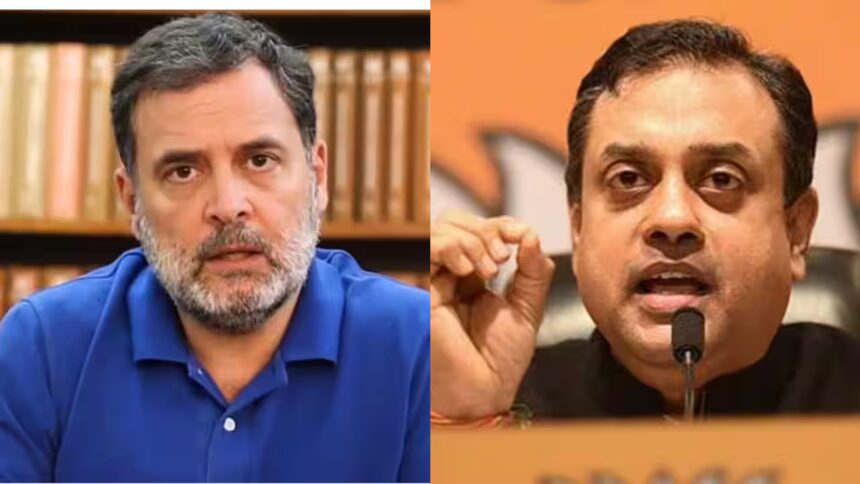
The political confrontation between the Bharatiya Janata Party and Congress escalated sharply after the BJP raised questions over the funding of Congress leader Rahul Gandhi’s international travel history, claiming he has undertaken 54 personal foreign trips over the past 22 years. The party alleged that the cost of these visits appears significantly higher than his declared income, triggering a fresh political controversy over transparency, accountability, and political targeting.
The issue was brought into the spotlight by BJP spokesperson Sambit Patra, who questioned how the Congress leader’s foreign travel expenses were being financed. According to the BJP, these visits span multiple countries including the United Kingdom, United States, Italy, Germany, Vietnam, Singapore, and several Middle Eastern nations.
The Congress party has dismissed the allegations as politically motivated, accusing the BJP of attempting to shift public attention away from pressing economic and foreign policy issues facing the country.
Rising Political Heat Over Foreign Visits and Transparency Claims
The BJP has argued that the scale and frequency of Rahul Gandhi’s foreign trips require greater financial disclosure. The party claims that while many of the visits are traceable through public records, parliamentary absence data, and media coverage, the financial trail behind these trips remains unclear.
BJP leaders further alleged that some of the trips involved significant expenditure, citing one example of a Southeast Asia visit reportedly costing several crores. The party has questioned whether such expenses were funded through personal income, foreign sources, or undisclosed support, and has demanded clarity under financial disclosure norms.
The ruling party has also linked the issue to compliance under India’s foreign funding regulations, raising questions about whether approvals under relevant laws were obtained if external funding was involved.
These claims have intensified the already adversarial political atmosphere between the two national parties, with both sides engaging in sharp public exchanges.
Congress Rejects Allegations, Calls Them Political Distraction
The Congress party has strongly rejected the BJP’s allegations, calling them a diversionary tactic aimed at shifting attention from governance issues. Senior Congress leaders argued that the ruling party is attempting to distract from concerns related to economic performance, inflation, and international diplomacy challenges.
Congress spokesperson Jairam Ramesh said the BJP’s focus on foreign travel was an attempt to avoid meaningful debate on policy matters. He also accused the government of using political narratives to weaken opposition voices and deflect scrutiny from national issues.
According to the Congress, there is no irregularity in Rahul Gandhi’s travel records, and all visits are either publicly documented or part of political and personal engagements. The party has also accused the BJP of selectively interpreting data to build a political narrative.
Escalating Debate Over Political Accountability and Public Disclosure
The controversy has reignited a broader debate around transparency standards for public figures, especially leaders occupying constitutional positions such as the Leader of Opposition. The BJP has argued that elected representatives should provide clearer disclosure of financial expenditures related to international travel, particularly when questions of scale and frequency arise.
The party has claimed that Rahul Gandhi’s declared income over the years does not align with the estimated cost of his foreign visits, which it places at several crores over two decades. It has also raised concerns about whether proper tax and foreign exchange disclosures have been made in accordance with regulatory requirements.
On the other hand, opposition leaders have argued that the BJP is politicising personal travel records and attempting to create a narrative without presenting verifiable financial evidence. They maintain that the allegations are speculative and intended to undermine the credibility of opposition leadership.
The issue has now become part of a wider political narrative ahead of upcoming electoral cycles, with both parties using the controversy to reinforce their broader messaging strategies.
Political Narrative Deepens Ahead of Key Electoral Season
As political temperatures rise, the foreign travel controversy adds another layer to the ongoing rivalry between the BJP and Congress. The BJP continues to frame the issue as one of accountability and transparency, while the Congress is positioning it as a distraction from governance concerns.
Political analysts suggest that such controversies often become symbolic in nature, reflecting deeper ideological battles rather than purely administrative concerns. In this case, the debate over financial disclosures, political image, and public accountability has merged with broader electoral positioning.
With both parties holding firm to their respective positions, the issue is likely to remain in the political spotlight in the coming weeks.
The dispute over foreign travel funding has once again highlighted the intense scrutiny faced by senior political leaders in India. While the BJP continues to demand clarity on financial disclosures, the Congress maintains that the allegations are politically driven. The issue underscores the growing importance of transparency narratives in contemporary Indian politics, where perception often plays as crucial a role as policy.