A sharp escalation in transatlantic tensions has unfolded after former United States president Donald Trump threatened sweeping tariffs against eight European countries over Greenland, prompting strong political pushback, public protests, and urgent diplomatic consultations across Europe. Denmark’s Prime Minister Mette Frederiksen declared that “Europe will not be blackmailed,” setting the tone for a unified European response as the European Union moved to halt progress on a major EU–US trade deal and called an emergency meeting to assess the economic and strategic fallout. The controversy has reignited debates about sovereignty, Arctic security, and the future of NATO cooperation, while thousands of protesters in Greenland and Denmark took to the streets to oppose what they view as unacceptable pressure on the world’s largest island.
Trump’s warning of a 10 percent tariff on exports from Denmark, Finland, France, Germany, the Netherlands, Norway, Sweden, and the United Kingdom, rising to 25 percent by June 2026, has transformed a long-simmering dispute over Greenland into a full-blown political and economic confrontation. European leaders argue that the threats undermine international law, territorial integrity, and alliance solidarity, while Trump has framed his demand as a matter of American national security tied to growing Chinese and Russian interest in the Arctic.
European leaders unite against tariff threats, stress sovereignty and alliance solidarity
Denmark’s Prime Minister Mette Frederiksen responded forcefully to Trump’s remarks, stating that Europe would not submit to economic coercion over issues of sovereignty. Her comments were echoed in a joint statement issued by the leaders of Denmark, Finland, France, Germany, the Netherlands, Norway, Sweden, and the United Kingdom, who warned that Trump’s approach risked triggering a “dangerous downward spiral” in transatlantic relations. The statement reaffirmed unwavering support for Greenland’s sovereignty and territorial integrity, emphasising that decisions about its future rest solely with the people of Greenland and the Kingdom of Denmark.
The eight countries underlined that they remain open to dialogue but only on the basis of respect for international law and democratic principles. They reiterated full solidarity with Denmark and Greenland, stressing that economic pressure or tariff threats cannot be used as tools to force territorial concessions. All eight nations, being NATO members, also highlighted their shared commitment to strengthening Arctic security as a collective transatlantic interest rather than a zero-sum geopolitical contest.
In this context, European leaders pointed to recent Danish military exercises in Greenland, known as Arctic Endurance, describing them as defensive and transparent measures aimed at enhancing regional security. They rejected any suggestion that such exercises posed a threat to other nations, instead portraying them as evidence of responsible alliance behaviour in a strategically sensitive region.
The European Union reacted swiftly on the economic front. EU officials confirmed that an emergency meeting was called to discuss the proposed tariffs and their potential impact on European economies and global trade. At the same time, the EU decided to pause the ratification process of the EU–US trade deal announced in July 2025, signalling that normal trade relations could not continue amid what Brussels views as overt economic intimidation. Siegfried Mureșan, Vice-President of the European People’s Party, publicly confirmed the delay, reinforcing the message that the tariff threats have tangible diplomatic and economic consequences.
Beyond the EU, reactions came from other allies. Canadian Prime Minister Mark Carney stated that Canada would always support the sovereignty and territorial integrity of countries, expressing concern over the recent escalation surrounding Greenland. Speaking during a visit to Doha, Carney said that decisions about Greenland’s future must be made by Greenland and Denmark alone. He added that discussions with Greenland’s prime minister had reaffirmed full NATO commitment to Greenland’s security, underscoring alliance unity in the face of external pressure.
Ireland’s Foreign Minister Helen McEntee also condemned Trump’s tariff threats as “completely unacceptable and deeply regrettable.” Although Ireland was not among the countries directly targeted, McEntee said peace and security depend on adherence to the United Nations’ fundamental principles. She stressed that respect for sovereignty and territorial integrity is non-negotiable and made clear that Ireland’s position on Greenland would not change. Her remarks reflected broader European concern that yielding to such threats could weaken international norms and embolden similar tactics elsewhere.
Protests erupt as Greenland’s strategic value fuels geopolitical confrontation
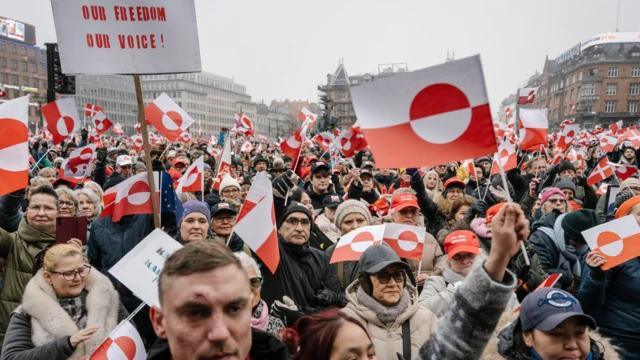
While diplomatic tensions played out at the highest political levels, public anger spilled onto the streets of Greenland and Denmark. Thousands of protesters marched through Nuuk, Greenland’s capital, carrying banners and chanting slogans such as “Greenland is not for sale.” Demonstrators included families with children, and even newborns in strollers bearing signs that read “My first protest,” underscoring the depth of feeling across generations. Protesters marched from downtown Nuuk to the US consulate, waving placards that read “Yankee go back” and “Make America go away,” and burning or displaying effigies of Trump as a symbol of resistance.
These demonstrations reflected widespread resentment toward what many Greenlanders see as an attempt to undermine their right to self-determination. Although Greenland is a semi-autonomous territory within the Kingdom of Denmark, its people have repeatedly asserted their desire to decide their own political future. Trump’s insistence that anything less than US control of Greenland is “unacceptable” has intensified fears that economic and political pressure could be used to override democratic choice.
At the heart of the dispute lies Greenland’s immense strategic importance. Geographically, the island sits between North America and Europe, making it a critical node in the North Atlantic and Arctic regions. Its location has long given it military significance, particularly for missile surveillance and early warning systems. The United States already operates the Thule Air Base in Greenland, a key component of its missile defence and space monitoring infrastructure, used to track potential threats from Russia and China.
Greenland’s natural resources add another layer to its strategic value. The island is believed to hold vast reserves of rare earth elements, oil, gas, and other critical minerals essential for modern technologies, including electric vehicles, renewable energy systems, and advanced defence equipment. With China currently dominating global production of many rare earths, Washington views Greenland as a potential means to reduce strategic dependence and secure future supply chains.
Climate change has further elevated Greenland’s geopolitical relevance. As Arctic ice melts, new maritime shipping routes are opening, shortening travel times between Asia, Europe, and North America. Control or influence over Greenland could give significant leverage over these emerging routes and shape the balance of power in the Arctic. For the United States, this region is increasingly viewed as a frontline of national security, where Russian and Chinese activity is closely monitored.
Trump has repeatedly argued that acquiring Greenland is necessary to counter these perceived threats, framing his tariff ultimatum as a tool to compel negotiations. He announced that, starting February 1, 2026, the eight European countries would face a 10 percent tariff on all goods exported to the United States, rising to 25 percent on June 1 if no agreement is reached. He claimed that the tariffs would remain in place until a deal for the “complete purchase of Greenland” is achieved, asserting that it was time for Denmark to “give back” after years of American support.
European leaders have warned that such a move could destabilise NATO itself. Germany, Sweden, France, Norway, the Netherlands, and Finland have already sent small numbers of troops to Greenland, while Denmark has increased its own military presence, framing these steps as defensive measures to reassure allies and deter escalation. Officials have cautioned that any unilateral attempt by the United States to acquire Greenland could fracture alliance trust and even risk undermining NATO’s cohesion.
As emergency meetings continue and protests persist, the confrontation over Greenland has become a defining test of transatlantic relations in an era of renewed great-power competition. The clash brings together trade policy, military strategy, climate change, and the enduring question of sovereignty, with Europe making clear that it will resist pressure it views as incompatible with democratic values and international law.