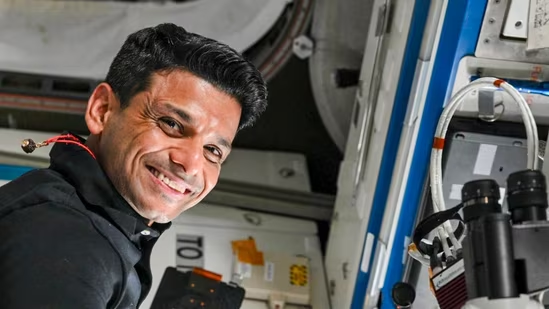
Indian astronaut Group Captain Shubhanshu Shukla and his Ax-4 crewmates will return to Earth from the International Space Station on July 14, concluding a mission focused on scientific research and technology tests that could define the future of space exploration. Initially planned for a two-week stay ending July 10, the mission was extended to ensure the best possible conditions for their safe return and the completion of critical experiments.
According to Axiom Space, the mission managers, the Ax-4 crew will undock from the ISS no earlier than 7:05 a.m. ET (4:35 p.m. IST) on July 14, weather permitting. The crew includes Commander Peggy Whitson, Pilot Shubhanshu “Shux” Shubhanshu Shukla, and Mission Specialists Sławosz “Suave” Uznański-Wiśniewski and Tibor Kapu, who have spent their final days in orbit advancing experiments aimed at deep space readiness and improving life on Earth.
Science and Technology at the Mission’s Core
Since docking with the ISS on June 26 aboard SpaceX’s Dragon spacecraft Grace, the Ax-4 crew has worked on 60 experiments representing 31 countries. These include scientific studies, technology demonstrations, and outreach efforts designed to prepare for lunar and deep space missions while delivering innovations that could benefit everyday life on Earth.
Representing the Indian Space Research Organisation (ISRO), Shubhanshu Shukla led seven indigenously designed microgravity experiments alongside five collaborative projects under ISRO-NASA agreements. On Day 15 of the mission, Shubhanshu Shukla managed microalgae samples, testing their potential to provide sustainable food, oxygen, and biofuels for long-duration missions.
Studying Human Adaptation in Space
The Ax-4 mission also focused on understanding human adaptation to microgravity, critical for extended space travel. One key project, the Voyager Displays study, examined how spaceflight affects eye movement and coordination. The crew used virtual reality headsets and neural monitoring caps to assess microgravity’s influence on attention, motor skills, and stress, gathering data essential for planning future missions beyond low-Earth orbit.
By extending their mission, the Ax-4 crew maximised their contributions to these studies, ensuring detailed data collection before returning to Earth. Axiom Space highlighted that these efforts align with the goal of building technologies and gathering insights necessary for humanity’s next steps in deep space exploration.