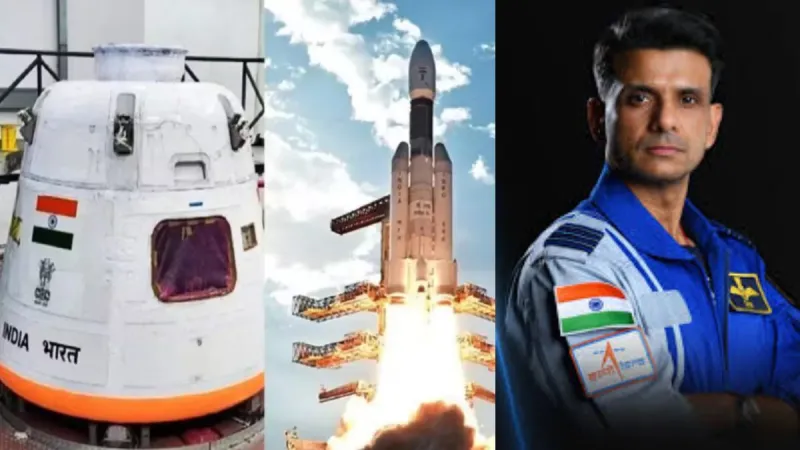
Group Captain Shubhanshu Shukla, a decorated Indian Air Force test pilot, is set to become the first Indian astronaut in over 40 years to travel into space, marking a historic leap for India’s space journey. Shukla will fly to the International Space Station (ISS) next month aboard the Axiom-4 (Ax-4) mission, making him the first Indian to ever visit the ISS and only the second Indian in space since Rakesh Sharma’s 1984 flight. His participation signals India’s growing ambition in global space exploration, backed by strategic international partnerships.
India’s strategic push into human spaceflight
Shubhanshu Shukla has been undergoing rigorous training with NASA and private space company Axiom Space for the past eight months, preparing for a mission that could shape India’s future human spaceflight plans. The Ax-4 mission, a privately funded commercial spaceflight, will launch from NASA’s Kennedy Space Centre in Florida aboard a SpaceX Crew Dragon spacecraft powered by a Falcon 9 rocket. India is said to have paid over $60 million for Shukla’s seat, highlighting its serious investment in human spaceflight.
The crew includes former NASA astronaut Peggy Whitson as the mission commander, Slawosz Uznanski from Poland, and Hungary’s Tibor Kapu, both serving as mission specialists. Group Captain Shukla will serve as the mission pilot, representing not just India but also ISRO’s readiness for future crewed missions such as Gaganyaan.
Shubhanshu Shukla: a trailblazer for India’s space dreams
A native of Lucknow and an alumnus of City Montessori School, Aliganj, Shukla was commissioned into the IAF in 2006 and has logged over 2,000 flying hours on various aircraft including Su-30MKI, MIG-29, and Jaguar. Known for his sharp skills as a fighter combat leader and test pilot, he was shortlisted for ISRO’s Human Spaceflight Program and has emerged as a frontrunner for the Gaganyaan mission.
Union Minister Jitendra Singh described the mission as a “defining chapter” in India’s space journey. ISRO Chairman Dr. V Narayanan confirmed Shukla’s preparedness for the ISS flight. The mission will also offer valuable experience in microgravity operations, launch procedures, and crew readiness—all critical for India’s future in human spaceflight.
This mission also coincides with a packed ISRO calendar, including the PSLV-C61 launch with the EOS-09 satellite and the Test Vehicle-D2 (TV-D2) mission to evaluate the Gaganyaan Crew Escape System.