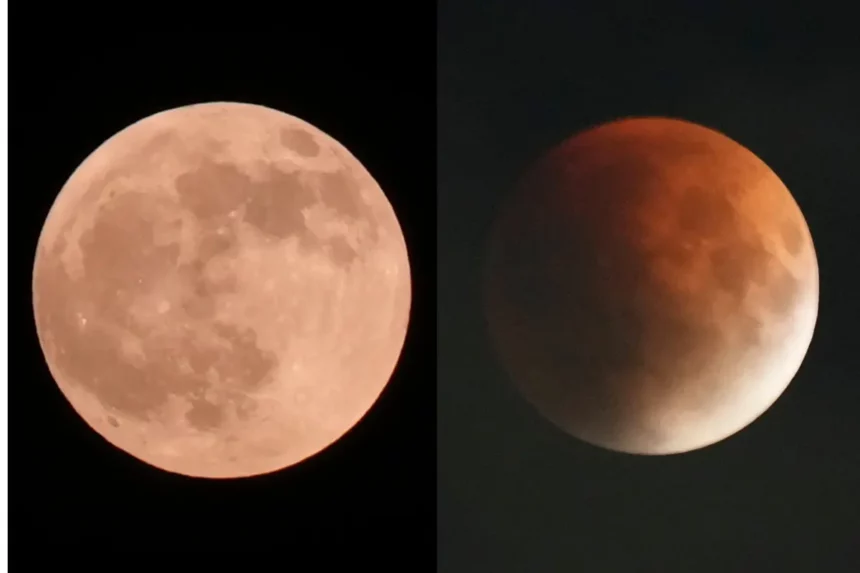
On Sunday night, India paused to witness a rare and mesmerizing celestial spectacle as the Moon transformed into a vivid copper-red disk during a total lunar eclipse, captivating observers from sprawling cities to serene villages. Across the country, people congregated on open grounds, terraces, riverbanks, and even busy street corners to catch a glimpse of the “blood moon,” a phenomenon that occurs when the Earth’s shadow passes over the Moon, giving it a deep, reddish hue. The lunar eclipse offered not just an astronomical treat but also a cultural and spiritual moment, drawing devotees, students, and astronomy enthusiasts alike to celebrate and observe the event. From the bustling ghats of Varanasi to state-of-the-art planetariums, the night was marked by awe, reverence, and scientific curiosity as India collectively engaged in this rare celestial alignment.
Blood Moon Across Cities and Spiritual Sites: A Nation in Awe
Across India, the lunar eclipse became a unifying experience that transcended geographical and social boundaries. In Karnataka’s Bengaluru, the Jawaharlal Nehru Planetarium became a hub for enthusiasts eager to observe the eclipse through telescopes. The Association of Bangalore Amateur Astronauts, founded in 1976, facilitated the viewing and explained the science behind the phenomenon to children and adults alike. President Ravi of the association highlighted that events like these nurture a lifelong interest in astronomy, providing a unique opportunity for people to connect with the universe in real time. Meanwhile, the Science Centre in Kalaburagi organized public viewing sessions, allowing visitors of all ages to witness the Moon gradually darken and adopt a reddish glow. Children and students were seen pointing telescopes skyward, experiencing firsthand the awe-inspiring transition from bright white to deep copper-red.
The lunar eclipse also carried a spiritual and ritualistic significance, particularly along India’s sacred rivers. In Varanasi, devotees gathered at Dashashwamedh Ghat to perform holy baths, meditate, and offer prayers as the total lunar eclipse began. The transformation of the Moon into a blood-red orb coincided with chants, rituals, and spiritual observances, illustrating how astronomical events continue to hold cultural resonance across generations. Similarly, at Ramkund in Maharashtra’s Nashik, saints, mahants, and devotees conducted special rituals, offering mantra recitations and performing ceremonies aligned with the celestial event. These practices not only underscore the cultural depth of such phenomena but also reflect the longstanding Indian tradition of connecting natural events with spirituality and religious observances.
The phenomenon drew attention beyond India’s borders as well, with astrophysicists and astronomy experts weighing in on the scientific underpinnings of the event. Ryan Milligan, an astrophysicist at Queen’s University Belfast, explained that the Moon appears red during a lunar eclipse because sunlight reaching it is filtered through the Earth’s atmosphere. Blue light, having shorter wavelengths, scatters more easily, leaving longer red wavelengths to illuminate the Moon, creating the striking “blood moon” effect. Such explanations helped bridge the gap between cultural interpretations and scientific understanding, enhancing public appreciation for the complex interplay of celestial mechanics that produce these visual spectacles.
The Longest Total Lunar Eclipse Since 2022: Science, Technology, and Collective Viewing
Sunday’s eclipse was notable for its duration and visibility. The total lunar eclipse, which spanned from 11:01 pm to 12:23 am, lasted 82 minutes, making it the longest total lunar eclipse visible from India since 2022 and the first across the entire nation since July 27, 2018. Astronomers emphasized the rarity of such events, noting that eclipses of this duration provide extended opportunities for scientific observation, photography, and public engagement. Across urban centers, live streams hosted by astronomy enthusiasts mitigated the challenges posed by cloudy skies, enabling viewers in overcast regions to witness the eclipse virtually. These technological interventions highlighted the growing role of digital platforms in facilitating access to natural phenomena, making astronomy more inclusive and widely appreciated.
The widespread interest in the lunar eclipse also reflected India’s long-standing fascination with celestial events. From historical observatories to modern planetariums, the country has nurtured a culture of astronomy education and public engagement. Events such as this serve as a bridge between scientific education and cultural experience, creating spaces for families, students, and enthusiasts to gather, learn, and marvel collectively. Observers in rural areas and smaller towns improvised viewing spots on terraces, roadsides, and community spaces, illustrating the widespread enthusiasm for witnessing such a rare celestial alignment. In addition to scientific observation, many participants used the event as an opportunity to photograph the Moon, share images on social media, and document the experience for posterity, blending tradition with modern modes of communication.
Meteorological conditions did pose some challenges, as cloudy skies obscured visibility in several regions. Yet, the resilience of astronomy communities and widespread live streaming ensured that the spectacle could still be appreciated nationwide. Niruj Mohan Ramanujam, Head of Science, Communication, Public Outreach, and Education at the Indian Institute of Astrophysics, remarked that the full eclipse lasted for over 82 minutes, providing ample time for detailed observation and study. The extended duration allowed viewers to witness the subtle gradations in color and shadow as the Earth’s umbra moved across the Moon’s surface, reinforcing the educational and experiential significance of such rare events.
Beyond the immediate aesthetic appeal, the lunar eclipse served as a reminder of India’s growing interest in both astronomy and public science communication. Planetariums, science centers, and amateur astronomy associations have increasingly leveraged such events to foster scientific literacy, inspire future researchers, and build a culture of curiosity and exploration. By combining cultural traditions, scientific inquiry, and modern technology, the observation of Sunday’s lunar eclipse demonstrated the multidimensional impact of celestial events on society, spanning education, spirituality, recreation, and media engagement.
Observers were captivated not only by the Moon’s transformation but also by the collective experience of witnessing a rare cosmic phenomenon. The event served as a catalyst for dialogue about the science of eclipses, the importance of astronomy in everyday life, and the ways in which humans connect with the larger cosmos. From prayer rituals at ghats to detailed telescope observations in planetariums, India showcased a harmonious blend of reverence, curiosity, and enthusiasm, making the blood moon lunar eclipse a landmark event in the country’s astronomical calendar.
In essence, the lunar eclipse on Sunday highlighted the intricate interplay of science, culture, and technology, bringing together diverse communities in shared awe. The phenomenon reminded viewers of the underlying cosmic mechanics, the scattering of sunlight through the Earth’s atmosphere, and the enduring fascination humans hold for the night sky. Whether witnessed through a telescope, on a riverbank, or via live stream, the blood moon captivated the nation, offering a rare opportunity to reflect on the wonders of the universe and India’s continuing engagement with both celestial science and spiritual tradition.
The celestial event left behind stunning images of the blood moon, captured by professional astronomers and enthusiastic citizens alike. Social media platforms were flooded with photographs showcasing the Moon in shades of red and copper, reflecting the global resonance of the phenomenon and the powerful visual impact of lunar eclipses. From historical ghats to contemporary scientific institutions, the event became a unifying spectacle, demonstrating how natural phenomena can inspire wonder, connect communities, and enrich cultural and scientific understanding.
Through both observation and interpretation, Sunday’s lunar eclipse became a celebration of human curiosity, the enduring allure of the cosmos, and India’s unique capacity to blend tradition with modern scientific exploration. Across the country, communities paused, gazed upward, and collectively experienced a moment of celestial wonder, marking another chapter in the nation’s engagement with astronomy and reaffirming the universal appeal of the night sky.