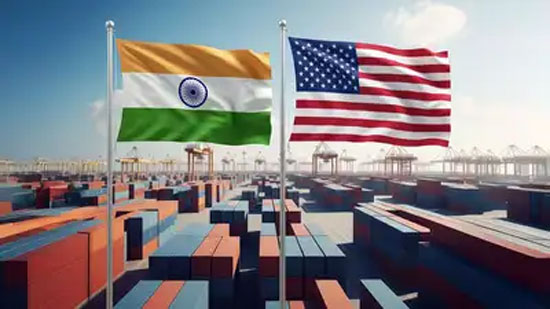
India’s long-running negotiations with the United States over a wide-ranging trade agreement appear to have entered their final and most promising phase, with chief economic adviser V. Anantha Nageswaran expressing confidence that the pact could be signed by March 2026. After years of unresolved tariff disputes, shifting political priorities in Washington and New Delhi, and the added complexities of global geopolitical realignments, the renewed momentum reflects a significant recalibration in bilateral economic diplomacy. For two countries whose trade volumes have surged dramatically over the past decade, a structured and mutually beneficial agreement could redefine the strategic and economic architecture of one of the world’s most important partnerships.
A near-final stage in negotiations shaped by geopolitics, tariff debates and diplomatic recalibration
The prospect of a breakthrough follows months of intensive negotiation during which both governments have worked to resolve contentious issues ranging from market access and tariff structures to regulatory frameworks and the future treatment of key export categories. The chief economic adviser noted that although the deal has been elusive for several years, most major economic differences have now been addressed, enabling negotiators to focus on remaining details that need harmonisation before a formal signing. His remarks signal a significant shift in tone from caution to quiet optimism, reflecting the belief within India’s economic leadership that political, strategic and commercial interests on both sides have finally converged.
United States officials have similarly acknowledged that India’s latest proposals represent some of the strongest and most comprehensive inputs tabled during the negotiation process. Such recognition suggests that the United States, too, sees value in closing the chapter on long-standing disagreements that have periodically strained ties between the world’s two largest democracies. The bilateral relationship has grown well beyond traditional trade concerns, encompassing technology cooperation, defence partnerships and supply chain resilience, making the trade pact a logical next step in an already deepening strategic alignment.
Geopolitical considerations have inevitably influenced the pace and structure of the negotiations. The shifting global order—marked by tensions in East Asia, supply chain vulnerabilities exposed during the pandemic and a renewed push among major economies to diversify trade dependencies—has added layers of urgency to both capitals. For India, securing greater access to the American market supports its ambitions to scale up manufacturing, boost exports and position itself as a credible alternative hub in global production networks. For the United States, expanding commercial ties with India supports long-term strategic objectives in Asia, particularly as Washington seeks closer partnerships with countries that share its concerns over economic and political pressures in the Indo-Pacific.
Despite progress, negotiators have had to wrestle with long-standing tariff challenges that once led Washington to impose higher duties on several Indian export categories. India, for its part, has approached the talks cautiously to ensure that any tariff liberalisation does not weaken key domestic industries. Balancing global competitiveness with domestic sensitivities has been central to India’s negotiating strategy, and much of the forward movement in recent months reflects careful calibration rather than abrupt policy shifts.
Commerce and industry minister Piyush Goyal has maintained that conversations with the United States remain active and constructive, even if formal timelines continue to shift. His stance aligns with the chief economic adviser’s assessment that the majority of core issues stand resolved. According to senior officials, India’s expectation now is that the United States should move decisively to finalise the agreement if it is satisfied with the compromises offered. The message emerging from New Delhi is clear: the political and technical groundwork has been laid, and the moment for consolidation is near.
At the same time, American legislators must navigate domestic political pressures as they evaluate any trade pact. Sectors likely to face increased Indian competition, such as agriculture or certain manufacturing categories, may seek stronger safeguards before approval. This dynamic has historically made trade agreements politically sensitive within the United States, irrespective of the governing administration. Negotiators from both countries must therefore ensure that the final agreement presents tangible benefits that resonate across diverse constituencies.
Economic signals, currency movements and the promise of a reshaped bilateral trade landscape
The evolving discussion around the India-US trade pact also coincides with a period of economic volatility marked by fluctuations in the value of the Indian rupee against the dollar. As the rupee approached record lows, some analysts pointed to delays in the trade agreement and elevated demand for U.S. currency as contributing factors. While currency movements result from a complex interplay of global macroeconomic forces, the perception that trade uncertainty can influence investor sentiment underscores the broader significance of the negotiations.
The chief economic adviser has consistently argued, however, that a weaker rupee is not inherently adverse, particularly when global conditions favour export-driven growth. He has emphasised that India’s underlying economic fundamentals remain strong, supported by resilient domestic demand, cautious fiscal management and a steady expansion in high-value sectors. This perspective lends additional confidence that India can absorb short-term volatility while benefiting substantially from the structural advantages a trade pact with the United States would provide.
A successful agreement would deepen India’s access to the American market, providing substantial opportunities for sectors such as pharmaceuticals, information technology, textiles, engineering goods and specialised services. For Indian companies, reduced tariffs and clearer regulatory frameworks could unlock new export channels, while also enabling domestic industries to integrate more fully into U.S.-led supply chains. At a strategic level, the pact could support India’s ambitions to become a manufacturing hub positioned at the heart of global trade realignments.
For the United States, the agreement would offer expanded access to India’s fast-growing consumer base and its increasingly sophisticated economic ecosystem. American exporters in agriculture, machinery, aerospace, renewable energy and digital services stand to gain from greater market certainty and the removal of barriers that have previously hindered commercial expansion. Moreover, a formalised trade structure could reinforce the United States’ strategic presence in South Asia, boosting cooperation with a partner whose geopolitical significance has risen sharply in recent years.
The broader international community is watching the negotiations closely. In an era where multilateral trade agreements face mounting pressure and the global trading system grapples with fragmentation, a major bilateral pact between India and the United States could inject renewed momentum into global commerce. It could also influence other emerging and advanced economies seeking to strengthen or diversify their trade relationships amid uncertain geopolitical conditions.
Still, finalising the agreement will require navigating political sensitivities within both countries. In India, sectors such as agriculture, dairy and domestic manufacturing may raise concerns about increased competition. In the United States, legislators representing farming states and industrial regions may scrutinise the implications of enhanced Indian market access. Diplomats and trade officials must therefore continue balancing competitiveness, resilience and national interest as they construct the final architecture of the deal.
Despite these challenges, the forward movement in negotiations represents a defining moment for the bilateral relationship. As the world undergoes a period of economic fragmentation and strategic recalibration, India and the United States have an opportunity to anchor their partnership in a framework that encourages stability, innovation and shared economic growth. If the pact is finalised by March 2026, as suggested by India’s chief economic adviser, it may mark not only the end of a long negotiation cycle but the beginning of a new era in bilateral engagement.