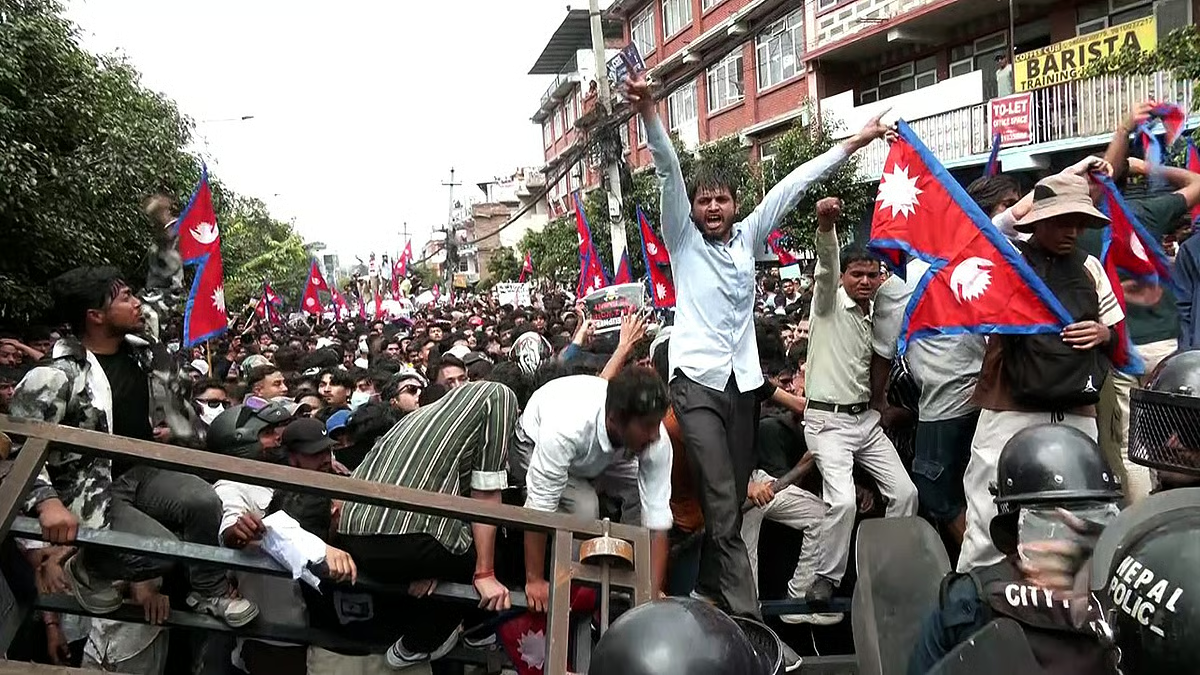
India has expressed deep concern over the spiraling unrest in neighboring Nepal, where violent protests have left at least 19 people dead and more than 300 injured in the capital Kathmandu and other parts of the country. New Delhi’s response, delivered through the Ministry of External Affairs (MEA), emphasized its sadness at the loss of young lives, extended condolences to grieving families, and underscored the importance of dialogue and peaceful resolution in the face of intensifying political turmoil. The statement comes as Nepal reels under widespread demonstrations, triggered by the government’s controversial decision to impose and then abruptly lift a ban on social media platforms, a move that has snowballed into a broader political crisis marked by mounting calls for Prime Minister KP Sharma Oli’s resignation.
India’s Measured Response and Regional Concerns
India’s official statement, issued on Tuesday, conveyed not only the government’s concern but also its sense of urgency about developments in Nepal, a country with which it shares deep cultural, historical, and geographical ties. “We are closely monitoring the developments in Nepal since yesterday and are deeply saddened by the loss of many young lives. Our thoughts and prayers are with families of the deceased. We also wish speedy recovery for those who were injured,” the MEA said, reflecting India’s measured yet compassionate tone.
The statement further stressed that India, as a close friend and neighbor of Nepal, hopes that “all concerned will exercise restraint and address any issues through peaceful means and dialogue.” By framing its message this way, New Delhi reaffirmed its longstanding approach of encouraging political stability and constructive engagement in Nepal while avoiding direct interference in its internal affairs.
The ministry also acknowledged the security restrictions being enforced in Kathmandu, where authorities reimposed a curfew following renewed clashes on Tuesday morning. Indian nationals in Nepal were advised to remain cautious, comply with local regulations, and avoid areas of unrest, signaling India’s awareness of the risks faced by its citizens abroad amid the volatile situation.
India’s concern goes beyond humanitarian sympathy, as political instability in Nepal has often had ripple effects on regional security and bilateral relations. Given the open border between the two countries, unrest in Nepal invariably spills over into trade, migration, and cross-border dynamics. For India, ensuring that Nepal navigates this crisis through dialogue rather than violence is a priority, especially at a time when broader regional geopolitics are already fraught with complexities.
Escalating Violence and Public Outrage in Nepal
While India’s statement highlights a diplomatic and humanitarian perspective, the reality on the ground in Nepal paints a grim picture of deepening political and social unrest. The protests that erupted on Monday quickly turned violent as demonstrators clashed with security forces in Kathmandu and the eastern city of Itahari. Local reports suggest that police and paramilitary forces opened fire on unarmed protesters, many of whom were students, marking the deadliest crackdown on civilian unrest in the country in recent years.
The immediate trigger for the unrest was Prime Minister KP Sharma Oli’s controversial decision to ban social media platforms, a move widely condemned as authoritarian and aimed at silencing dissent. The subsequent lifting of the ban failed to pacify the public. Instead, it fueled outrage, with demonstrators accusing KP Sharma Oli of eroding democratic freedoms and governing through repression. By Tuesday morning, protests had intensified once again, with demonstrators blocking major roads near Parliament and in Kalanki, forcing authorities to impose an indefinite curfew in the Ring Road area of Kathmandu just hours after lifting a previous one.
At least 19 people were reported dead by local media, with more than 300 others injured in the clashes. Hospitals in Kathmandu have struggled to cope with the influx of wounded protesters, and eyewitness accounts have described scenes of chaos and anguish as families search for missing relatives. Personal stories of tragedy have only amplified the anger directed at the government.
One particularly poignant testimony came from Madhav Sundar Khadga, a retired Nepal Army Colonel, who said his son went missing during the protests. Fighting back tears, he accused the government of brutal suppression. “I called him up three times, he did not receive the call. After 4 pm, the phone was switched off. I came to the police but they hit me. I want the President to dissolve this Government,” he told reporters. Such accounts have fueled public resentment, portraying the government not as a protector of its people but as a perpetrator of violence.
Students have been at the forefront of these demonstrations, echoing demands for KP Sharma Oli’s resignation. A young protester told ANI, “Yesterday, many students were killed and the Prime Minister of Nepal, KP Sharma Oli, should leave the nation. Students should continue to raise their voice.” This reflects a generational defiance, with youth activists unwilling to back down despite the government’s heavy-handed tactics.
Prime Minister KP Sharma Oli, addressing the nation late on Monday night, announced the withdrawal of the social media ban and promised several measures including the creation of an investigation panel, financial assistance for victims’ families, and free medical treatment for the injured. However, his assurances have largely fallen flat. Protesters view his response as reactive and insufficient, interpreting the crackdown as a symptom of deeper authoritarian tendencies within his administration. Calls for his resignation have only grown louder, with demonstrations showing no signs of abating.
The government, for its part, has attempted to frame the unrest as the result of infiltration by “vested interest groups,” a narrative that many Nepalis find unconvincing. Critics argue that the protests are a spontaneous expression of widespread disillusionment with a government accused of corruption, democratic backsliding, and failure to address citizens’ concerns.
The broader political crisis in Nepal is unfolding at a time when the country faces significant economic challenges, including inflation, unemployment, and post-pandemic recovery strains. Against this backdrop, the perception of a government attempting to stifle dissent has only deepened public frustration. For many, the protests are not just about the social media ban but about a broader crisis of governance and trust.
Growing Pressure on Prime Minister KP Sharma Oli
The turmoil has placed Prime Minister KP Sharma Oli in perhaps the most precarious position of his political career. Though he has weathered challenges before, the scale and intensity of the current protests suggest a tipping point. Opposition parties have seized the moment, aligning themselves with public outrage and demanding accountability from the government. The international community, while cautious in its responses, is increasingly concerned about the direction Nepal is taking under KP Sharma Oli’s leadership.
For KP Sharma Oli, the immediate challenge lies in quelling the unrest without further escalating violence. Yet his government’s reliance on force, combined with dismissive rhetoric about infiltrators, has alienated a significant portion of the population. The promises of investigation panels and compensation, while potentially meaningful in other contexts, appear hollow against the backdrop of mounting casualties and deep public anger.
India’s carefully worded response underscores the diplomatic stakes. While New Delhi avoids any direct call for regime change, its emphasis on restraint and dialogue is implicitly a call for KP Sharma Oli to change course. The Indian government’s decision to highlight the loss of “many young lives” resonates strongly with the images and accounts emerging from Nepal, signaling solidarity with the people without directly challenging the authority of the Nepalese government.
At the same time, India’s position reflects a delicate balancing act. Overt interference in Nepal’s domestic politics could backfire, fueling nationalist sentiments and complicating bilateral relations. Yet silence in the face of such turmoil would also be untenable, particularly given the cross-border implications. By urging dialogue, India positions itself as a responsible neighbor, while leaving space for Nepal’s internal political dynamics to play out.
As protests continue to spread and pressure mounts on KP Sharma Oli, Nepal’s future appears uncertain. What is clear, however, is that the unrest has laid bare the deep dissatisfaction among large sections of the population, particularly the youth. The government’s attempt to regulate digital spaces has backfired spectacularly, transforming into a broader struggle over democracy, governance, and accountability. For India and the wider region, the crisis in Nepal is not merely a domestic issue but a moment of reckoning for the fragile democratic fabric of South Asia.