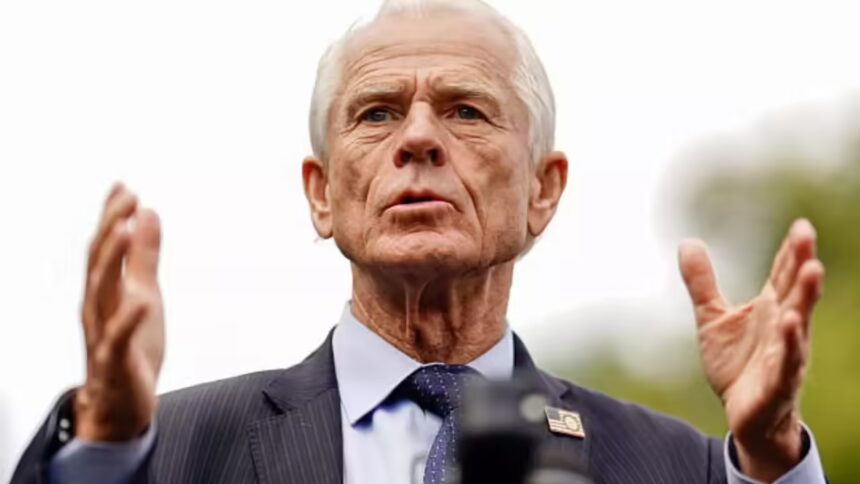
In a renewed escalation of rhetoric between Washington and New Delhi, White House trade advisor Peter Navarro has issued a blunt warning to India, saying the country must change course on tariffs and energy ties with Russia or risk facing grave consequences. Peter Navarro’s remarks come at a sensitive time, as President Donald Trump’s administration has doubled tariffs on Indian goods and amid growing strains over India’s expanding imports of Russian crude.
Peter Navarro Targets India Over Tariffs and Energy Choices
Speaking on the conservative news outlet Real America’s Voice, Peter Navarro launched into a stinging critique of New Delhi’s economic policies, accusing India of hiding behind what he described as the “Maharajah of tariffs.” He claimed that India maintains the highest tariff barriers among all major economies against American goods and warned that such practices are no longer tolerable for the United States.
“They have the highest tariffs in any major country in the world against the United States. We got to deal with that,” Peter Navarro said, emphasizing that Washington could no longer accept what he called an uneven playing field in bilateral trade. His comments reflect long-standing frustrations within the Donald Trump administration about India’s protectionist policies, which many US officials argue limit access for American products and services in the world’s fifth-largest economy.
The criticism did not stop with tariffs. Peter Navarro turned his attention to India’s growing energy partnership with Moscow, a development that has become a flashpoint in the broader geopolitical struggle triggered by Russia’s war in Ukraine. He accused India of moving from being a marginal buyer of Russian crude before the invasion to becoming a major beneficiary of discounted oil since 2022.
“India had bought only tiny drops of Russian oil before Moscow’s invasion of Ukraine,” Peter Navarro said, “but now it is profiteering off cheap Russian crude.” He added that American taxpayers are indirectly paying the price, since discounted Russian oil allows Moscow to redirect funds into sustaining its war machine. “American taxpayers end up having to send more money for the conflict,” he claimed, linking India’s energy decisions directly to global security concerns.
The trade advisor contrasted India’s stance with that of traditional US allies such as the European Union, Japan, South Korea, the Philippines, and Indonesia, all of whom he said had strengthened ties with Washington through trade and security cooperation. “I think India must come around at some point,” he warned. “And if it doesn’t, it’s laying down with Russia and China, and that won’t end well for India.”
Linking India’s Energy Policy to Global Security
Peter Navarro’s statements carried a strong strategic undertone, suggesting that India’s continued reliance on Russian energy imports undermines the West’s efforts to isolate Moscow economically. “India’s got to stop buying Russian oil. The road to peace partly runs through New Delhi,” he argued. By framing India’s actions as pivotal to global stability, Peter Navarro raised the stakes of the debate well beyond tariffs and bilateral trade negotiations.
The advisor insisted that Europe, too, must halt Russian energy purchases, portraying such imports as funding the continuation of the war. But his focus on India reflected Washington’s growing frustration that one of its closest emerging partners continues to balance ties between the West and Russia, even while deepening cooperation with the United States in defense and technology sectors.
Peter Navarro also revisited his long-running criticism of China, calling US trade diplomacy with Beijing little more than “Kabuki” theater that demanded unwavering trust in President Donald Trump. He noted that Washington has imposed tariffs of more than 50 percent on Chinese imports, a figure designed to signal toughness and resolve. But he implied that India’s current path risked placing it in the same category as Beijing—an economic competitor and geopolitical challenge.
This rhetorical framing underscores a recurring theme in Peter Navarro’s worldview: that trade cannot be separated from geopolitics, and that nations benefiting from access to American markets must align with US security interests. By drawing India into this argument, Peter Navarro suggested that New Delhi’s choices on tariffs and oil purchases could determine whether it is viewed in Washington as a trusted partner or as a rival aligned with Russia and China.
The sharpness of Peter Navarro’s language—describing India’s energy policy as “profiteering” and predicting that its current path “won’t end well”—reflects the Donald Trump administration’s growing impatience with New Delhi. It also illustrates how economic disputes over tariffs can quickly become entangled with larger questions of global power and security in the Donald Trump era.
Broader Criticism of BRICS and Escalating Tariff Tensions
Peter Navarro’s ire was not limited to India. In a separate interview, he directed harsh criticism at the BRICS bloc—an economic grouping that now counts 10 members after Indonesia’s entry in 2025. He dismissed the bloc’s credibility, alleging that its members’ economic models are deeply dependent on exports to the United States.
“When they sell to the US, their exports are like vampires sucking our blood dry with their unfair trade practices,” Peter Navarro charged. His use of the “vampire” analogy is not new; earlier this year he warned Britain that if China could not “suck the American blood,” it would turn to other major economies such as the United Kingdom and the European Union instead. The imagery reflects Peter Navarro’s view that the United States is being exploited by trade partners who benefit disproportionately from access to the American consumer market.
In his assessment, BRICS lacks cohesion, unity, or the capacity to survive without its economic ties to Washington. He claimed the grouping’s members “historically hate each other and kill each other” and predicted that the bloc would eventually collapse without US trade. Such remarks underscored Peter Navarro’s skepticism toward emerging economic coalitions that position themselves as counterweights to the West.
At the same time, Peter Navarro’s sharp rhetoric about India landed against the backdrop of new tariffs imposed by President Donald Trump. On August 27, the administration implemented additional duties of 25 percent on Indian imports, effectively doubling the tariff burden to 50 percent. The White House framed this move explicitly as punishment for India’s growing energy relationship with Moscow, sending a clear signal that Washington’s patience was wearing thin.
Bilateral negotiations on a broader trade agreement remain stalled, with little progress visible on contentious issues such as market access, intellectual property rights, and digital trade regulations. Peter Navarro’s comments, therefore, not only reflect frustration but also serve as a public warning that Washington may escalate economic pressure further if India does not shift course.
Pushback and Online Controversy
Peter Navarro’s rhetoric has also sparked significant backlash outside formal diplomatic circles. A recent post in which he accused India of buying Russian oil purely for profit and “feeding the Russia war machine” was flagged by X’s community notes feature for lacking context. The incident triggered a heated online exchange between Peter Navarro and tech billionaire Elon Musk, who defended the platform’s fact-checking system.
“On this platform, the people decide the narrative. Community Notes corrects everyone, no exceptions,” Elon Musk posted, underscoring the importance of crowd-sourced accountability in shaping online discourse. The spat highlighted how Peter Navarro’s combative style has drawn criticism not just from foreign governments but also from influential voices within the United States.
This online pushback mirrors broader skepticism about Peter Navarro’s approach to trade and diplomacy, which critics often describe as confrontational and overly simplistic. Yet his influence within the Donald Trump administration remains significant, particularly in shaping policies that link economic decisions with broader strategic concerns. His remarks on India, therefore, are not merely rhetorical flourishes but signals of potential policy directions.
In many ways, Peter Navarro’s framing of India as both a critical partner and a potential adversary reflects the delicate balancing act facing the United States. While Washington values New Delhi as a counterweight to China and as a key partner in the Indo-Pacific, growing tensions over trade and Russia complicate the relationship. Peter Navarro’s blunt warnings encapsulate the difficulties of reconciling economic grievances with geopolitical imperatives in a rapidly shifting global order.