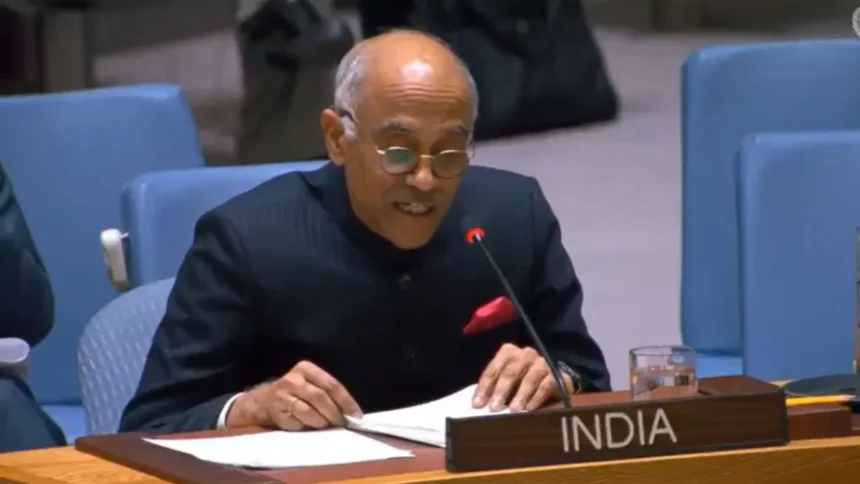
In a strong and unprecedented address to the United Nations Security Council on the occasion of the 80th UN Day, India’s Permanent Representative to the UN, Parvathaneni Harish, delivered a powerful statement calling upon Pakistan to immediately end the “grave and ongoing human rights violations” in the areas illegally occupied by it. Speaking during an open debate organized to mark the United Nations Day, Ambassador Harish emphasized that Jammu and Kashmir is, and will always remain, an “integral and inalienable part of India.” The address highlighted India’s unwavering commitment to upholding the rights and dignity of the people of Jammu and Kashmir while simultaneously asserting India’s firm stance on Pakistan’s continued occupation and exploitation in the region. Harish’s remarks drew attention not only to the human rights abuses perpetrated by Pakistan but also underscored India’s vision of multilateralism, justice, and international cooperation as essential pillars for global peace and security.
India’s Firm Stand Against Pakistan’s Violations and Illegitimate Occupation
During his address, Ambassador Harish strongly condemned Pakistan’s military presence and oppressive measures in the regions under its illegal control. He explicitly stated that Pakistan must end the “grave and ongoing human rights violations,” highlighting the suffering of the local population who are reportedly subjected to brutal repression, arbitrary detentions, and systemic exploitation of resources. Harish pointed out that the people living in the occupied territories are in open revolt against Pakistan’s oppressive rule, asserting that their struggle reflects a collective yearning for dignity, freedom, and justice. He further emphasized that while citizens in Jammu and Kashmir exercise their fundamental rights in accordance with India’s constitutional framework and democratic traditions, such values are considered “alien” by Pakistan. The Indian ambassador’s comments presented a detailed account of how the population under Pakistan’s control faces continuous military harassment, economic exploitation, and denial of basic human freedoms, reinforcing India’s position that Pakistan’s occupation is both illegal and illegitimate under international law.
Harish’s address also highlighted the importance of holding Pakistan accountable on international platforms like the United Nations, stressing that continued silence or inaction would perpetuate the suffering of millions. He elaborated on how the global community has the responsibility to uphold justice and protect human rights in conflict zones, and that Pakistan’s consistent violations undermine the principles of international law and the United Nations’ charter. By addressing the UNSC, India sought to draw attention to the broader consequences of Pakistan’s actions, including regional instability, humanitarian crises, and the erosion of peace prospects. The ambassador also reiterated that Jammu and Kashmir’s status is indisputable, firmly integrated within the sovereign territory of India, and that any attempts to challenge this reality are inconsistent with both historical facts and contemporary international norms.
Commitment to Multilateralism, Justice, and Global Cooperation
In addition to addressing Pakistan’s violations, Ambassador Harish used the platform to reaffirm India’s broader worldview and commitment to global cooperation. He invoked the principle of Vasudhaiva Kutumbakam, the vision of the world as one family, to articulate India’s dedication to promoting justice, dignity, prosperity, and opportunity for all peoples and societies. Harish underscored that India’s stance on Jammu and Kashmir, human rights, and multilateral engagement is deeply rooted in its belief in international partnerships, collaboration, and the rule of law. By stressing the importance of multilateral institutions such as the United Nations, he highlighted the need for collective responsibility in addressing conflicts, human rights abuses, and violations of sovereignty across the world. The ambassador also emphasized that India’s approach is guided by principles of transparency, fairness, and sustained engagement with global institutions to advance peace and stability.
Addressing the relevance of the United Nations in the contemporary geopolitical landscape, Ambassador Harish noted that the UN continues to face scrutiny regarding its legitimacy, credibility, and efficacy. He remarked that while the organization has made invaluable contributions since World War II, questions about its ability to effectively mediate conflicts, enforce human rights norms, and maintain global order remain. By connecting India’s concerns regarding Pakistan to broader discussions on UN effectiveness, Harish framed the issue as not only a bilateral dispute but also a matter of international law, justice, and accountability. He emphasized that the UN, as the world’s largest multilateral institution, has both the authority and responsibility to address illegal occupations, human rights violations, and systemic repression, setting a global precedent for upholding the rights of oppressed populations.
Through his address, Harish also underscored India’s commitment to maintaining peace and stability in South Asia while defending its territorial sovereignty. He conveyed that India seeks dialogue and cooperation wherever possible, but remains resolute in asserting that its integral territories, including Jammu and Kashmir, are non-negotiable and cannot be compromised under any circumstances. Highlighting India’s adherence to democratic norms, the ambassador contrasted India’s commitment to upholding fundamental rights and civil liberties with Pakistan’s record of oppression in the occupied regions. This juxtaposition was intended to reinforce India’s position as a responsible global actor committed to justice, human rights, and rule-based international order.
Furthermore, Ambassador Harish’s speech detailed India’s proactive approach in international diplomacy to safeguard its national interests while promoting global norms. He argued that India’s engagement with the United Nations, multilateral forums, and bilateral partnerships is guided by the principles of fairness, ethical responsibility, and constructive collaboration. The address also emphasized the importance of accountability, not only in regional disputes like Jammu and Kashmir but also in ensuring that countries violating international law are held responsible for their actions. By addressing the UNSC directly, India sought to mobilize international awareness and support, calling upon member nations to recognize the illegitimacy of Pakistan’s occupation and to advocate for the protection of human rights in the region.
In his concluding remarks at the open debate, Ambassador Harish reiterated India’s long-standing commitment to multilateralism, justice, and global peace. He stressed that India continues to believe in the potential of international cooperation to address conflicts, promote sustainable development, and ensure the protection of human rights worldwide. By highlighting both Pakistan’s ongoing violations and India’s principled approach to diplomacy, Harish positioned India as a responsible global actor that seeks solutions grounded in law, ethics, and cooperative engagement. He further asserted that Jammu and Kashmir’s status as an inalienable part of India is non-negotiable, reflecting centuries of historical, legal, and constitutional affirmation.
The address by India at the UNSC during the 80th UN Day debate served as a reminder to the international community of Pakistan’s continuous violations, while also emphasizing India’s proactive, principled, and multilateral approach to safeguarding human rights, territorial integrity, and global stability. Harish’s speech underlined that the principles of justice, dignity, and cooperation are not merely aspirational but actionable imperatives that guide India’s diplomatic conduct. By framing the discussion within the broader context of UN relevance, human rights, and global governance, India effectively used the platform to assert its sovereignty, call out illegitimate occupations, and advocate for an international system grounded in fairness, accountability, and collective responsibility.
India’s representation at the UNSC highlighted the complex interplay between regional territorial disputes, human rights advocacy, and global diplomatic engagement. Ambassador Harish’s address offered a detailed narrative on the ongoing violations in Pakistan-occupied regions, juxtaposed with India’s commitment to democracy, human rights, and multilateral engagement. By emphasizing both accountability and collaboration, India conveyed its expectations that the international community recognize the urgency of addressing human rights abuses, support territorial sovereignty, and uphold the principles of justice and fairness in global governance.
The address further underlined that India’s proactive participation in multilateral forums is guided by ethical responsibility and strategic foresight. Harish highlighted that India’s advocacy is not limited to territorial disputes but extends to promoting global justice, equitable development, and respect for human dignity. By reinforcing these principles at the UNSC, India positioned itself as a leader in responsible global governance, committed to defending human rights and ensuring the rule of law prevails across the international system.
By combining the narratives of human rights violations, illegal occupation, and multilateral engagement, India presented a comprehensive and persuasive case against Pakistan’s actions while simultaneously reinforcing its own principles of justice, democracy, and international cooperation. The address at the United Nations Security Council served as a reaffirmation of India’s long-standing position on Jammu and Kashmir, while also situating the issue within the broader framework of global governance, accountability, and the protection of human rights.
Overall, Ambassador Harish’s address at the UNSC Open Debate provided a platform to assert India’s sovereignty, highlight Pakistan’s ongoing human rights abuses, and reinforce the principles of multilateralism, justice, and cooperation as central tenets of India’s foreign policy. By situating Jammu and Kashmir’s status within historical, constitutional, and legal contexts, India sent a clear message that its territorial integrity is non-negotiable. The address also reflected India’s broader commitment to advocating for human rights, engaging constructively with multilateral institutions, and promoting a global order based on fairness, accountability, and cooperation.
The speech marked a significant moment in India’s diplomacy at the United Nations, combining assertiveness on national sovereignty with principled advocacy for justice and human rights. By highlighting the contrast between India’s democratic values and Pakistan’s oppressive practices, Ambassador Harish successfully leveraged the UNSC platform to underscore India’s position on Jammu and Kashmir and to call for international attention to ongoing human rights violations in Pakistan-occupied territories.