India reaffirmed its strong commitment to climate justice and equitable global cooperation during the COP30 meeting, emphasizing that developed countries must enhance financial support for developing nations, leave carbon space for them, and honor their obligations under the UN Climate Convention. At the same time, India cautioned that unilateral trade measures and selective climate actions could undermine the spirit of multilateralism that forms the foundation of global climate negotiations.
Representatives from India delivered two key interventions at the conference — one on behalf of the Like-Minded Developing Countries (LMDC), representing over half the world’s population, and another on behalf of the BASIC bloc, which includes Brazil, South Africa, India, and China. Both statements underscored the urgency of financial assistance, equitable carbon distribution, and a just transition for developing countries, as the world approaches the tenth anniversary of the Paris Agreement.
Suman Chandra, Director at the Ministry of New and Renewable Energy, represented India and the LMDC group, articulating that the needs of developing nations must be central to the global climate dialogue. She noted that while multilateralism is celebrated, it faces serious threats from unilateral and trade-restrictive measures that could deepen inequality. “This is the most opportune moment to meaningfully discuss climate change, related trade restrictive unilateral measures, and how they impact our countries,” she said.
Chandra highlighted that India had proposed an agenda item on Article 9.1 of the Paris Agreement, which mandates developed nations to provide financial resources to assist developing countries. She emphasized that this commitment was not optional but foundational to the Paris framework. According to her, in the “era of implementation,” financial needs have become some of the most significant deterrents to progress in the developing world.
India’s Call for Equitable Finance and Carbon Space
Chandra reminded the global community that it has been ten years since the Paris Agreement and thirty-three years since the UN Framework Convention on Climate Change (UNFCCC) was adopted. “The fact that all of us are gathered here is a testament to our commitment to multilateralism and international cooperation,” she said, while urging that the Paris Agreement’s architecture must not be altered under the pretext of marking its anniversary.
She further asserted that the world must remain committed to the principles of equity and common but differentiated responsibilities (CBDR), which recognize that while all nations must act on climate change, their capacities and historical responsibilities differ. “We must reaffirm our strongest commitment to these principles here, not attempt to sideline or ignore them,” she said.
The Indian representative expressed grave concern about the widening adaptation finance gap, warning that the needs of developing countries already exceed nearly fifteen times the existing financial flows. She said that the international community has failed to deliver on the promise of doubling adaptation finance by 2025, calling the existing funds “a meager sum to begin with.”
“The adaptation finance needs are ever increasing, and a huge adaptation finance gap stares us in the face,” she said, noting that reports indicate that even the current flows are far below what is required to meet the adaptation challenges faced by developing nations.
India reiterated that the negotiations must be guided by the principle of Common But Differentiated Responsibilities and Respective Capabilities (CBDR-RC), stressing that climate finance, technology transfer, and capacity building must be at the heart of the implementation process. “The means of implementation indicators must reflect the progress of finance, technology transfer, and capacity building provided by developed countries to developing countries in line with Articles 9, 10, and 11 of the Paris Agreement,” Chandra said.
She also addressed the issue of a just transition, emphasizing the need for institutional arrangements that integrate the principles of equity and justice in global climate action. According to her, a just transition must not only focus on the energy sector but encompass the “whole of economy and whole of society” approach, ensuring that no community or nation is left behind.
India also expressed hope for the launch of the Technology Implementation Programme, which it sees as a crucial catalyst to drive ambitious climate goals. “We look forward to the launch of the Technology Implementation Programme as a key catalyst to drive ambitious means of implementation to developing countries,” Chandra said, stressing that such initiatives should help developing nations overcome barriers to technology transfer and achieve their nationally determined contributions (NDCs).
She concluded India’s intervention with a firm appeal to global unity and honesty in tackling climate challenges: “Since this is a COP for the truth, let us affirm the truth. We are not here to point fingers, but the facts speak for themselves. We cannot simply bypass the roadblocks and impediments to implementation. Let us address them meaningfully and collectively.”
BASIC Bloc Stresses Early Net Zero, Clear Definition of Climate Finance
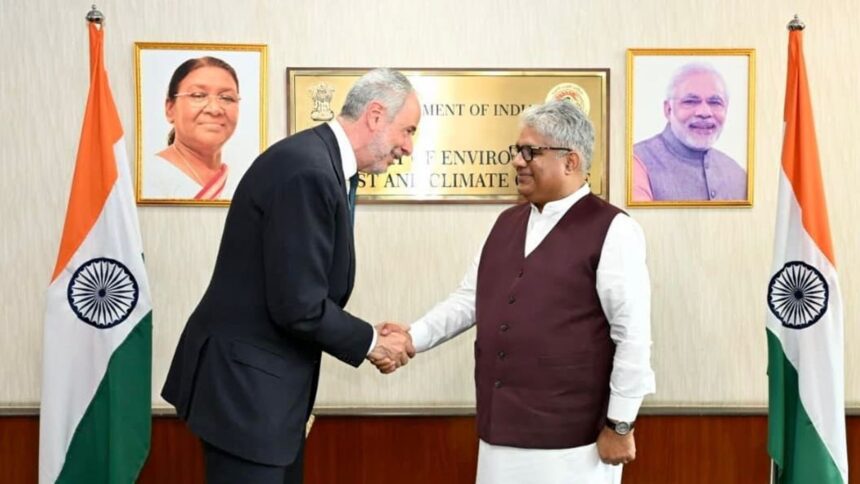
Representing the BASIC group — Brazil, South Africa, India, and China — India’s second intervention further amplified the collective concerns of major developing economies. Tanmay Kumar, Secretary at the Ministry of Environment, Forest and Climate Change, said that the developed world must reach net zero emissions much earlier than currently projected if the world is to maintain any realistic chance of limiting global warming and preserving carbon space for developing nations.
Kumar emphasized that COP30, to be held a decade after the signing of the Paris Agreement, should be a “COP of adaptation,” focusing primarily on the needs of the most vulnerable nations and populations. “Adaptation is the most pressing necessity for regions most vulnerable worldwide. The majority of them have contributed the least to global warming but will suffer the most from its impacts,” he said, stressing that adaptation measures must be given as much importance as mitigation.
He called for a minimum package of indicators under the UAE–Belém Work Programme to ensure tangible progress on global adaptation goals. “COP30 needs to deliver a strong outcome on global adaptation, and we should all agree on a minimum package of indicators, while demonstrating flexibility for further technical discussions as needed,” Kumar said.
The Indian official reiterated that climate finance must be clearly defined under the UNFCCC and the Paris Agreement. He pointed out that the lack of a universal definition has created confusion, double counting, and underreporting of financial flows from developed to developing nations. “There is an urgent need for a clear, transparent, and universally agreed definition of climate finance to ensure predictability, accessibility, and trust in finance to grow,” he said, adding that such clarity is essential for scaling and accelerating climate funding.
He criticized the inadequacy of current climate finance commitments, calling them insufficient and far below the real needs of the developing world. “Developed countries need to reach net zero much earlier than projected, release the remaining carbon space in favour of developing countries, invest significantly more in negative emission technologies, and fulfil their obligations under the convention,” Kumar said.
He noted that while the completion of the Global Stocktake (GST) at COP28 was a positive step, it should not be used as an excuse to reopen the Paris Agreement’s framework. “The Paris Agreement’s architecture should not be revisited. Revising and updating the NDCs as informed by the first GST is left to parties in accordance with the Paris Agreement,” he stated.
Kumar also stressed that the Just Transition Work Programme (JTWP) should be seen as a vehicle for strengthening the implementation of equity and justice in both mitigation and adaptation measures. He said that it should encompass a “whole of economy” and “whole of society” approach to ensure that transitions are fair, inclusive, and sustainable for all.
India’s interventions, representing both LMDC and BASIC, also echoed findings from recent research. A study by the Council on Energy, Environment and Water (CEEW) highlighted that if the world’s wealthiest economies contributed just 0.08% of their GDP to the Fund for Responding to Loss and Damage, it could unlock USD 60 billion annually — a 75-fold increase from current pledges of roughly USD 800 million. Though still below the USD 400 billion per year sought by developing countries, such contributions would represent 15% of the required finance, compared to the mere 0.2% currently mobilized.
Throughout the COP30 deliberations, India’s voice remained firm in defending the principles of fairness, responsibility, and collective progress. Its interventions called for stronger multilateral cooperation, respect for the foundational tenets of the Paris Agreement, and an urgent scaling up of climate finance, adaptation efforts, and technology transfers. India made it clear that the world cannot achieve climate justice or sustainable progress without an equitable global framework — one that empowers developing nations rather than constraining them through restrictive measures and insufficient financial commitments.