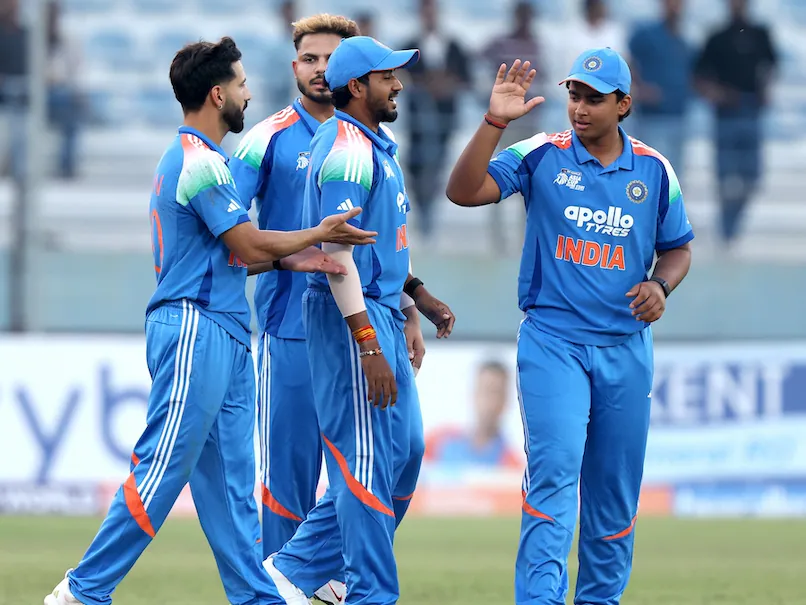
India’s Under-19 team delivered a commanding performance against Pakistan in the 2025 Under-19 Asia Cup, sealing a thumping 90-run victory in Dubai, even as attention shifted to the absence of post-match handshakes despite the ICC’s efforts to encourage sporting gestures between the two sides.
The high-voltage group-stage encounter between India and Pakistan at the Under-19 Asia Cup 2025 lived up to its billing in intensity, drama, and scrutiny. While India’s young cricketers produced a clinical all-round display to outclass their traditional rivals by a wide margin, the contest was overshadowed by the continuation of a symbolic deadlock off the field. Once the match concluded, players from both teams walked off without exchanging handshakes, ignoring reported suggestions from the ICC aimed at reinforcing sportsmanship. The result strengthened India’s position at the top of the group and underlined the depth of talent in their youth system, but the lack of post-match interaction once again highlighted the strained sporting relationship between the two nations.
India’s dominance was built on discipline, patience, and bursts of aggression at the right moments. Batting first after Pakistan won the toss and elected to bowl, the Indian colts posted a competitive total of 240 before being bowled out. The score, while not overwhelming on paper, proved far beyond Pakistan’s reach due to India’s incisive bowling and sharp fielding. The eventual margin of victory reflected India’s control throughout the match rather than a single phase of brilliance.
India’s Batting Effort and Chouhan’s Crucial All-Round Impact
India’s innings began under slightly testing conditions, with the toss delayed earlier due to rain and the surface offering some assistance to the bowlers. Pakistan’s decision to bowl first was aimed at exploiting early movement, and their bowlers did manage to apply pressure during the initial overs. Early wickets meant India could not fully capitalise on the powerplay, and there were moments when Pakistan looked capable of restricting the run flow significantly.
However, India’s top and middle order showed maturity beyond their years. Aaron George emerged as the standout batter, anchoring the innings with a well-constructed 85. His knock combined composure with selective aggression, ensuring that India did not lose momentum despite wickets falling at the other end. George absorbed pressure effectively, surviving testing spells and gradually expanding his range of shots as the innings progressed. His ability to rotate strike and find the boundary after long dry spells proved crucial in stabilising the innings.
Support came in phases from several batters. Vihaan Malhotra and Ayush Mhatre contributed valuable runs, even if they were unable to convert their starts into big scores. The innings faced another wobble when wickets fell in quick succession around the middle overs, briefly tilting the balance in Pakistan’s favour. At one point, India were 167 for four after 30 overs, with Pakistan sensing an opportunity to restrict them to a below-par total.
That momentum was halted decisively by Kanishk Chouhan, whose contribution at the death transformed India’s innings. Chouhan played a vital knock of 46, accelerating in the final overs to push India past the 230 mark. His clean striking, particularly against the spinners, allowed India to regain control after a period of stagnation. The finishing touch was further enhanced by late contributions from the lower order, including a six from Henil Patel, which ensured Pakistan’s bowlers could not completely dominate the closing stages.
Despite Pakistan’s efforts, India were eventually bowled out for 240, a total that looked competitive rather than imposing. Yet, given the pressure of an India-Pakistan encounter and the quality of India’s bowling attack, it was always going to demand a special chase from Pakistan.
India’s bowling performance soon made it clear that 240 was more than sufficient. From the opening overs, the Indian bowlers displayed accuracy, variation, and intensity. Deepesh Devendran was the pick of the attack, producing a sensational opening spell that dismantled Pakistan’s top order. His ability to extract movement and bounce unsettled the batters, and his early breakthroughs set the tone for the innings. Devendran finished with three wickets in his first spell, leaving Pakistan struggling to build any momentum.
Pakistan’s chase never truly settled. Although they reached 21 without loss after seven overs, the pressure mounted quickly as Devendran struck twice in rapid succession. India’s fielders added to Pakistan’s woes with sharp catching and relentless energy, ensuring that every single run was hard-earned. A brief controversy arose when India thought they had a wicket, only for the umpires to rule otherwise, but the decision did little to alter the overall direction of the game.
The middle overs saw Pakistan attempt to rebuild, but wickets continued to fall at regular intervals. Vaibhav Suryavanshi, who had a relatively quiet outing with the bat, made a significant impact with the ball and in the field. He picked up a crucial wicket, removing the Pakistani captain Yousaf, and later took an outstanding running catch to dismiss Huzaifa Ahsan, effectively sealing the match. His contribution highlighted the all-round strength of the Indian side, where even players not starring in one discipline found ways to influence the game.
Huzaifa Ahsan was the lone bright spot for Pakistan, showing resilience and skill in a difficult chase. His half-century offered a glimmer of hope, and for a brief period, he threatened to make the contest interesting. However, with wickets tumbling at the other end and the required run rate climbing steadily, his efforts were ultimately in vain. Once Ahsan was dismissed for 70, caught brilliantly by Suryavanshi off Chouhan’s bowling, the outcome was beyond doubt.
Chouhan’s influence with the ball completed a memorable all-round performance. After contributing crucial runs with the bat, he returned to take three wickets, exploiting Pakistan’s desperation to accelerate. His spell ensured that Pakistan never mounted a late surge, and the Indian bowlers wrapped up the innings efficiently. Pakistan were eventually bowled out well short of the target, handing India a comprehensive 90-run victory.
Handshake Absence and What It Says About the Rivalry
While India’s performance earned widespread praise, much of the post-match discussion revolved around what did not happen rather than what did. As the final wicket fell and India celebrated a significant group-stage win, cameras and spectators waited to see whether players from both sides would line up for the customary handshakes. Reports ahead of the match had suggested that the ICC was keen on encouraging the two teams to exchange handshakes as a gesture of sportsmanship, particularly at the junior level.
That moment never came. Players from India and Pakistan walked off separately, maintaining the status quo that has defined recent encounters between the two nations across age groups. The absence of handshakes was not accompanied by any on-field confrontation or visible hostility, but its symbolism was unmistakable. For many observers, it served as a reminder that political and diplomatic tensions continue to spill into sporting spaces, even at the youth level.
From a cricketing perspective, India could hardly have asked for a better result. The emphatic victory not only boosted their net run rate but also reinforced their status as strong favourites to top the group. The team showed balance in all departments, with contributions spread across batting, bowling, and fielding. Captain Ayush Mhatre, who was keen to bounce back after a disappointing previous outing, led a disciplined side that executed plans effectively against a familiar opponent.
For Pakistan, the defeat was a sobering one. After an earlier dominant performance in the tournament, including bowling out Malaysia for just 48, expectations were higher. However, the inability to cope with sustained pressure, particularly against quality pace and disciplined spin, exposed areas that will need urgent attention if they are to remain competitive in the tournament.
The match also reinforced the importance of depth and adaptability at the Under-19 level. India’s ability to recover from mini collapses, both with the bat and ball, reflected a system that prepares players for high-pressure situations. Pakistan, on the other hand, struggled to find similar resilience once momentum shifted decisively in India’s favour.
As the Under-19 Asia Cup progresses, India will carry forward confidence, momentum, and a strengthened position in the standings. Yet, the continued absence of basic post-match courtesies ensures that every India-Pakistan encounter remains about more than just cricket. Even among teenagers, the rivalry carries layers of history, emotion, and unresolved tension that go beyond the boundary ropes.