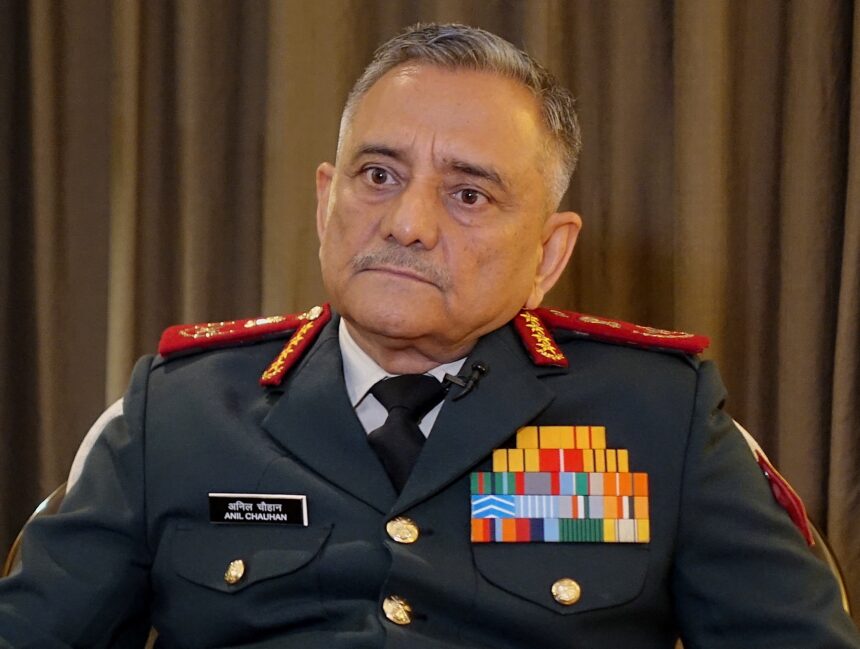
Chief of Defence Staff (CDS) General Anil Chauhan has confirmed that the Indian armed forces will soon disclose detailed data on the damage inflicted on Pakistan during the recent Operation Sindoor. Speaking candidly at an event in Pune, he revealed that an assessment is underway to quantify the Pakistani aircraft and radar systems destroyed during the military operation, which was India’s response to the Pahalgam terror attack on April 22. Chauhan emphasized that results, not casualties, define success in modern warfare—drawing a cricket analogy to illustrate India’s decisive edge.
CDS: ‘We’ll Reveal Strikes on Pakistani Aircraft and Radars’
Chauhan explained that the Indian response to the terror strike was calibrated and strategic, blending kinetic and non-kinetic actions. He refrained from commenting on Indian losses, stating, “It’s like winning a Test match by an innings — the focus is on the result, not how many wickets or runs.” He added that technical parameters are being used to make a “rough but reliable” estimate of the damage done to Pakistan’s military infrastructure, and that figures will be made public soon.
The CDS described Operation Sindoor, conducted between May 7 and May 10, as a new-age war model — largely contactless, except for engagements along the Line of Control. It was a deliberate departure from conventional conflict, aimed at neutralizing terror bases and key assets without ground escalation. According to him, Pakistan had planned to force India into submission within 48 hours, but Indian precision strikes turned the tide swiftly, forcing Pakistan to call for a ceasefire.
Pakistan’s Push Backfires, Ceasefire Follows Rapid Indian Offensive
Chauhan said that by 1 am on May 10, Pakistan had escalated attacks across multiple fronts, expecting India to crumble under pressure. But India responded with strategic airstrikes that caused significant destruction at several Pakistani air force bases. Particularly noteworthy was India’s use of BrahMos missiles to hit deep enemy targets, reportedly taking out 11 airbases.
Pakistan’s ballistic missile response was neutralized mid-air by Indian air defence systems, further tipping the scale. Eventually, it was Pakistan’s Director General of Military Operations (DGMO) who reached out to his Indian counterpart, requesting an immediate ceasefire — a move that indicated how swiftly India’s counter-strike had dismantled Pakistan’s military push.
General Chauhan confirmed that India agreed to the ceasefire after reaching an “understanding,” effectively concluding one of the shortest but most impactful military confrontations in recent years.