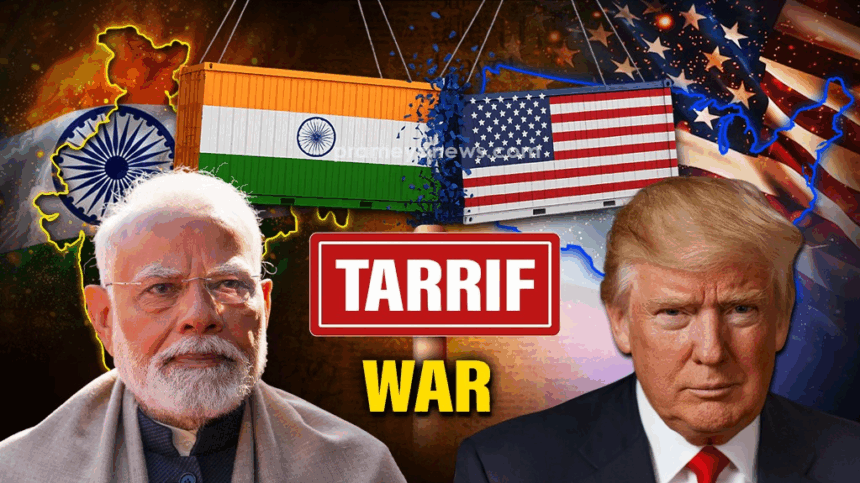
The escalating trade standoff between Washington and New Delhi has entered a decisive phase, with US President Donald Trump preparing to impose a sweeping 50 percent tariff on Indian products. The move, framed by the Donald Trump administration as part of its broader strategy to pressure Moscow over the Ukraine war, has sparked a strong political and economic response from India. Prime Minister Narendra Modi, addressing citizens in Gujarat, vowed that India would not compromise on the interests of its farmers, small industries, and domestic producers, even as tariff deadlines loom and US officials broaden threats against multiple nations over digital taxes and technology regulations. The impending tariff escalation marks a turning point in Indo-US economic relations, highlighting the collision of global geopolitics, trade disputes, and domestic political agendas on both sides.
Donald Trump’s Tariff Gambit and Washington’s Global Strategy
The Donald Trump administration’s announcement of a draft notice doubling existing tariffs from 25 to 50 percent on Indian goods sent a shockwave through economic circles in both countries. Published by the Department of Homeland Security, the notice makes clear that the new rates will apply to all Indian products “entered for consumption” beginning at 12:01 a.m. Eastern Daylight Time on August 27, 2025. The justification, White House officials insist, is India’s continued purchase of Russian crude oil, a practice Washington views as undermining its sanctions campaign designed to weaken Moscow’s war economy.
President Donald Trump, who has consistently portrayed tariffs as more than an economic tool, defended the move in his characteristic style. “That’s going to be up to them. It takes two to tango, I always say, and they should meet,” he remarked when asked about the ongoing stalemate between Russian President Vladimir Putin and Ukrainian President Volodymyr Zelensky. Donald Trump has long claimed that tariffs serve as levers of both diplomacy and deterrence, going so far as to argue that “of the seven wars I stopped, four were because I had tariffs and trade.” Such rhetoric underlines his belief that economic pressure, rather than military engagement, is the key to shaping global outcomes.
Vice President JD Vance has echoed this approach, noting in interviews that India’s inclusion in secondary sanctions is not accidental but part of a larger push to weaken Moscow’s ability to fund its military operations. “We are applying aggressive economic leverage against Russia,” Vance told NBC’s Meet the Press, while leaving open the possibility of either intensifying or easing the pressure depending on developments on the battlefield. For Washington, India’s energy ties with Russia represent a loophole in the sanctions framework, and Donald Trump’s tariff policy is aimed at forcing New Delhi to reconsider its options.
Beyond Russia, however, the Donald Trump administration has expanded its scope of economic confrontation to other parts of the world. On his social media platform Truth Social, Donald Trump accused European countries and others of imposing discriminatory digital service taxes and technology regulations. He warned of “substantial additional tariffs” and restrictions on exports of US chips and advanced technology unless such measures were rolled back. Though he did not directly name the European Union or the United Kingdom, his words clearly targeted the EU’s Digital Markets Act and the UK’s proposed digital services tax. Canada has already experienced Washington’s retaliatory stance, with Donald Trump canceling trade talks after Ottawa announced a similar tax on American multinational companies. Canada later rescinded its plan, illustrating the effectiveness of Donald Trump’s tariff threats in some cases.
Since returning to the presidency in January 2025, Donald Trump has adopted an aggressive trade agenda reminiscent of his first term, applying tariffs not only on traditional rivals such as China but also on close allies like Canada, the UK, and members of the European Union. His justification remains the same: American workers and companies, particularly in the technology sector, should not be treated as “the piggy bank” or “the doormat” of the world. By escalating tariffs on India, he has extended this philosophy into South Asia, linking trade disputes with geopolitical calculations in the most overt manner to date.
For the global economy, the consequences are serious. India is the world’s fifth-largest economy and a critical market for American exporters. A sudden spike in tariffs could disrupt trade flows worth tens of billions of dollars annually, from textiles and agricultural goods to technology components. US companies with supply chains linked to India may face cost increases, while Indian exporters fear loss of competitiveness in one of their largest markets. Analysts warn that the dispute could also derail ongoing negotiations on digital trade, investment protections, and intellectual property cooperation between the two democracies.
PM Modi’s Defiance and India’s Push for Strategic Autonomy
In Ahmedabad, Prime Minister Narendra Modi addressed the looming crisis in unmistakable terms. Standing before a gathering at the inauguration of development projects, he declared that India would withstand all external pressure. “For PM Modi, interests of farmers, cattle rearers and small-scale industries are paramount. Pressure on us may increase, but we will bear it all,” he said. His words signaled a blend of defiance and reassurance, intended both for domestic audiences anxious about economic fallout and for international observers measuring India’s strategic resolve.
PM Modi also sharpened his political attack on the Congress Party, accusing it of creating a culture of dependency on imports to facilitate corruption and scams. By contrast, he positioned his government’s policies as rooted in self-reliance, drawing on the legacy of both Mahatma Gandhi and Lord Krishna. “India is empowered by walking on the path of Sudarshan Chakradhari Mohan Lord Shrikrishna and Charkhadhari Mohan Mahatma Gandhi,” PM Modi declared, fusing religious symbolism with nationalist rhetoric to reinforce the message of resilience.
The emphasis on swadeshi, or indigenous goods, is not merely rhetorical. Over the past decade, PM Modi has consistently promoted schemes such as “Make in India,” “Atmanirbhar Bharat,” and production-linked incentives to encourage domestic manufacturing and reduce reliance on imports. In the face of Donald Trump’s tariffs, this policy framework provides a narrative of strength: India will not only resist economic coercion but also use the challenge as an opportunity to deepen self-sufficiency.
India’s defiance is also rooted in its broader strategic calculus. New Delhi has repeatedly defended its decision to continue importing discounted Russian crude, arguing that affordable energy is a necessity for sustaining growth and stability in a country of 1.4 billion people. Officials point out that Europe itself relied heavily on Russian gas until the Ukraine war forced a pivot, and that expecting India to abruptly cut ties without viable alternatives is unrealistic. For PM Modi’s government, accepting Washington’s demands would mean jeopardizing economic stability and energy security at a time when inflationary pressures already weigh on household budgets.
At the same time, India has expanded its outreach to both Moscow and Beijing, signaling that it will not allow external powers to dictate its energy or foreign policy choices. Recent meetings between Indian and Russian officials have explored avenues for deeper cooperation in energy, defense, and infrastructure, while India has also engaged China in regional forums despite ongoing border tensions. Such moves reflect India’s longstanding commitment to strategic autonomy, a policy that resists alignment with any single bloc and prioritizes independent decision-making.
For PM Modi, the confrontation with Donald Trump offers both risks and opportunities. Economically, a 50 percent tariff could harm export sectors employing millions of workers, from textiles to gems and jewelry. Politically, however, standing firm against American pressure allows him to project strength ahead of domestic elections and reinforce his image as a leader who safeguards national interests. By invoking Gandhi and Krishna in the same breath, PM Modi ties India’s economic struggle to both moral and cultural legacies, framing resistance not just as policy but as duty.
The unfolding drama also exposes the fragility of the Indo-US partnership, often celebrated as a defining relationship of the 21st century. While defense cooperation, technology sharing, and diplomatic alignment on Indo-Pacific security have strengthened ties, trade disputes reveal enduring fault lines. For Donald Trump, tariffs are instruments of leverage that serve political ends, whether deterring Russian aggression or dismantling foreign digital regulations. For PM Modi, resisting such pressure is integral to preserving sovereignty and protecting domestic constituencies.