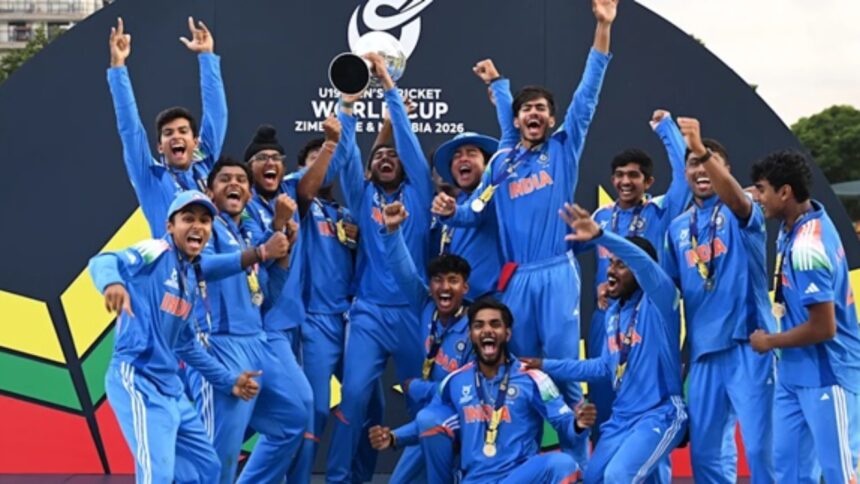
India’s under-19 cricket team delivered a commanding performance to secure a historic world cup title on the global stage.
vaibhav suryavanshi’s record-breaking brilliance powers india to monumental total
India’s triumph in the ICC Under-19 Cricket World Cup was built on an extraordinary batting display that left an indelible mark on the tournament’s history. After winning the toss in the final at Harare, the Indian team opted to bat first, a decision that soon proved inspired as the batters produced one of the most dominant performances ever witnessed in an under-19 world cup final.
At the heart of this innings was Vaibhav Suryavanshi, who played a breathtaking knock that combined raw power with remarkable composure. His 175 off just 80 deliveries not only anchored India’s innings but also shattered records, setting a new benchmark for individual excellence in a world cup final. From the outset, Suryavanshi asserted control, dispatching bowlers to all parts of the ground with a maturity well beyond his years.
His innings was marked by fearless stroke play, precise timing, and an ability to accelerate without losing shape. England’s bowlers struggled to contain him as he repeatedly found the boundary, forcing frequent changes in bowling and field placements. Even as wickets fell at the other end, Suryavanshi maintained his rhythm, ensuring that India’s scoring rate never dipped.
Strong support came from captain Ayush Mhatre, who led from the front with a composed half-century. His 53 provided stability during a crucial phase of the innings, allowing Suryavanshi to play with freedom. The partnership between the two ensured that India remained firmly in control, blending aggression with responsibility.
Middle-order contributions further strengthened the total. Abhigyan Kundu added a valuable 40, rotating the strike effectively and capitalising on loose deliveries. Together, the batting unit showcased depth and intent, pushing England onto the defensive for long stretches. Despite England’s bowlers making occasional inroads, India’s relentless approach ensured that momentum remained firmly in their favour.
By the end of the allotted 50 overs, India had amassed a staggering 411 for nine, one of the highest totals in the history of under-19 world cup finals. For England, James Minto emerged as the most successful bowler with three wickets, while Sebastian Morgan and Alex Green claimed two apiece. Manny Lumsden chipped in with one wicket, but the overall effort struggled to stem the flow of runs.
Suryavanshi’s innings was later recognised with both the player of the match and player of the series awards, underlining his influence throughout the tournament. His performance in the final epitomised India’s batting dominance and set the tone for what would follow in the second innings.
India’s bowlers seal emphatic win as nation celebrates historic achievement
Chasing an imposing target of 412, England began with intent, aware that an aggressive approach was their only realistic option. Early boundaries provided brief hope, but the required run rate continued to climb, placing immense pressure on their batting lineup. As the innings progressed, India’s bowlers maintained discipline, striking at regular intervals to prevent England from building sustained momentum.
England found resistance through Caleb Falconer, who played a courageous knock of 115. His innings was a blend of determination and controlled aggression, briefly threatening to shift the contest. Ben Dawkins offered valuable support with a well-crafted 66, and together they attempted to steady the chase. However, the mounting asking rate and the loss of wickets at crucial moments gradually tilted the balance back in India’s favour.
India’s bowling attack rose to the occasion with a collective effort. RS Ambrish led the charge, picking up three key wickets that disrupted England’s middle order. Deepesh Devendran and Kanishk Chouhan contributed with two wickets each, exploiting pressure situations and forcing errors from the batters. Khilan Patel and captain Ayush Mhatre also chipped in with a wicket apiece, ensuring that England never regained control of the chase.
England were eventually bowled out for 311 in 40.2 overs, sealing a comprehensive 100-run victory for India. The margin of victory was historic, marking the largest win by runs in an under-19 world cup final and underlining the gulf between the two sides on the day.
The triumph marked India’s sixth under-19 world cup title, extending their record as the most successful nation in the tournament’s history. Leading the side, Ayush Mhatre guided the team through the competition unbeaten, a testament to both strategic clarity and consistent execution. The victory was not just a reflection of individual brilliance but of a well-rounded team effort that excelled in all departments.
Celebrations followed swiftly as the achievement drew praise from across the country. Droupadi Murmu congratulated the young cricketers for their dominant and undefeated campaign, noting that the team had made the nation proud with its discipline and determination. She also wished the players success in their future careers, highlighting the promise shown by the emerging talent.
C P Radhakrishnan lauded the team’s achievement and singled out Vaibhav Suryavanshi for his record-breaking performance in the final. He also extended special appreciation to captain Ayush Mhatre for his leadership throughout the tournament, describing the victory as a proud moment for the country.
Narendra Modi added his congratulations, commending the players for showcasing exceptional skill and resilience on the world stage. He remarked that the triumph would inspire countless young athletes across the nation and reaffirm India’s strong cricketing foundation at the grassroots level.
For Indian cricket, the victory reaffirmed the strength of its youth development system and its ability to consistently produce world-class talent. The performances throughout the tournament reflected preparation, mental toughness, and a fearless approach, qualities that continue to define India’s under-19 legacy on the global stage.