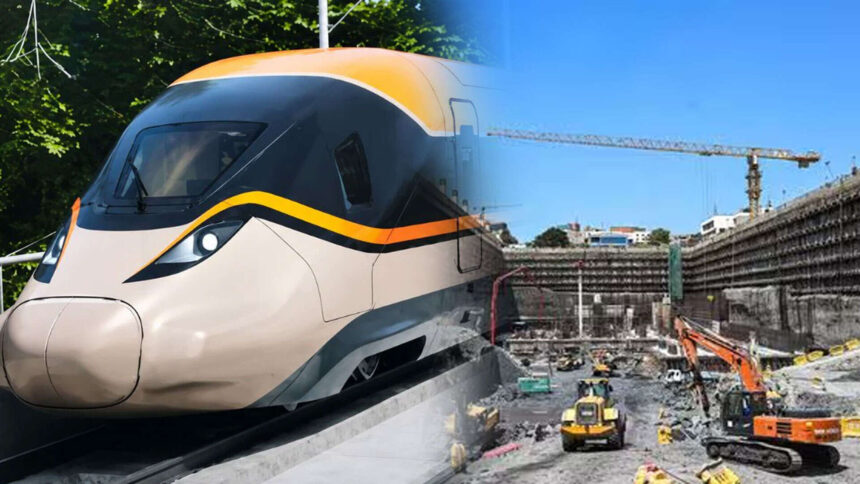
India moved one step closer toward entering the era of high speed rail transportation after the first official visual design of the country’s proposed bullet train was unveiled at the Ministry of Railways in New Delhi. The display has generated nationwide excitement because the ambitious Mumbai Ahmedabad High Speed Rail corridor is expected to transform rail travel, infrastructure development, economic connectivity and technological advancement across the country.
The first look of the proposed bullet train was displayed prominently at Gate Number Four of the Ministry of Railways building in the national capital. The visual presentation offers an early glimpse into the design and appearance of the train set that will eventually operate on India’s first high speed rail corridor between Mumbai and Ahmedabad.
The unveiling of the design represents more than a simple infrastructure announcement. It symbolizes India’s broader ambition to modernize transportation systems, introduce advanced engineering technologies and establish world class rail connectivity capable of matching global standards. High speed rail has long been considered a hallmark of advanced transport infrastructure, and the Mumbai Ahmedabad project is expected to become one of the most transformative mobility initiatives in independent India.
According to officials associated with the project, the Mumbai Ahmedabad High Speed Rail corridor is currently scheduled for launch on August fifteen twenty twenty seven. Once operational, the bullet train is expected to reduce travel time between the two major economic centers to nearly two hours, dramatically improving passenger convenience and business connectivity.
At present, conventional rail journeys between Mumbai and Ahmedabad typically require several hours depending on the train service. The introduction of high speed rail is therefore expected to redefine intercity mobility by offering faster, safer and more efficient transportation.
The unveiling of the train design came shortly after another major development in the project. The National High Speed Rail Corporation Limited announced that the first Tunnel Boring Machine cutterhead had been successfully lowered at Vikhroli in Mumbai for tunnel construction connected to the corridor.
The lowering of the massive cutterhead marked an important engineering milestone because tunnel construction represents one of the most technically demanding aspects of the project. The cutterhead measures thirteen point six meters in diameter and weighs approximately three hundred fifty tonnes. It forms part of the primary assembly process for the giant Tunnel Boring Machine that will excavate underground sections of the corridor.
Two enormous Tunnel Boring Machines are currently being assembled for the project. Each machine reportedly weighs more than three thousand tonnes, making them among the largest engineering systems deployed for railway tunnel construction in India. These machines will be responsible for constructing a sixteen kilometer section of the twenty one kilometer Mumbai tunnel corridor.
One of the most remarkable features of the project is the planned undersea tunnel beneath Thane Creek. Stretching nearly seven kilometers underwater, the tunnel will become India’s first undersea rail tunnel once completed. The development is considered a major technological achievement for the country’s infrastructure sector.
Engineers involved in the project explained that the Tunnel Boring Machines have been specifically designed to excavate a single large tunnel capable of accommodating both the upward and downward bullet train lines. Such engineering efficiency is expected to optimize tunnel construction while maintaining safety and structural stability.
The massive cutterhead component required extraordinary logistical coordination before installation. According to project authorities, the component arrived at the construction site in five separate shipments because of its enormous size and weight. It was then assembled using highly precise welding techniques involving nearly sixteen hundred kilograms of specialized welding material.
The tunnel section between Vikhroli and Bandra Kurla Complex in Mumbai is particularly challenging because it passes beneath densely populated urban regions as well as beneath the Mithi River. Construction teams are therefore relying on advanced tunneling technologies and precision engineering to ensure safety and minimize disruption to surrounding areas.
The Bandra Kurla Complex station itself is expected to become one of the most important transportation hubs connected to the bullet train corridor. Located in Mumbai’s major business district, the station will likely serve thousands of passengers daily once operations begin.
The Mumbai Ahmedabad High Speed Rail project represents one of India’s largest infrastructure collaborations with Japan. Japanese expertise and Shinkansen technology are playing a central role in the project’s development. The corridor is based on advanced Japanese high speed rail systems known globally for their safety, punctuality and operational efficiency.
Japan’s involvement extends beyond technology transfer into financing, engineering support and operational guidance. The partnership has often been highlighted as an example of growing strategic and economic cooperation between India and Japan.
The bullet train corridor is expected to stimulate economic growth across regions connected by the route. High speed transportation systems often contribute to increased investment activity, tourism development, real estate expansion and business integration. Faster connectivity between Mumbai and Ahmedabad could significantly improve economic productivity by reducing travel time for professionals and commercial travelers.
Supporters of the project argue that the corridor will create substantial employment opportunities during both construction and operational phases. Engineers, technicians, construction workers, safety specialists and maintenance professionals are expected to benefit from the large scale infrastructure initiative.
In addition to economic benefits, the project is also viewed as a technological leap for Indian railway modernization. The corridor incorporates advanced signaling systems, earthquake detection technologies, modern station infrastructure and internationally benchmarked safety standards.
Safety remains one of the defining characteristics of modern high speed rail systems. Japanese Shinkansen technology, which forms the foundation of the project, has maintained one of the world’s strongest safety records since its introduction decades ago. Indian authorities aim to replicate similar operational standards once the corridor becomes functional.
Environmental considerations have also formed part of the project planning process. High speed rail is often promoted as a cleaner alternative to road and short haul air travel because it can transport large numbers of passengers with lower per capita emissions. Improved rail connectivity may therefore contribute toward reducing transportation related environmental impact over time.
Despite enthusiasm surrounding the project, the bullet train corridor has also faced challenges during its development. Land acquisition issues, environmental clearances, engineering complexities and rising project costs have periodically affected timelines. However, authorities continue emphasizing that construction progress remains substantial and long term benefits justify the scale of investment.
Political leaders and infrastructure experts frequently describe the bullet train corridor as a symbol of India’s modern infrastructure ambitions. The project aligns with broader national goals focused on urban modernization, advanced transportation systems, manufacturing expansion and global competitiveness.
The first official visual display of the bullet train design has therefore generated strong public curiosity and optimism. Many observers view the project as a defining moment in the evolution of Indian railway infrastructure, similar to how metro rail systems transformed urban transportation in major cities.
Public reaction to the unveiled design has largely centered around excitement regarding India finally joining the list of countries operating dedicated high speed rail services. Countries such as Japan, China, France and Spain have long demonstrated the transformative impact of high speed transportation on economic development and regional connectivity.
The Mumbai Ahmedabad corridor may also pave the way for future bullet train routes across India. Several additional high speed rail corridors have already been discussed for potential future expansion connecting major metropolitan and industrial regions.
Experts believe successful execution of the first corridor will significantly influence public confidence and policy support for broader high speed rail development nationwide. Operational efficiency, passenger affordability and safety performance will ultimately determine long term public acceptance of the system.
The bullet train project also reflects the changing aspirations of Indian infrastructure planning where emphasis increasingly focuses on speed, efficiency, technological sophistication and sustainable mobility. Modern transportation networks are considered essential for supporting rapid urbanization and economic growth in emerging economies.
As construction advances and engineering milestones continue being achieved, anticipation surrounding India’s first bullet train is expected to grow steadily. The unveiling of the train’s design offers citizens a tangible glimpse into a future where high speed rail becomes an integral part of national transportation infrastructure.
The Mumbai Ahmedabad High Speed Rail corridor is therefore not merely a railway project. It represents a larger vision of technological progress, economic modernization and infrastructure transformation designed to position India among leading nations in advanced transportation systems.