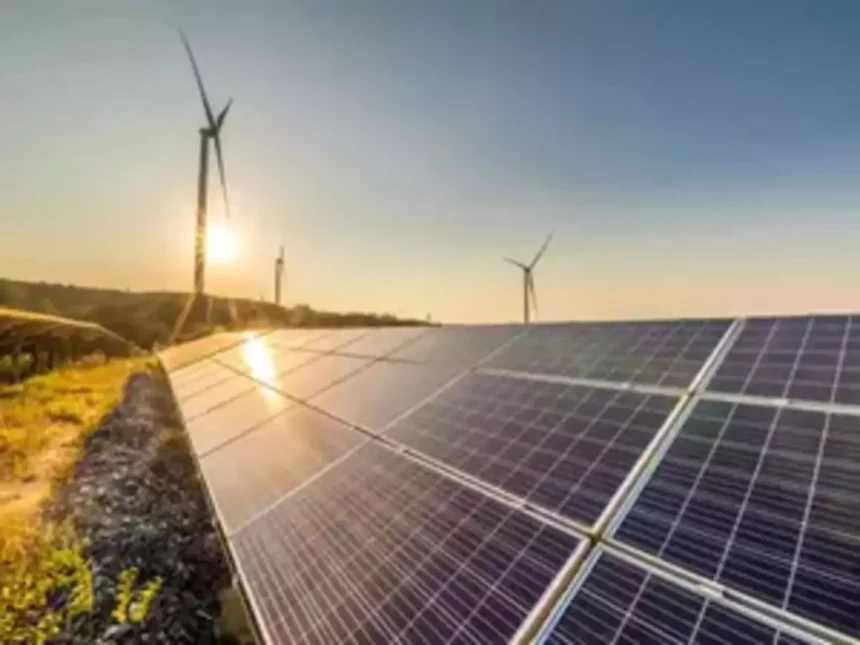
India needs to ramp up its non-fossil fuel capacity to 600 GW by 2030 to meet the country’s rapidly growing electricity demand in a reliable and cost-effective manner, according to a new study by the Council on Energy, Environment and Water (CEEW). The study, titled “How Can India Meet Its Rising Power Demand? Pathways to 2030,” is the first of its kind, modeling India’s power system dispatch for every 15 minutes in 2030. The report highlights that if power demand continues to outpace current projections, a high renewable energy pathway with 600 GW of non-fossil capacity will be the most viable solution.
The findings indicate that India’s existing, under-construction, and planned generation capacities would be sufficient to meet power needs in 2030, provided electricity demand grows as per projections made by the Central Electricity Authority (CEA). However, if economic growth strengthens or climate change-induced warming increases electricity demand beyond current estimates, India must accelerate its clean energy expansion. The 600 GW non-fossil target includes 377 GW of solar energy, 148 GW of wind energy, 62 GW of hydro power, and 20 GW of nuclear power. Achieving this goal will help reduce generation costs by 6-18 paise per unit, eliminate the need for additional coal plants, and save between ₹13,000 crore and ₹42,400 crore in power procurement costs. Moreover, it could create 53,000 to 1,00,000 new jobs and cut carbon emissions by 9-16% compared to the levels recorded in the fiscal year 2023-24.
A diversified renewable energy mix spread across different states will ensure reliable power supply at lower costs. The study suggests an additional 75 GW of solar energy should be distributed across states like Kerala, Bihar, Punjab, West Bengal, Odisha, and Telangana, while 25 GW of additional wind capacity can be installed in Madhya Pradesh, Maharashtra, Tamil Nadu, Karnataka, and Rajasthan. This diversified approach would significantly reduce the risk of unmet demand. Additionally, strengthening inter-state transmission networks by 6 GW could be avoided through strategic renewable deployment.
Failing to meet the 600 GW target will result in suboptimal outcomes, including higher power costs and increased reliance on coal. If India achieves only 400 GW of non-fossil capacity by 2030 while demand surpasses projections, the unmet demand could be double that of a 500 GW scenario. This would necessitate the construction of 16 GW of new coal capacity, which would take more than five years to develop, pushing overall system costs higher by ₹30,000-₹42,400 crore and increasing emissions by 17% compared to FY24 levels.
Minister of State for Power and Renewable Energy Shripad Yesso Naik emphasized that the government has set ambitious targets to expand non-fossil fuel capacity, aiming for net zero emissions by 2070. He noted that India’s clean energy transition has been remarkable, with non-fossil capacity rising from 76 GW in 2014 to 220 GW in 2025. The government remains committed to meeting its renewable energy targets, and every state must leverage its unique renewable energy potential to build a clean and efficient power grid. As part of India’s nationally determined contribution (NDC) under the Paris Agreement, the country aims to reduce the emissions intensity of its GDP by 45% by 2030, compared to 2005 levels, while increasing non-fossil energy resources to 50% of its installed power generation capacity, amounting to 500 GW. The CEEW study provides a crucial roadmap for achieving these ambitious targets and ensuring India’s energy security for the future.