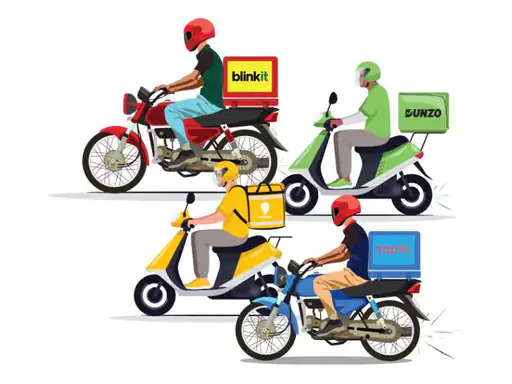
India has rapidly emerged as the third-largest quick commerce market in the world, following China and the United States. The sector’s remarkable growth trajectory, fueled by consumer demand for ultra-fast deliveries and robust investment, signals a transformative shift in how Indians shop. In 2024, the Indian quick commerce market reached $5.6 billion, approximately ₹50,000 crore, and is projected to double to $11 billion, or roughly ₹1 lakh crore, by 2030. This meteoric rise is being driven not just by traditional urban consumption patterns but also by a surge in investments and a growing appetite for convenience among the country’s millennials and Gen-Z consumers.
Investment Boom and Funding Dynamics in India’s Quick Commerce Sector
India’s position in the global quick commerce landscape is underscored by its ability to attract substantial investment. In 2024, global funding for quick commerce startups totaled $2.8 billion, of which India secured a significant 37 percent share. The attraction of investors to Indian startups such as Zepto, Blinkit, and Swiggy Instamart illustrates confidence in the market’s long-term potential. Since 2021, the sector has cumulatively drawn over $5 billion in funding, equivalent to roughly ₹45,000 crore, marking India as a preferred destination for venture capital in this rapidly evolving segment.
Investors are drawn by India’s unique demographic and urbanization trends, which create immense opportunities for ultra-fast delivery models. The consumer shift toward immediate gratification has created fertile ground for startups to innovate logistics, supply chain management, and last-mile delivery solutions. These developments have propelled India’s quick commerce ecosystem ahead of other global markets in terms of both adoption and funding. Leading companies are continuously refining operational efficiencies, investing in technology-driven inventory management, and exploring tier-2 and tier-3 cities as untapped growth corridors.
Furthermore, the influx of capital has enabled the sector to experiment with diverse categories beyond groceries, such as fashion, electronics, and personal care products. The investment wave reflects not only confidence in India’s current consumption patterns but also a bet on the scalability and sustainability of the quick commerce model across the country’s diverse urban and semi-urban markets. Experts believe that the availability of strong financial backing will accelerate the development of hyper-local delivery hubs and automated warehouses, further improving service speed and reliability.
Market Growth, Consumer Adoption, and Emerging Trends in Quick Commerce
India’s growth rate in quick commerce is not only remarkable but also globally unparalleled. Between 2025 and 2030, India’s market is projected to grow at a compound annual growth rate of 15.5 percent, nearly double China’s 7.9 percent and significantly higher than the United States’ 6.72 percent. This rapid expansion reflects the country’s unique demographic advantages, increasing smartphone penetration, and evolving urban consumer expectations. In 2024, India had an estimated 140 million quick commerce users, a number expected to surge to 233 million by 2030, showcasing the sector’s vast potential to reshape retail behavior.
The phenomenon of quick commerce hinges on ultra-fast delivery, typically ranging from ten to thirty minutes, distinguishing it from traditional e-commerce models such as Amazon or Flipkart, where delivery times often span one to two days or more. This immediacy is particularly appealing to urban millennials and Gen-Z consumers, who prioritize convenience and speed across categories including groceries, personal care, electronics, and fashion. While groceries continue to dominate the market, contributing approximately 70 percent of the gross merchandise value, emerging categories such as beauty products, electronics, and lifestyle goods are witnessing rapid adoption, signaling the broadening scope of quick commerce.
Industry leaders emphasize that the demand for immediacy extends beyond mere groceries. Blinkit’s CEO, Satish N, highlighted the consumer shift by noting that urban millennials and Gen-Z now expect instant access to a variety of products, including convenience items. Similarly, Deepinder Goyal, founder of Zomato, estimates that India’s quick commerce sector, currently valued at $5–6 billion, is growing at 40–50 percent annually. He projects that if these services penetrate tier-2 and tier-3 cities effectively, the market could reach $50 billion by 2030, reflecting the immense untapped potential of smaller urban centers.
Logistics innovation has been a critical enabler of this growth. Startups are deploying sophisticated algorithms for route optimization, automated inventory management systems, and predictive demand models to ensure product availability and timely delivery. Hyper-local distribution centers and micro-fulfillment hubs in urban neighborhoods have become essential components of quick commerce, minimizing delivery times and enhancing consumer satisfaction. Furthermore, partnerships with delivery aggregators, adoption of electric vehicles for sustainable logistics, and strategic use of technology platforms are shaping a future-ready ecosystem.
The expansion of quick commerce also aligns with global e-commerce trends, where consumers increasingly expect seamless, near-instantaneous fulfillment. India’s rapid adoption demonstrates a convergence of technology, consumer behavior, and venture investment, creating a market that is not only fast-growing but also increasingly sophisticated. As quick commerce evolves, it is expected to influence supply chain practices, warehouse management, and retail strategies across industries, establishing India as a key global player in the ultra-fast delivery sector.
India’s emergence as the third-largest quick commerce market highlights the intersection of consumer demand, investment momentum, and technological innovation. With projected growth outpacing global peers, expanding consumer adoption, and increasing investor confidence, the country is set to redefine the future of retail. As the market matures, stakeholders anticipate further diversification of offerings, operational optimization, and expansion into new urban and semi-urban areas, signaling a transformative era in Indian retail and global commerce engagement.