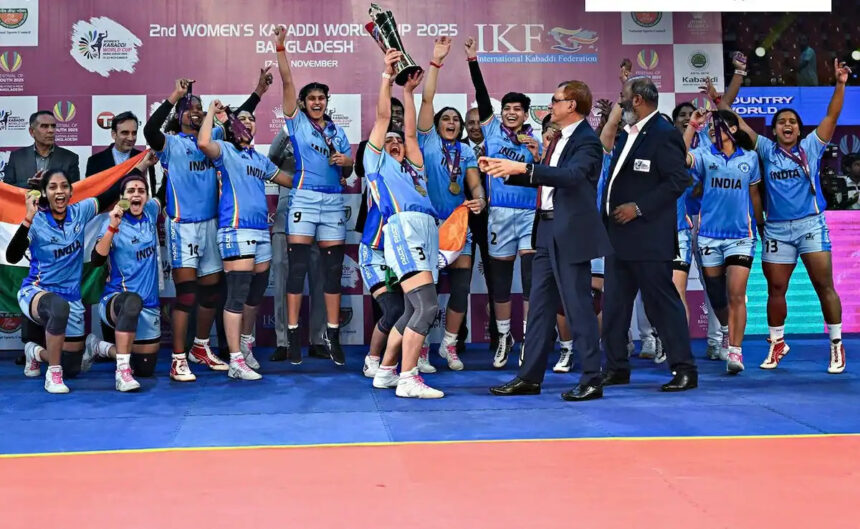
India has once again confirmed its supremacy in women’s kabaddi by clinching the 2025 Women’s Kabaddi World Cup in Dhaka, defeating Chinese Taipei with a decisive 35–28 scoreline. This victory marks consecutive championships for the Indian women’s team, reflecting their growing strength, discipline, and strategic acumen on the international stage. Throughout the tournament, India displayed a combination of precise defensive formations, calculated raids, and consistent on-court coordination, culminating in a performance that highlighted both individual brilliance and collective synergy. Fans and analysts alike hailed the team’s structured approach, composure under pressure, and adaptability, which allowed them to overcome formidable opposition and assert dominance in the tournament’s climax. The triumph further cements India’s stature as the leading force in global women’s kabaddi, inspiring the next generation of players and raising expectations for the sport’s continued development across the nation and beyond.
Tactical Excellence and Commanding Performance in the Final
From the outset of the final match, India demonstrated a disciplined approach, executing a tight defensive structure that neutralized Chinese Taipei’s offensive strategies. The team’s careful balance between attack and defense ensured a narrow yet strategic lead by halftime, with players maintaining positional discipline and anticipating the opponent’s moves effectively. After the break, India intensified its raids, combining speed with tactical precision, which prevented the opposition from mounting any significant comeback. Each phase of the game was marked by consistency, with defensive blocks, swift counter-attacks, and coordinated raids ensuring complete control over the match’s rhythm. The players’ ability to adapt to evolving game situations, maintain composure under pressure, and execute pre-planned strategies was evident throughout, showcasing not only their skill but also their deep understanding of game dynamics at the highest level. Observers noted that India’s seamless rotations, anticipation of opponent strategies, and efficient energy management were key factors in maintaining dominance across all periods of the match, ultimately leading to a well-deserved victory.
Leadership and Individual Brilliance Driving India’s Victory
The leadership of captain Ritu Negi and vice-captain Pushpa Rana proved instrumental in India’s World Cup campaign. Ritu’s management of momentum and strategic decision-making guided the team through high-pressure scenarios, while Pushpa’s agile raids and formidable defensive interventions provided a crucial balance between attack and containment. Beyond the leadership duo, all-round performances from players such as Champa Thakur, Bhawna Thakur, and Sakshi Sharma ensured depth in the lineup, reinforcing India’s tactical plans and sustaining team energy through the tournament. Each player contributed in both offensive and defensive phases, enabling India to maintain consistent pressure on their opponents and secure crucial points at critical moments. The coaching staff, led by head coach Tejaswi and assistant coach Priyanka, played a pivotal role in shaping these strategies, instilling tactical clarity, and ensuring mental preparedness for high-stakes encounters. Their guidance was particularly evident in the semifinal against Iran, where India dominated from the start, enforced all-outs, and maintained relentless defensive pressure, setting the tone for their decisive performance in the final. The combination of strong leadership, individual talent, and strategic foresight created an environment where players could perform at peak levels, showcasing the maturity and competitive edge that defines India’s world-class kabaddi squad.
The championship also emphasizes India’s long-term dominance in women’s kabaddi, highlighting the team’s ability to maintain high standards across consecutive tournaments. The victory reflects a culture of discipline, continuous skill development, and structured training, which collectively foster resilience and strategic thinking on the mat. India’s success not only elevates the profile of women’s kabaddi globally but also inspires young athletes to pursue excellence in the sport, contributing to the growth of kabaddi as a competitive and widely respected game. By combining tactical intelligence, leadership, and rigorous preparation, the Indian women’s team continues to set benchmarks for performance in international competitions, reinforcing their position as pioneers and role models in the sport. The 2025 World Cup triumph is more than just a victory; it is a testament to the dedication, teamwork, and strategic insight that define India’s approach to kabaddi, signaling the nation’s ongoing commitment to maintaining global excellence and nurturing the next generation of champions.