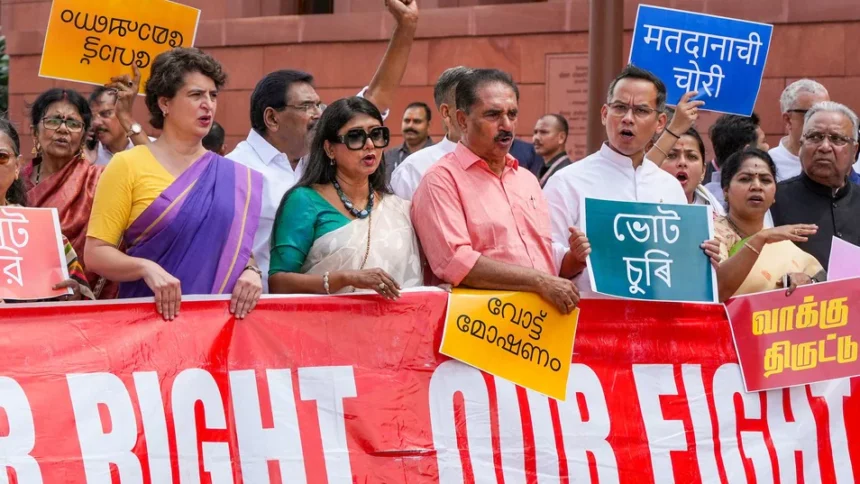
On Monday morning, a significant political demonstration is set to take place in New Delhi, with over 300 Members of Parliament (MPs) from 25 opposition parties planning to march from the Parliament complex to the Election Commission of India (ECI) headquarters. The protest, scheduled to begin around 11:30 a.m., aims to highlight allegations of large-scale electoral fraud — referred to by opposition leaders as “vote chori” (vote theft) — in the 2024 Lok Sabha elections, as well as to oppose the ongoing Special Intensive Revision (SIR) of electoral rolls in Bihar ahead of its assembly elections.
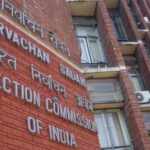
The MPs will gather at Makar Dwar, a prominent entry point to the Parliament complex, before moving towards Nirvachan Sadan, the ECI’s headquarters on Ashoka Road. The route, just under two kilometres, is expected to be heavily policed. However, according to senior Delhi Police officials, the march is unlikely to receive clearance. Speaking to Hindustan Times on condition of anonymity, one officer confirmed that no formal application for police permission had been submitted by the organisers. Without such clearance, the procession may be stopped before reaching its intended destination.
A United Opposition Front — But Without a Formal INDIA Bloc Banner
While the march has been called under the banner of the INDIA bloc — the opposition’s coalition formed to challenge the Bharatiya Janata Party (BJP) — it will deliberately avoid displaying any official INDIA bloc branding. This decision was made to accommodate the Aam Aadmi Party (AAP), which withdrew from the alliance last month but still holds 12 seats in Parliament.
“This is a programme of the Opposition and we expect AAP to join it,” said Trinamool Congress MP Sagarika Ghose. According to a senior opposition leader, the TMC played a key role in persuading AAP to participate despite its formal exit from the coalition.
Instead of a single alliance banner, the marchers will carry multi-language posters and placards in English, Hindi, Tamil, Bengali, and Marathi. These will call for the halting of the Bihar voter roll revision and demand accountability from the Election Commission over what they describe as systemic voter list manipulation.
The Bihar Voter Roll Dispute
A central focus of the protest is the Special Intensive Revision of electoral rolls in Bihar, which opposition leaders allege is being conducted in a biased and opaque manner. They fear that the exercise could result in mass deletion of legitimate voters or the inclusion of dubious entries, thereby influencing the upcoming Bihar assembly elections.
Opposition MPs argue that a clean and transparent voter list is a non-negotiable precondition for free and fair elections. The Bihar SIR process, they claim, lacks sufficient transparency and public oversight, leaving open the possibility of politically motivated manipulation.
Congress Launches Public Portal to Mobilise Support
On Sunday, the Congress party launched a dedicated web portal inviting citizens to register their support for the opposition’s demands and to press the Election Commission for greater transparency. The portal urges the release of digital voter rolls in a machine-readable format so that citizens, journalists, and political parties can independently audit the data.
“Vote Chori is an attack on the foundational idea of ‘one man, one vote’,” Rahul Gandhi, Leader of Opposition in the Lok Sabha, posted on X (formerly Twitter). “A clean voter roll is imperative for free and fair elections. Our demand from the EC is clear — be transparent and release digital voter rolls so that people and parties can audit them. The fight is to protect democracy.”
Rahul Gandhi’s Allegations of Large-Scale Voter Fraud
The current wave of opposition anger traces back to Rahul Gandhi’s press conference last week, during which he alleged that more than 100,000 votes were fraudulently cast or manipulated in the Mahadevapura assembly segment of the Bangalore Central parliamentary constituency during the 2024 Lok Sabha elections.
According to Gandhi, the alleged vote theft was carried out through five distinct types of manipulation, though he did not disclose all operational details publicly. “We started examining the details and discovered that approximately 1,00,250 votes were stolen in Mahadevapura,” Gandhi claimed, presenting some of the findings during the briefing.
The allegation is among the most serious ever made by a senior opposition leader against the Election Commission in recent years. Gandhi has accused the poll body of failing in its constitutional duty to ensure free and fair elections — and, more provocatively, of indirectly aiding the BJP’s victory through its inaction or complicity.
Election Commission’s Response
The Election Commission has categorically rejected Gandhi’s claims, describing them as “incorrect” in multiple public statements. The poll body has also formally asked Gandhi to submit the complete list of allegedly dubious voters under oath, treating it as a matter that requires personal accountability due to its gravity.
The EC’s stance is that without verifiable data presented under a sworn declaration, such allegations remain unsubstantiated and risk damaging public trust in the electoral process.
However, Gandhi has so far resisted complying with this demand. He argues that he has already sworn an oath to uphold the Constitution upon becoming an MP, and that this should be sufficient to affirm the truthfulness of his statements.
Possible Confrontation on March Day
With the Delhi Police signalling an unwillingness to allow the march to proceed without permission, Monday’s demonstration carries a risk of confrontation. If the police attempt to block the procession, opposition MPs may face a choice: disperse peacefully or defy the order, risking legal action and potential detention.
Given the high-profile nature of the participants — which includes senior leaders from Congress, the Samajwadi Party, Trinamool Congress, Dravida Munnetra Kazhagam, AAP, Left parties, Rashtriya Janata Dal, Nationalist Congress Party (Sharad Pawar faction), Shiv Sena (Uddhav Balasaheb Thackeray faction), and National Conference — any disruption or clash could draw significant national and international attention.
Symbolism Beyond the Immediate Protest
For the opposition, the march is not just about Bihar’s electoral rolls or the Mahadevapura allegations. It is part of a broader political narrative portraying the BJP as undermining democratic institutions and the Election Commission as failing to act independently.
By gathering such a large number of MPs from across the political spectrum, the organisers aim to send a message of unity and collective resistance. Even the decision to drop the INDIA bloc branding is strategic — it signals that opposition to alleged electoral malpractice is not confined to any one coalition but is a shared democratic concern.
What Comes Next ?
While the immediate outcome of Monday’s march remains uncertain, the episode underscores the growing political tension surrounding India’s electoral processes ahead of several crucial state polls and the 2029 general election.
If the opposition succeeds in delivering its memorandum or meeting with Election Commission officials, it may frame the event as a victory for public pressure. If the march is blocked, opposition leaders are likely to use the incident to further their claims of shrinking democratic space under the current government.
Either way, the confrontation over “vote chori” allegations and voter roll transparency seems far from over. As political stakes rise, so too will public scrutiny of the Election Commission — and the opposition’s ability to maintain unity across its diverse ranks will be tested in the months ahead.