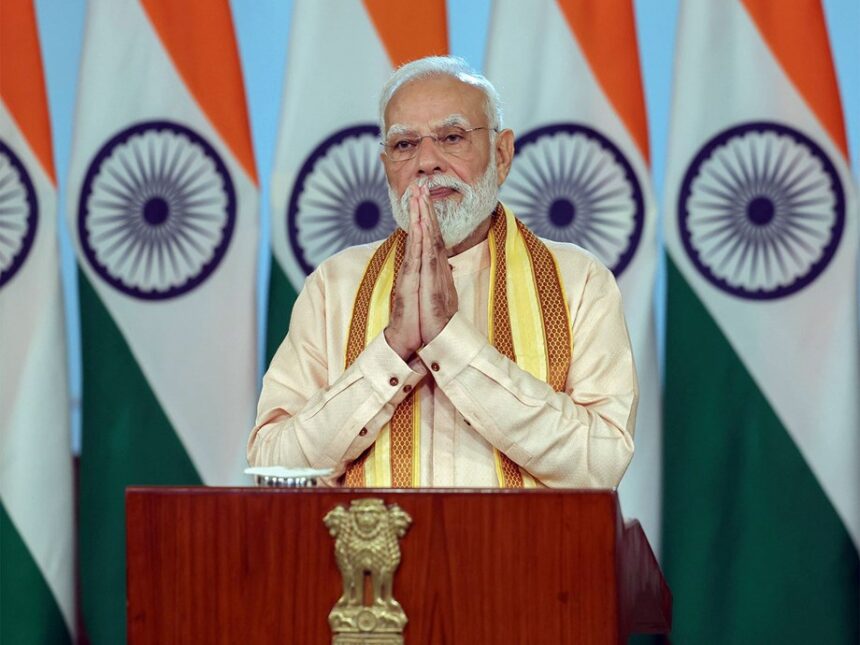
India today commemorated the 150th anniversary of its national song Vande Mataram, a historic and deeply emotional symbol of the nation’s unity, pride, and struggle for freedom. The celebrations, held across the country, were led by President Droupadi Murmu, Prime Minister Narendra Modi, Union Home Minister Amit Shah, and several other leaders, who paid glowing tributes to Bankim Chandra Chattopadhyay’s timeless composition. The day marked not just a remembrance of a song, but a celebration of the spirit of India’s freedom struggle and the values that continue to define the nation’s collective identity.
Prime Minister Narendra Modi inaugurated the year-long commemoration of Vande Mataram in New Delhi by releasing a special postal stamp and a commemorative coin. In his message, the Prime Minister described the 150th anniversary as a moment of immense pride for every Indian, recalling how the song had become a source of inspiration for generations of freedom fighters. “Tomorrow, 7th November, is a momentous day for every Indian. We celebrate 150 glorious years of Vande Mataram, a stirring call that has inspired generations and ignited an undying spirit of patriotism across our nation,” he wrote on X, reflecting the emotional significance of the day.
A Song that Defined a Nation’s Spirit
President Droupadi Murmu, in her tribute, described Vande Mataram as much more than a song—it was a national awakening, a “proclamation of emotional consciousness and unity” that shaped India’s journey to independence. She traced its origins to Bankim Chandra Chattopadhyay’s composition written during the late 19th century against the backdrop of British colonial oppression and the Sannyasi Rebellion. The President noted that by the time of the 1905 Swadeshi Movement, the song had evolved into the rallying cry of an emerging nation.
“The immortal song Vande Mataram, composed by Bankim Chandra Chattopadhyay, became a powerful source of inspiration for the freedom struggle. It embodied the devotion, determination, and courage of a people striving for their motherland’s dignity,” she said, urging citizens to uphold the song’s essence of unity and emotional strength for generations to come.
Union Home Minister Amit Shah, too, paid homage to the song’s enduring relevance, describing it as “the voice of India’s soul.” He emphasized that Vande Mataram served as a unifying force that transcended linguistic, cultural, and regional divides during the independence movement. “The song united the nation during the struggle for independence and continues to ignite the eternal flame of nationalism in the hearts of our countrymen,” Shah said. He encouraged families to sing the full version of Vande Mataram together to ensure that its spirit remains alive in every Indian household.
BJP National President JP Nadda, addressing a gathering in Delhi, said that Vande Mataram had become “a triumphant chant of freedom in the lives of countless revolutionaries.” He added that under Prime Minister Modi’s leadership, the entire country was commemorating this milestone with a renewed sense of pride and patriotism. “The song was not merely a call—it was a revolution of the heart. Today, under the leadership of the Prime Minister, we are celebrating 150 years of this divine proclamation of Mother India,” he said.
The BJP president also announced that Vande Mataram singing events would be held across the country from November 7 to 26, culminating on Constitution Day. The events aim to unite citizens in collective remembrance and celebration of the song’s legacy, which, as he said, “transformed India’s cry for freedom into a hymn of devotion.”
A Living Legacy of Unity and Patriotism
In Uttar Pradesh, Chief Minister Yogi Adityanath also participated in a special ceremony to mark the 150th anniversary. Addressing a large gathering, he said that Vande Mataram was not just a composition, but a spiritual and emotional force that infused the idea of “Nation First” into the consciousness of Indians. “The national song inspired generations to dedicate themselves to Bharat Mata. It instilled the idea that our devotion must always be towards the nation,” Yogi Adityanath remarked, highlighting the song’s continued resonance in modern India.
Originally penned by Bankim Chandra Chattopadhyay in 1875 and later included in his celebrated novel Anandamath, Vande Mataram quickly transcended the pages of literature to become a rallying call for resistance. The words—translated as “I bow to thee, Mother”—embodied reverence for the motherland, portraying India not merely as a geographical entity but as a divine presence worthy of devotion and sacrifice.
During the Indian freedom struggle, the song became synonymous with nationalist fervor. It was sung by revolutionaries, echoed in protest marches, and printed on pamphlets that circulated secretly among activists defying British rule. The song’s emotional power was so profound that the colonial administration sought to ban its public performance, fearing it would inflame nationalist sentiment—a fear that proved true as the melody of Vande Mataram continued to resonate in the hearts of millions.
Even after independence, Vande Mataram retained its symbolic strength. While Jana Gana Mana was adopted as the national anthem, Vande Mataram was recognized as the national song, a decision that acknowledged its historical and emotional importance. The first two stanzas, written in simple yet evocative Sanskritized Bengali, remain the most widely sung, capturing the essence of devotion to the motherland.
As India completes 150 years of this national treasure, the song continues to serve as a reminder of the unity and diversity that define the Indian spirit. From classrooms and cultural events to Independence Day and Republic Day celebrations, Vande Mataram is still sung with reverence, connecting the past to the present in a continuous thread of national pride.
The government’s year-long commemoration aims to bring Vande Mataram closer to the youth, emphasizing its timeless message in the digital age. Special programs, exhibitions, and musical renditions are being organized nationwide, blending traditional and modern interpretations to appeal to a new generation. Schools and universities have been encouraged to organize events that highlight the song’s historical context and cultural relevance.
Cultural scholars point out that Vande Mataram remains unique among patriotic compositions for its fusion of devotion and resistance. It is both a hymn and a battle cry—a song that celebrates beauty while calling for action. It united poets, revolutionaries, and ordinary citizens in a shared sense of purpose, bridging the gap between faith and nationalism.
Today, as leaders across the political spectrum pay homage to the song, the message of Vande Mataram stands as relevant as ever. In an age of global change and internal challenges, its call for unity, courage, and pride in one’s heritage continues to inspire. As President Murmu emphasized, the spirit of the song must be preserved not just as a memory of the past but as a living philosophy for the future.
The 150th anniversary of Vande Mataram thus becomes a reminder of India’s journey—from subjugation to sovereignty, from despair to determination. It embodies the resilience of a people who found in music and words the strength to dream of freedom and the power to achieve it. As the celebrations unfold throughout the year, the echoes of Vande Mataram will once again rise across the country, reminding every citizen that the true essence of patriotism lies not just in remembrance, but in commitment to the ideals that the song so beautifully enshrines.