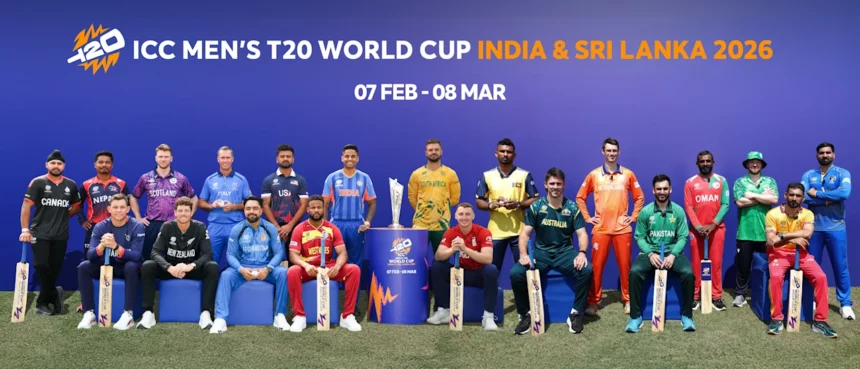
The ICC men’s t20 world cup 2026 brings elite teams, packed venues, and global anticipation together for cricket’s fastest showpiece.
A landmark tournament spreads across india and sri lanka with expanded format and venues
The ICC Men’s T20 World Cup represents a defining moment in the evolution of short-format cricket, combining scale, intensity, and inclusivity like never before. Scheduled across India and Sri Lanka, the tournament spans February and March, transforming the subcontinent into the epicentre of global cricket for over a month. With twenty international teams competing, the event marks the largest men’s t20 world cup to date, reflecting both the format’s popularity and cricket’s widening global footprint.
The tournament structure has been designed to maximise competitiveness while preserving the unpredictability that defines t20 cricket. Teams are divided into four groups, each featuring a blend of traditional powerhouses and emerging nations. Every match in the group stage carries significance, as only the top two teams from each group progress to the Super Eight phase. This structure ensures that consistency, adaptability, and squad depth are rewarded, while still allowing space for surprise results that have become synonymous with t20 tournaments.
India’s role as co-host brings unmatched scale and atmosphere to the competition. Stadiums such as Ahmedabad, Mumbai, Kolkata, Delhi, and Chennai are expected to host capacity crowds, with millions more following across digital and broadcast platforms. Sri Lanka’s iconic venues add a contrasting flavour, blending tropical conditions with rich cricketing heritage. Together, the two hosts offer varied pitches and conditions that test teams’ versatility, from spin-friendly surfaces to high-scoring grounds demanding explosive batting.
Logistical planning for a tournament of this magnitude has been extensive. Teams will travel across multiple cities and countries within a compact timeframe, requiring careful scheduling and recovery management. The calendar balances rest days with high-intensity match windows, recognising the physical demands of t20 cricket while maintaining momentum for fans. For players, adaptability off the field will be as crucial as performance on it.
Beyond the matches themselves, the tournament is positioned as a cultural festival. Fan zones, community outreach programmes, and city-wide celebrations are planned to accompany fixtures, turning match days into shared experiences. The hosts aim to showcase not only cricketing excellence but also regional culture, cuisine, and hospitality, reinforcing the world cup’s identity as more than just a sporting contest.
The expanded format also reflects the International Cricket Council’s ambition to grow the game beyond its traditional boundaries. Associate nations now enter the tournament not merely as participants, but as genuine competitors capable of influencing outcomes. Their presence adds depth to the competition and signals a shift toward a more inclusive global cricket ecosystem.
teams, players, and narratives shape a tournament rich with possibility
At the heart of the t20 world cup lies a convergence of talent, ambition, and narrative. Established cricketing giants arrive with expectations shaped by history, while newer teams carry the hunger to challenge reputations. For defending champions and former winners alike, the tournament represents a chance to reaffirm dominance. For others, it is an opportunity to redefine their place in world cricket.
India enters the competition with the dual advantage of home conditions and immense public support. The pressure of expectation is high, but so is belief in the depth of talent produced by the country’s cricketing system. Familiarity with conditions, combined with the energy of home crowds, positions India as a central storyline throughout the tournament. Yet history has shown that home advantage in t20 cricket can be a double-edged sword, demanding emotional control and tactical clarity.
Australia, England, West Indies, New Zealand, South Africa, Pakistan, Sri Lanka, and Bangladesh bring contrasting philosophies to the competition. Some emphasise raw power and pace, others rely on spin, fielding intensity, or strategic flexibility. In t20 cricket, these stylistic differences often collide dramatically, producing matches that can swing decisively within a few overs.
Emerging nations add another layer of intrigue. Teams from outside the traditional elite arrive with players experienced in global leagues, accustomed to pressure and innovation. Their familiarity with modern t20 tactics reduces the gap between established and emerging sides, making upsets more likely. For these teams, even a single high-profile victory can have lasting impact on cricket’s development back home.
Individual brilliance remains central to the t20 narrative. Batters capable of changing matches in a handful of deliveries, bowlers who thrive under death-over pressure, and all-rounders who influence games in multiple phases often become defining figures. The compact format magnifies individual moments, turning a single catch, spell, or innings into tournament-shaping memories.
Off the field, technology and analysis play an increasingly influential role. Teams arrive armed with data-driven strategies, opposition match-ups, and workload management plans. Innovations in broadcast technology promise to bring fans closer to the action than ever before, with immersive angles and real-time insights enhancing engagement. Social media and digital platforms ensure that moments resonate globally within seconds, extending the tournament’s reach far beyond stadiums.
The t20 world cup also functions as a reflection of cricket’s modern identity. It bridges generations, attracting long-time followers while appealing to new audiences drawn by speed, entertainment, and accessibility. For younger fans, the tournament often serves as an entry point into the sport, shaping lifelong allegiances and memories.
As matches unfold, narratives will evolve organically. Rivalries will intensify, underdogs will challenge favourites, and moments of pressure will reveal character. The tournament’s length allows stories to develop gradually, rewarding teams that adapt and learn as conditions change. Every phase, from group matches to knockout encounters, contributes to a broader arc that defines the champion.
The ICC men’s t20 world cup 2026 stands as a statement about cricket’s present and future. It reflects confidence in the format’s ability to unite diverse audiences, reward innovation, and deliver drama at scale. For players, it is the ultimate t20 stage. For fans, it is a month-long celebration of speed, skill, and shared emotion across borders.