A video titled “Dhurandhar, the film. What is the reality. My eye witness from Lyari” has triggered fresh debate over how Karachi’s Lyari neighbourhood is portrayed in popular cinema. The video features a personal and emotional account by Arif, a man born and raised in Lyari, who questions the accuracy of the depiction of the area in the recently released Hindi film Dhurandhar.
In the video, Arif presents himself as an eyewitness to Lyari’s lived reality, contrasting it sharply with the film’s narrative. He argues that Dhurandhar relies heavily on long-standing stereotypes associated with Lyari, particularly those centred on crime, gangs and violence, while overlooking the social fabric, cultural richness and everyday struggles of its residents. According to him, such portrayals reduce a complex neighbourhood into a one-dimensional backdrop for action and espionage.
Arif emphasises that his criticism stems from personal experience rather than political positioning. Having grown up in Lyari, he claims intimate knowledge of the area’s people, values and social life. In the video, he challenges scenes from the film, suggesting that several elements appear exaggerated or disconnected from reality. He stresses that while Lyari has witnessed periods of unrest in the past, it is equally known for its strong sense of community, resilience, sports culture, music and art — aspects he believes are largely missing from the cinematic portrayal.
Dhurandhar, released in 2025, is an Indian Hindi-language spy action thriller directed by Aditya Dhar and starring Ranveer Singh and Akshaye Khanna. The film revolves around intelligence operations, criminal networks and geopolitical conflict, with parts of the story set in Karachi’s Lyari area. These sequences were recreated on large sets outside Pakistan. The Lyari track in the film has drawn particular attention because of its connection to criminal networks and its narrative linkage to the 2008 Mumbai attacks, a creative choice that has faced criticism from Pakistani commentators.
Arif’s video adds to a growing chorus of voices questioning the ethics and implications of such storytelling. He argues that merging Lyari’s history of local gang conflict with broader narratives of terrorism reinforces negative perceptions and strips the community of its individuality. Throughout the video, his tone remains personal and impassioned, underlining his emotional connection to Lyari and his discomfort with seeing his birthplace represented primarily through violence.
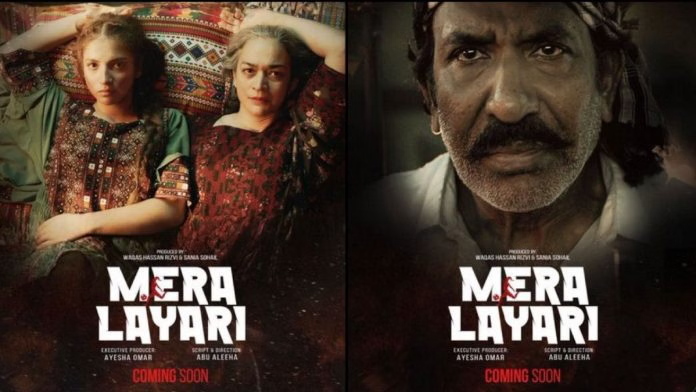
The controversy surrounding Dhurandhar has also taken a political and cultural turn in Pakistan. Days after the film’s release, the Sindh government announced plans for a counter-film titled Mera Lyari, aimed at presenting what it describes as an authentic and positive narrative of the neighbourhood. The announcement was shared on social media by leaders associated with the Pakistan Peoples Party, framing the project as a response to what they termed “Indian propaganda”.
Mera Lyari is directed by Abu Aleeha and produced by actor Ayesha Omar, who also stars in the film alongside Dananeer Mobeen and Samiya Mumtaz. According to local reports, the film will focus on Lyari’s arts, music, sports and daily life, deliberately avoiding stereotypical or negative depictions. The project is expected to highlight stories of pride, resilience and progress, and is slated for release in January 2026.
In social media statements, Sindh government representatives and Pakistani users have defended Lyari’s identity. Posts on X described the neighbourhood as a symbol of culture and peace rather than violence, asserting that misrepresentation cannot erase reality. Supporters of Mera Lyari have argued that communities should be allowed to tell their own stories instead of being defined by external narratives.
Arif’s video, while not affiliated with any official campaign, aligns with this broader sentiment. By offering a ground-level perspective, it seeks to humanise Lyari and encourage audiences to question cinematic portrayals that claim authenticity. His message urges viewers to look beyond films and listen to the voices of those who have lived the experiences being portrayed on screen.
As debates over representation, nationalism and storytelling continue across borders, the response to Dhurandhar and the emergence of Mera Lyari underline the powerful role cinema plays in shaping public perception — and the equally strong pushback that can emerge from communities determined to reclaim their narrative.