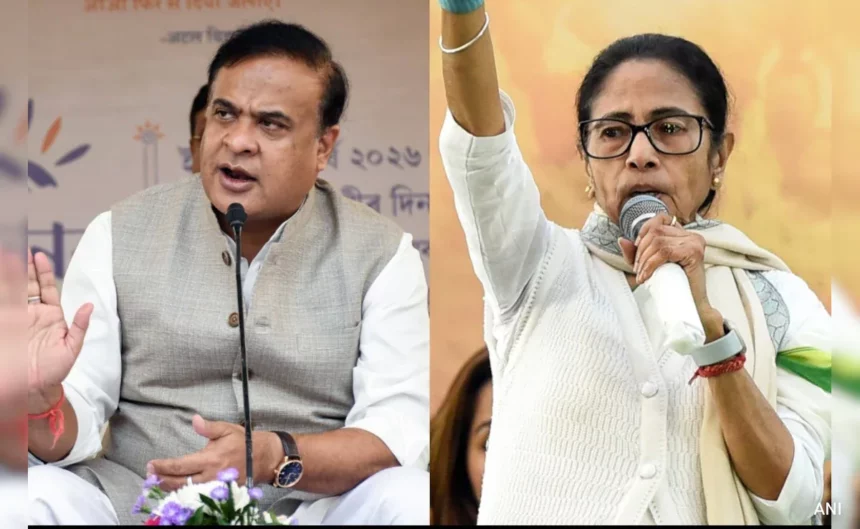
Assam Chief Minister Himanta Biswa Sarma’s call for coordinated action against illegal immigration across eastern states has intensified political tensions, as West Bengal Chief Minister Mamata Banerjee responded sharply with allegations of political misuse of agencies, escalating rhetoric ahead of ongoing election campaigns marked by rallies, roadshows, and administrative actions across multiple states.
The exchange highlights the increasingly confrontational tone of electioneering, where issues such as demographic change, border management, governance, and institutional integrity are being actively debated, with both sides attempting to shape voter perception while strengthening their respective political narratives in a highly competitive electoral environment.
Immigration Debate and Political Messaging Intensify in Eastern Region
The political debate gained momentum after Himanta Biswa Sarma raised concerns regarding demographic changes, claiming that the Muslim population has seen a consistent increase in successive census data and suggesting that similar patterns are emerging in Assam, and he further appealed to voters in West Bengal to take what he described as a decisive role in shaping the country’s future, linking the issue of illegal immigration to broader national concerns.
His remarks also included a call for the formation of a coordinated task force among eastern states aimed at addressing illegal immigration, reflecting a policy-oriented approach to what he described as a growing regional challenge, particularly in border areas where migration and security issues intersect with local political dynamics.
The issue of immigration has long remained a sensitive political subject in eastern India, especially in states bordering Bangladesh, where debates often involve questions of identity, security, resource allocation, and electoral impact, and the current statements have once again brought these concerns into the center of political discourse.
At the same time, such remarks have drawn criticism from opposition leaders who argue that demographic narratives are being used for political mobilization, leading to further polarization in an already competitive political landscape where voter alignment is influenced by both local issues and broader national themes.
Mamata Banerjee Counters BJP, Raises Concerns Over Raids and Political Pressure
Responding to the remarks and the broader campaign environment, Mamata Banerjee launched a strong counterattack, stating that those currently in power would themselves face investigative actions if they lose authority, signaling a direct challenge to the ruling establishment’s use of central agencies and enforcement mechanisms during election periods.
Speaking at multiple public gatherings, including in Dum Dum and Cooch Behar, she alleged that raids were being conducted at party offices and residences of candidates, claiming that such actions were politically motivated and aimed at influencing the electoral process, while also asserting that these measures would not weaken her party’s resolve or impact its performance in the elections.
She further accused the BJP of attempting to exert control over West Bengal through administrative and political pressure, describing the situation as an attempt to alter the democratic framework of the state, and emphasized that electoral outcomes should be determined by voters rather than institutional interventions.
Her statements also included criticism of broader policy issues, including concerns over proposed legislative measures and their potential implications, which she argued could have long-term consequences for the country’s federal structure and social balance, thereby linking state-level politics with national policy debates.
Election Activity Intensifies Across States Amid Political Exchanges
While the political confrontation continues in West Bengal, election-related activities are simultaneously gaining momentum across multiple states, reflecting the scale and intensity of the current electoral cycle, with parties deploying senior leaders, releasing campaigner lists, and organizing rallies and outreach programs to strengthen voter engagement.
In West Bengal, campaign schedules remain packed with rallies, roadshows, and padyatras led by key leaders, indicating a high level of political mobilization as parties attempt to maximize outreach before polling phases, while the Congress has also announced its list of campaigners for the second phase of voting scheduled for April 29, adding to the competitive environment.
Administrative preparations are also underway, with the Election Commission initiating processes related to Electronic Voting Machines and Voter Verifiable Paper Audit Trails to ensure smooth conduct of polling, reflecting the logistical scale involved in managing elections across multiple constituencies.
In Tamil Nadu, parallel developments include campaign rallies by various political leaders, voter outreach efforts, and the casting of postal ballots by polling personnel, demonstrating how election activities across states are interconnected within the broader national political framework.
Additionally, enforcement actions such as Income Tax raids on political figures have added another layer of complexity to the election environment, contributing to ongoing debates over the role of institutions during electoral periods and their perceived impact on political competition.
The combination of aggressive campaigning, administrative preparation, and political confrontation underscores the high-stakes nature of the current electoral phase, where every statement, rally, and action contributes to shaping voter sentiment and influencing the final outcome.