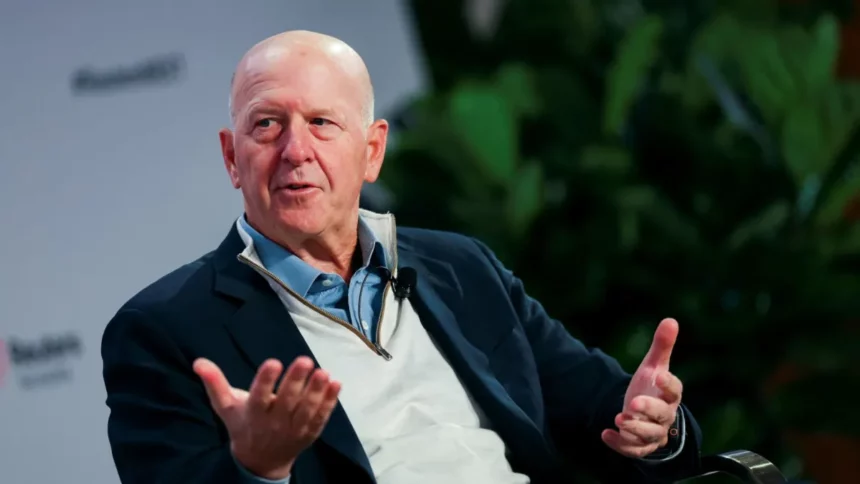
Goldman Sachs CEO David Solomon is optimistic about the recovery of the initial public offering (IPO) market after a prolonged slowdown. Speaking at a summit hosted by Cisco in Silicon Valley, Solomon said that the IPO market is expected to pick up in the near future, signaling an end to the multi-year drought. “It’s going to pick up,” Solomon stated in a candid interview with Cisco CEO Chuck Robbins on Wednesday. Reflecting on the past few years, Solomon acknowledged that the market had been sluggish, adding, “It’s been slow, it’s been turned off.”
The comments from Solomon came shortly after Goldman Sachs reported strong fourth-quarter results that surpassed analysts’ expectations. The banking giant’s results were buoyed by an uptick in capital markets activity, providing a sense of optimism for the year ahead. Solomon noted that, despite the challenges faced by the market over the past few years, there are signs that capital markets, as a whole, are starting to show renewed vitality. He attributed some of this optimism to the upcoming inauguration of President-elect Donald Trump, with the belief that the shift in political power will lead to a more favorable business environment.
The technology sector, in particular, has been struggling with IPO activity since the end of 2021. Rising inflation and increasing interest rates caused tech stocks to fall out of favor, and as a result, tech IPOs have been largely dormant. Mergers and acquisitions (M&A) in the sector have also faced difficulties, as heavy regulatory scrutiny has constrained the ability of major players to grow through dealmaking.
However, Solomon expressed a more positive outlook on the situation. He indicated that the mood is changing and that momentum is building both for M&A and IPO activity. “We have a more constructive kind of optimism, which always helps,” he said. Solomon also emphasized that, broadly speaking, he believes the business environment has improved. This renewed optimism, according to Solomon, is helping to create the conditions for a recovery in the IPO market.
On the same day as his interview at the Cisco summit, Solomon participated in his company’s earnings call, where he elaborated further on the potential impact of President-elect Trump’s election and a shift back to Republican control in Washington. Solomon noted that these political changes are already starting to make a significant difference in the business world. He highlighted that there is a substantial backlog from sponsors and an overall increased appetite for dealmaking, thanks in part to a more favorable regulatory environment.
Goldman Sachs’ upbeat results contributed to a strong performance in the stock market, with the S&P 500 posting its biggest gain since November. Goldman Sachs’ stock surged by 6% on Wednesday, further fueling the positive sentiment surrounding the bank’s future performance. While the stock market has experienced a strong run over the past two years, with the S&P 500 and Nasdaq reaching record highs last month, IPOs have yet to see a substantial rebound. The IPO market did see the debut of ServiceTitan, a cloud software vendor, in December, marking the first significant venture-backed IPO in the U.S. since Rubrik in April 2021.
Solomon acknowledged that the IPO market is starting to recover but cautioned that the values of companies have come down since 2021. He pointed out that as valuations adjust, companies are gradually returning to the market. He also mentioned that some companies are already preparing for IPOs. For example, chipmaker Cerebras filed for an IPO in September, although the process was delayed due to a review by the Treasury Department’s Committee on Foreign Investment in the U.S. (CFIUS). In another instance, online lender Klarna revealed in November that it had confidentially filed its IPO paperwork with the U.S. Securities and Exchange Commission (SEC).
Despite the positive signs for the IPO market, Solomon did highlight some structural reasons why companies may choose to remain private. He noted that the number of public companies in the U.S. has decreased significantly over the past 25 years. Whereas there were roughly 13,000 public companies a quarter-century ago, that number has now fallen to approximately 3,800. Solomon pointed out that public companies now face much higher standards for disclosure, and there is ample private capital available at scale. As a result, some companies may find it more advantageous to stay private rather than go public.
“It’s not fun being a public company,” Solomon admitted. He added, “Who would want to be a public company?” These remarks highlight the growing trend of companies opting for private funding as an alternative to the rigorous requirements of being a publicly traded entity.
While the IPO market has been slow to recover, there are signs of optimism in the air, fueled by improved market conditions and a more favorable regulatory environment. David Solomon’s comments suggest that the IPO market could see a resurgence in the near future, though it remains to be seen how quickly this recovery will take shape. The ongoing regulatory landscape, combined with political shifts and market conditions, will likely play a significant role in determining the pace of IPO activity in the coming months.