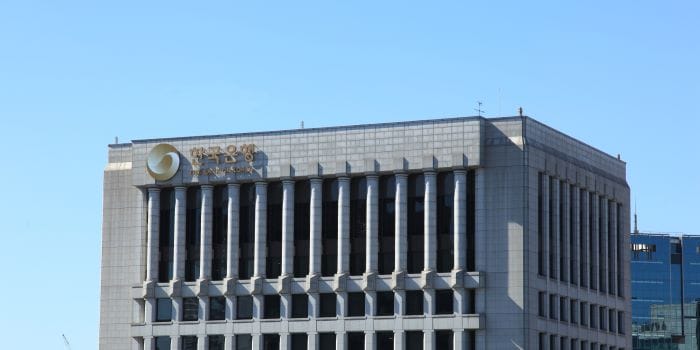
The Bank of Korea (BOK) made a surprising decision on Thursday by holding its benchmark policy rate at 3%, opting to take a wait-and-see approach to assess changes in both domestic and international economic conditions. This decision came as a shock to many analysts, as economists had largely anticipated a 25-basis-points rate cut following the central bank’s two consecutive rate cuts in previous meetings. Despite the unexpected move, the BOK remains cautious, highlighting increasing risks to economic growth and growing volatility in exchange rates.
In its official statement, the BOK acknowledged that while inflation had stabilized and household debt growth had slowed, downside risks to economic growth had intensified. The central bank also pointed out the rising volatility in exchange rates, which it attributed to unexpected political risks that have recently escalated. Additionally, the BOK cited the uncertainty created by shifting domestic political conditions and changing economic policies in major countries as contributing factors to its decision to hold rates steady.
The decision comes at a turbulent time for South Korea, where political instability has reached new heights. On Wednesday, South Korean President Yoon Suk Yeol was impeached and arrested, marking a historic first for a sitting South Korean president. The ongoing political turmoil is undoubtedly a major factor influencing the BOK’s cautious stance, as the country faces uncertainty both politically and economically.
In the immediate aftermath of the decision, South Korea’s stock market showed positive movement, with the Kospi index rising 1.25% and the smaller Kosdaq index climbing 1.69%. The South Korean won also strengthened by approximately 0.3%, trading at 1,450.27 against the U.S. dollar. However, experts are split on whether the BOK’s decision to leave rates unchanged will be enough to stabilize the country’s economic outlook.
Alex Holmes, the Research Director for Asia at the Economist Intelligence Unit, spoke to CNBC’s “Squawk Box Asia” immediately following the announcement, calling the decision “very tricky” for the central bank. Holmes pointed out that, even before the political uncertainty, South Korea’s economy was struggling to gain momentum. While certain export sectors, such as semiconductors and electronics, were performing well, other exports were lagging behind. Moreover, the domestic economy faced challenges in gaining traction, with consumer sentiment deteriorating and slow progress in construction investment.
Holmes also highlighted the depreciation of the South Korean won, which has fallen more significantly than the Japanese yen since October, despite the Bank of Korea’s relatively smaller interest rate differential compared to the U.S. Federal Reserve. This currency weakness is one of the factors contributing to the BOK’s caution in cutting rates further, as the central bank must balance the risks of stimulating inflation while also addressing the currency depreciation.
Another key issue that the BOK is grappling with is South Korea’s rising household debt, which had previously been a major concern. However, 2024 marks the first year that household debt has declined as a percentage of GDP, signaling some stabilization. The central bank is likely hesitant to cut rates too aggressively, fearing a rebound in household debt that could undermine economic stability.
Looking ahead, the BOK has issued a stark warning regarding South Korea’s GDP growth prospects for the coming years. The central bank stated that it is “highly likely” that South Korea will miss its GDP growth forecasts of 2.2% for 2024 and 1.9% for 2025. The BOK attributed this expected slowdown to weaker export growth and a slower-than-expected recovery in domestic demand, as consumer sentiment continues to falter.
While export growth showed some signs of improvement in December, consumption recovery has weakened, and investment in construction projects remains sluggish. The central bank also expressed concerns about the high level of uncertainty surrounding future economic growth, citing changes in domestic politics, the potential economic stimulus measures under the incoming Trump administration, and ongoing geopolitical risks.
The Bank of Korea’s decision to hold rates steady, coupled with its cautious economic forecast, signals a challenging year ahead for South Korea’s economy. With increasing political instability, global economic pressures, and an uncertain path for domestic growth, the country faces a delicate balancing act as it attempts to navigate these turbulent conditions. The BOK’s cautious approach will likely continue in the coming months as it closely monitors both domestic developments and global economic trends.