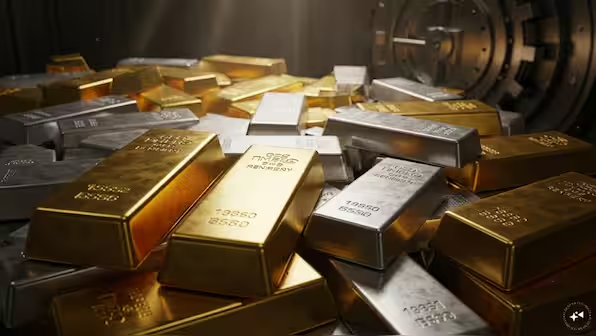
Gold and silver prices, after witnessing an extraordinary surge to record-breaking levels earlier this year, are now facing the possibility of a significant correction as heightened market volatility and global economic uncertainty begin to reshape investor expectations.
The domestic bullion market has experienced sharp fluctuations in recent weeks, prompting renewed debate over the sustainability of the rapid rally that defined much of the previous year. On February 18, 2026, fresh figures released by the India Bullion and Jewellers Association showed that silver rose by ₹4,000 per kilogram to ₹2.37 lakh, compared with ₹2.33 lakh a day earlier. During the same session, 10 grams of 24-carat gold increased by ₹98 to reach ₹1.52 lakh. While the daily rise appeared moderate, it came after months of extraordinary expansion that had already pushed both metals to historic highs.
The domestic bullion market recorded its most dramatic peak on January 29, when gold touched an all-time high of ₹1.76 lakh per 10 grams and silver surged to ₹3.86 lakh per kilogram. These unprecedented levels reflected a combination of global macroeconomic instability, currency volatility, geopolitical tensions, and aggressive speculative participation in commodity markets. Investors worldwide turned toward precious metals amid concerns about inflation persistence, currency depreciation, and financial system fragility.
The calendar year 2025 proved to be one of the most remarkable phases for precious metals in recent history. Gold prices climbed by ₹57,000 during the year, representing a striking 75 percent annual rise. On December 31, 2024, 10 grams of 24-carat gold were priced at ₹76,000. By December 31, 2025, the same quantity had surged to ₹1.33 lakh. Silver delivered an even more dramatic performance. The white metal jumped by ₹1.44 lakh per kilogram in 2025, marking a staggering 167 percent increase. From ₹86,000 per kilogram at the end of 2024, silver closed 2025 at ₹2.30 lakh per kilogram.
Such extraordinary gains significantly altered investor psychology. Many retail participants, who traditionally view gold as a safe-haven asset, entered the market aggressively during the rally, fearing that they might miss further upside. Institutional investors and speculative traders contributed to heightened activity, amplifying price swings and creating momentum-driven buying cycles. Rising prices attracted additional demand, reinforcing the upward trajectory and strengthening the perception that bullion offered protection amid uncertainty.
However, the very speed of this ascent has prompted analysts to caution that elevated levels may not remain sustainable in the short to medium term. Rapid appreciation often increases vulnerability to corrections, especially when supported largely by sentiment and risk aversion rather than stable demand fundamentals. Market observers now suggest that bullion may be transitioning from an exuberant rally phase to a period of recalibration.
Record Highs and Emerging Risk of Ten Percent Correction in Bullion Market
Market experts believe that the current phase reflects deep volatility rather than enduring structural strength. G. Chokkalingam of Equinomics Research has projected that gold and silver prices could decline by at least ten percent within the next six months. His assessment also indicates that industrial metals such as copper may remain volatile amid broader global economic uncertainty.
One of the primary drivers of this cautious outlook is the possibility of a global economic slowdown. When growth weakens, industrial demand patterns shift. Silver, which has substantial industrial applications in electronics, renewable energy infrastructure, and manufacturing processes, becomes particularly sensitive to economic deceleration. A moderation in industrial production can reduce demand for silver, thereby exerting downward pressure on prices.
Liquidity conditions across global financial markets represent another significant factor. If central banks maintain restrictive monetary policies to contain inflation, capital flows into speculative assets may moderate. Reduced liquidity can magnify price swings, particularly in asset classes that have already experienced rapid appreciation. After an exceptional rally, profit-booking by investors seeking to secure gains can intensify downward movements.
Currency fluctuations further influence bullion pricing. A stronger dollar environment typically places pressure on international gold prices, as it makes the metal more expensive for holders of other currencies. Domestic bullion prices depend on exchange rates, import duties, and global benchmark valuations. If macroeconomic conditions stabilize and inflationary concerns ease, safe-haven demand may soften, increasing the likelihood of correction.
Volatility in other financial segments, including technology equities and digital assets, may also contribute to synchronized adjustments. During periods of broader market stress, investors often liquidate positions across asset classes to maintain liquidity or rebalance portfolios. Such cross-market dynamics can accelerate corrections in precious metals even when long-term structural support remains intact.
Despite these correction risks, gold retains historical significance as a hedge against inflation, geopolitical instability, and currency depreciation. Central bank purchases in recent years have reinforced long-term demand. Therefore, a potential ten percent decline may represent consolidation following extraordinary gains rather than a structural breakdown.
Investment Considerations Amid Heightened Volatility in Gold and Silver Markets
In an environment characterized by sharp fluctuations, disciplined decision-making becomes essential. Investors must distinguish between short-term speculative trading and long-term wealth preservation strategies. Emotional buying during rapid rallies often results in elevated acquisition costs and increased exposure to correction risk.
Authenticity remains the foremost consideration when purchasing physical gold. Buyers should ensure that products carry hallmark certification issued by the Bureau of Indian Standards. Hallmarking verifies purity and confirms compliance with standardized quality parameters. Certified gold typically bears an identification code specifying purity level and testing center details, safeguarding consumer interests.
Price verification is equally important. Gold is traded in multiple purity categories, including 24-carat, 22-carat, and 18-carat forms. Rates fluctuate daily in response to international trends, currency movements, and domestic demand-supply conditions. Investors should cross-check prevailing prices before purchasing to avoid overpayment during volatile sessions.
Strategic timing also plays a crucial role. Phased investment during periods of price moderation can help manage average acquisition costs and reduce exposure to peak valuations. Diversification across asset classes further enhances portfolio resilience during uncertain cycles.
Silver requires careful evaluation because of its dual identity as both a precious and industrial metal. Its demand is influenced not only by investment sentiment but also by manufacturing activity, renewable energy expansion, and technological development. Economic forecasts and industrial indicators should therefore inform decisions involving silver.
The current bullion environment reflects a transitional phase following an exceptional rally in 2025 and record highs at the beginning of 2026. Price direction in the coming months will depend on global macroeconomic developments, investor sentiment, liquidity conditions, and geopolitical dynamics.