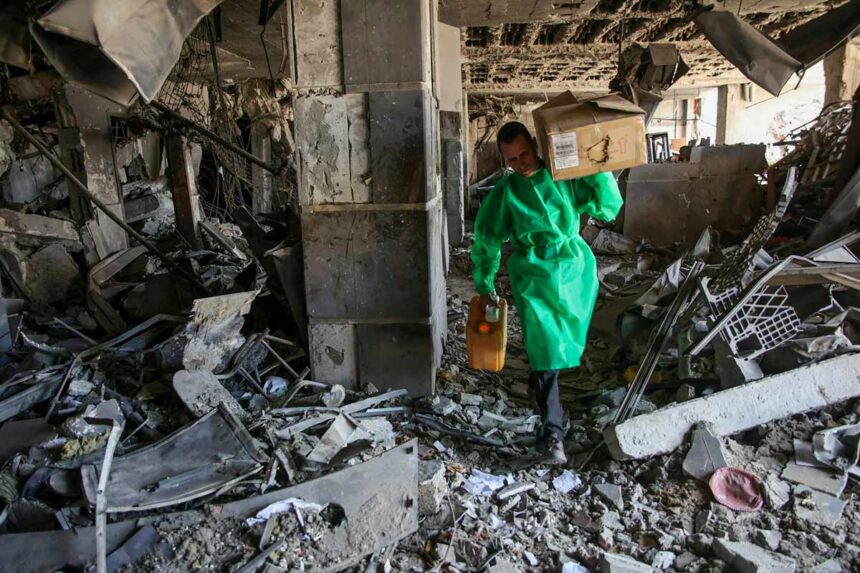
In a growing humanitarian crisis, medical workers and healthcare facilities are increasingly under deliberate attack in conflict zones, prompting experts to label such acts “healthocide.” From Gaza to Lebanon, Ukraine, Sudan, Syria, and El Salvador, doctors, nurses, and hospitals face targeted violence, obstruction, and intimidation, even as international humanitarian law guarantees the principle of medical neutrality. This alarming trend threatens not only the lives of healthcare professionals but also the ability of vulnerable populations to access essential care, underscoring the urgent need for global attention and accountability.
Deliberate Targeting of Healthcare Workers and Facilities
Recent analyses and reports highlight a sharp rise in attacks on medical personnel and institutions, revealing a disturbing disregard for international protections. In Gaza, healthcare workers have endured killings, arbitrary detention, beatings, and humiliation, while hospitals have been bombed or converted into conflict zones. The American University of Beirut’s Dr Joelle Abi-Rached and colleagues note that ambulances are often blocked or directly attacked, leaving injured civilians without access to care. These incidents illustrate that medical neutrality is increasingly ignored in wartime scenarios, leaving health services dangerously exposed.
Data from various monitoring organizations paints a stark picture: Israel’s full-scale invasion of Gaza has resulted in nearly a thousand medical workers’ deaths, with dozens of doctors detained without charge. Lebanon has recorded hundreds of healthcare worker casualties, significant ambulance damage, and numerous hospital attacks between October 2023 and January 2025. Globally, the Safeguarding Health in Conflict Coalition documented over 3,600 attacks or obstructions of healthcare in 2024, the highest ever recorded. Such acts range from the arbitrary arrest and torture of medical professionals to the direct targeting of patients and hospital infrastructure.
International Law Under Threat
The repeated attacks on healthcare systems have sparked urgent calls for greater enforcement of international humanitarian law. Current conventions, including the Geneva Conventions, theoretically protect healthcare workers and facilities, yet experts warn that these laws often allow broad interpretation, creating loopholes that enable attacks if medical sites are deemed “harmful to the enemy.” Human rights and medical professionals stress that this ambiguity contributes to escalating violence and reinforces impunity for perpetrators.
Global health lawyers and ethicists have highlighted Gaza as the most extreme example, where health systems necessary for sustaining populations at risk of famine are systematically dismantled. Hospitals have been converted into battlegrounds, and health workers face arbitrary detention and violence, depriving the most vulnerable of urgent care. The British Medical Association emphasizes the moral and legal responsibility to safeguard healthcare access and hold violators accountable.
Calls for Action and Accountability
Experts urge medical associations, governments, NGOs, and the United Nations to take decisive steps against healthocide. This includes publicly denouncing violations of medical neutrality, ensuring enforcement of humanitarian law, and documenting abuses to prevent future incidents. Proposed measures include creating a UN special rapporteur focused specifically on protecting health services in conflict zones, highlighting global accountability gaps, and mobilizing resources to protect healthcare workers in vulnerable regions.
Testimonies from detained health professionals illustrate the severity of abuses, with reports of torture, deprivation of food and water, sleep disruption, and prolonged stress positions. Such deliberate targeting has lasting consequences, not only for individuals but for entire healthcare systems and the populations that rely on them. By institutionalizing protections, documenting violations, and advocating for international intervention, experts hope to curb the rise of healthocide and uphold the integrity of medical neutrality worldwide.
The UK government, along with international actors, has called on Israeli authorities to investigate attacks on medical personnel and ensure accountability. This mirrors a broader global call for transparent reporting, justice for affected workers, and structural changes that prevent further targeting of healthcare facilities. The emerging consensus among academics, human rights groups, and health authorities is that only proactive, coordinated, and legally enforced action can prevent the normalization of attacks on health services during conflict.
Global Implications of Healthocide
The increasing frequency of attacks on medical personnel and facilities is not confined to a single region. From the Middle East to Eastern Europe and parts of Africa, health systems are being strategically weakened as a tactic of war. This deliberate targeting not only violates humanitarian norms but also amplifies suffering for civilians dependent on essential medical care. Observers warn that failing to address these attacks threatens to destabilize healthcare provision worldwide and erode trust in the protection of humanitarian rights.
Medical professionals emphasize that healthocide represents a new form of war crime requiring urgent global recognition. They advocate for strengthened enforcement of international law, immediate protection for health services, and visible accountability for perpetrators. This includes ensuring safe passage for ambulances, protecting hospitals from bombardment, and shielding health workers from intimidation and arbitrary detention. By recognizing and responding to healthocide as a distinct and critical threat, the international community can safeguard both the lives of healthcare providers and the broader civilian populations they serve.
As conflicts continue and the targeting of health services escalates, medical neutrality and humanitarian principles face unprecedented challenges. The rising number of attacks underscores the necessity of international vigilance, proactive intervention, and comprehensive strategies to protect healthcare systems and the professionals who sustain them. The calls to action from health experts and international observers highlight the urgent need for coordinated global efforts to defend medical personnel, uphold human rights, and ensure the provision of life-saving care in conflict zones worldwide.