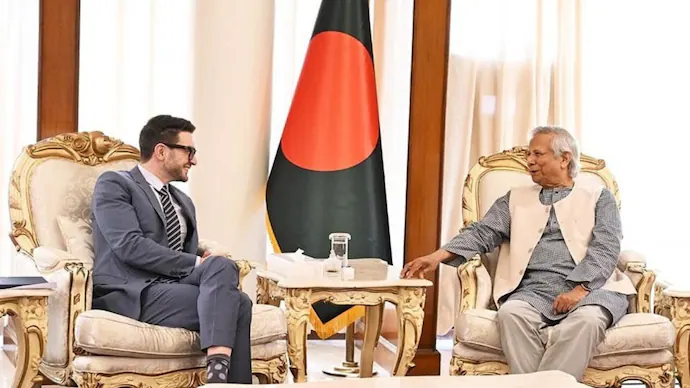
In the wake of the Trump administration’s decision to halt foreign aid to Bangladesh, Alex Soros, the son of American billionaire philanthropist George Soros and chairperson of the Open Society Foundations (OSF), met with Muhammad Yunus, the head of Bangladesh’s interim government. This marks the second meeting between the two in the past three months. The first occurred in New York last October, following Yunus’s appointment as the head of the interim government after the fall of Prime Minister Sheikh Hasina’s regime.
The recent meeting, which took place in Dhaka, focused on various important matters concerning Bangladesh’s political and economic future. Yunus shared details of the discussions, stating that the delegation led by Alex Soros and OSF president Binaifer Nowrojee expressed their strong support for the interim government’s reform agenda. Yunus’s office further confirmed through a tweet that the delegation’s discussions centered around Bangladesh’s efforts to rebuild its economy, track down siphoned-off assets, combat misinformation, and implement crucial economic reforms.
As reported by Bangladeshi media, the talks revolved around several key issues, including economic reforms, media freedom, asset recovery, new cybersecurity laws, and the ongoing Rohingya crisis. These topics have become increasingly relevant as the country faces a period of political and economic uncertainty.
The meeting between Alex Soros and Yunus comes in the context of broader geopolitical tensions. Alex Soros, who is also known for his engagement in global social and political issues, has previously referred to Yunus as an “old friend” of his father, referring to their longstanding association. Yunus is widely regarded for his groundbreaking work in microfinance and social welfare initiatives in Bangladesh. His financial ties to George Soros have drawn attention, given the political climate in Bangladesh and the broader region.
It’s worth noting that Alex Soros, who is engaged to Huma Abedin, a former top aide to Hillary Clinton, has been involved in various philanthropic efforts across the world. OSF, the organization he leads, has been a subject of controversy in some regions. It has been accused of supporting regime changes in countries across Eastern Europe, the Middle East, and Latin America. Critics claim that the OSF played a role in the political unrest in Bangladesh, particularly in relation to the fall of Sheikh Hasina’s regime in August of the previous year.
The former Prime Minister, Sheikh Hasina, had previously alleged that the US government was involved in the political unrest in Bangladesh, although she did not provide detailed evidence to support the claim. The accusations surrounding OSF’s activities, particularly its alleged role in influencing political outcomes in countries, have led to heightened scrutiny of the organization.
In recent weeks, George Soros and his foundation have also been embroiled in controversies in India. The billionaire’s name has been linked to debates surrounding the Adani Group, as Soros-funded organizations are believed to have played a role in exposing financial irregularities involving the group through the Organised Crime and Corruption Reporting Project (OCCRP). The Adani Group, which is owned by Indian billionaire Gautam Adani, has faced allegations of using opaque Mauritius-based funds to channel investments into its various companies.
Additionally, Soros’s connections have been scrutinized in India as political allegations have emerged, particularly from the Bharatiya Janata Party (BJP). The BJP has accused Congress leader Sonia Gandhi of having links with organizations funded by Soros. OSF’s activities have been under investigation in India due to its alleged support for organizations that have been critical of government policies and actions.
As the influence of George Soros, his Open Society Foundations, and their financial connections to global political and economic movements continues to unfold, the recent meeting between Alex Soros and Muhammad Yunus adds yet another layer to the complex relationship between philanthropy, politics, and global governance. As Bangladesh navigates its political transition, and as scrutiny of OSF’s global footprint intensifies, the upcoming months will likely provide further insights into the implications of these influential figures and organizations on the future of the country and the region.