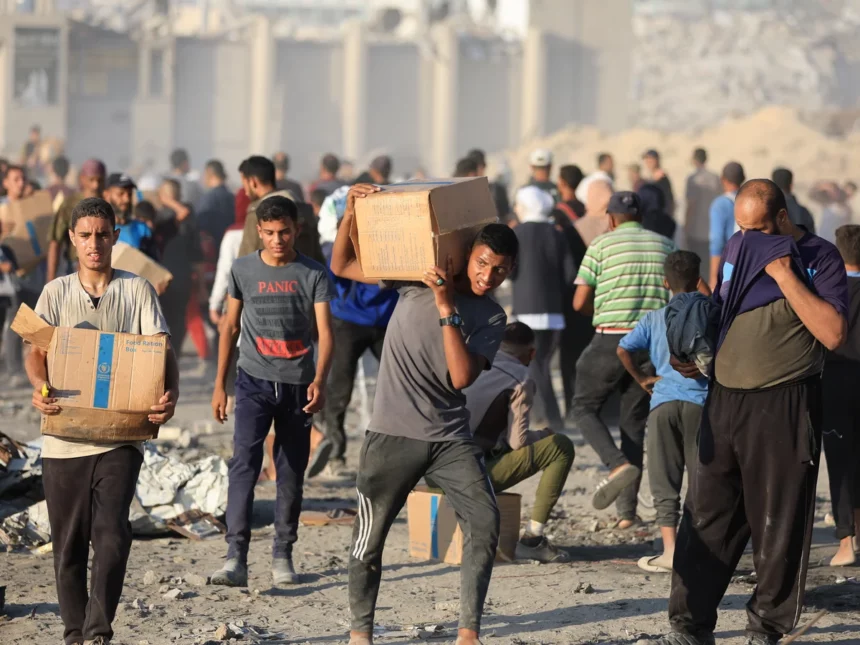
In Gaza, where survival now hinges on aid convoys and food distributions, nearly 800 people have been killed while trying to receive food since late May, according to the UN human rights office. The tragedy underscores the desperate conditions under Israel’s blockade and the ongoing violence, even as aid groups struggle to navigate military restrictions and security threats to deliver life-saving assistance.
Rising Death Toll Amid Aid Distribution
Since May 27, the UN reports that 798 people have been killed while attempting to receive food aid, with 615 deaths occurring near Gaza Humanitarian Foundation (GHF) sites and 183 along aid convoy routes. The GHF, backed by the US and Israel as an alternative to the UN system, has faced heavy criticism from rights groups for violating humanitarian principles and for being complicit in actions that have endangered civilians. Despite Israeli claims that Hamas has diverted aid, the UN has found no evidence supporting these assertions, while the GHF denies responsibility for deadly incidents at its sites.
The region has seen daily shootings at food distribution points, with people forced to follow complex instructions and walk long distances for aid, only to find no guarantee of safety. The continuing hostilities and military strikes have exacerbated the risk, with the Gaza Strip on the brink of famine 21 months into the Israel-Hamas war.
Violence, Attacks, and International Tensions
On Friday alone, Israeli strikes killed seven people in Gaza, including five at a school-turned-shelter in Jabalia al-Nazla, and injured several others in separate attacks across Gaza City and central regions. In Nuseirat, Al-Awda hospital reported receiving casualties after Israeli forces fired near an aid distribution point.
Adding to the volatility, the International Committee of the Red Cross (ICRC) reported that one of its staff members and a Palestine Red Crescent Society volunteer were injured by gunfire during a rescue mission in Gaza, despite traveling in clearly marked vehicles and coordinating their movements with authorities. The ICRC condemned the attack and reiterated that under international humanitarian law, medical and relief personnel should never be targeted.
The crisis extends beyond Gaza, with tensions in the Red Sea intensifying as commercial ships broadcast their nationality and religious affiliations to avoid attacks by Yemen’s Houthis, who claim solidarity with Palestinians. Recent attacks on vessels have sharply reduced traffic through the critical waterway, further complicating aid and supply chains in the region.
Global Responses and Shifting Diplomacies
As conditions deteriorate, the European Union has moved to sanction Israel for potential breaches of human rights obligations in Gaza and the West Bank, with proposed measures including suspending the EU-Israel association agreement and halting visa-free travel. Meanwhile, the EU has reached an agreement with Israel to increase aid delivery and open additional routes to improve the humanitarian situation in Gaza, although doctors warn that fuel shortages continue to put newborns and critical healthcare at risk.
In the wider region, tensions remain high as Iran confirmed the detention of a teenage French-German cyclist and as Lebanon’s president ruled out normalising ties with Israel despite recent diplomatic overtures from Tel Aviv. Additionally, the Kurdistan Workers’ Party (PKK) began disarmament efforts in Iraq, signaling a significant step in ending one of the region’s longest-running conflicts.
Amid these developments, the UN and aid organisations continue to push for uninterrupted humanitarian access and the protection of civilians as the humanitarian disaster in Gaza deepens under the weight of continued violence, restricted aid flows, and the looming threat of famine.