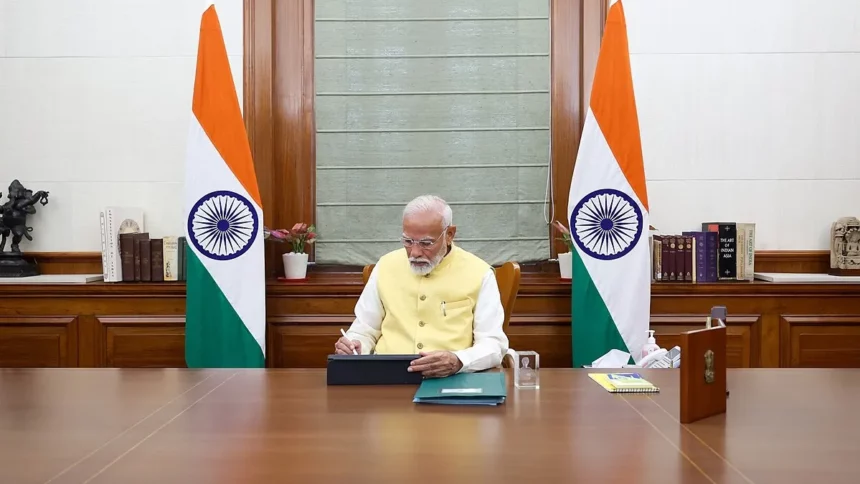
Prime Minister Narendra Modi is set to move the PMO to Seva Teerth, redefining India’s administrative landscape.
Ending a Colonial-Era Chapter as the PMO Leaves South Block
For the first time since independence, India’s highest executive office is preparing to leave a building that has symbolised power, continuity, and governance for nearly eight decades. Prime Minister Narendra Modi is set to shift the Prime Minister’s Office from the historic South Block to a newly constructed complex named Seva Teerth, marking a defining moment in India’s administrative history. The relocation is not merely logistical; it represents a conscious departure from colonial-era infrastructure toward a purpose-built environment designed to meet the needs of contemporary governance.
South Block has long stood as one of the most recognisable symbols of the Indian state. Built during British rule, it housed the offices of the Prime Minister, the Ministry of External Affairs, and other key institutions, becoming synonymous with executive authority. Generations of leaders worked within its walls, navigating wars, diplomatic breakthroughs, economic reforms, and political transitions. Its architecture and spatial hierarchy reflected a colonial mindset where power was centralised and physically elevated. As the PMO prepares to vacate the building, a chapter of post-independence administrative history comes to a close.
The decision to move the PMO aligns with a broader vision of reimagining how governance is conducted and represented. The new location, Seva Teerth, is part of the Central Vista Redevelopment Project, an ambitious effort to modernise the heart of New Delhi’s administrative district. The move symbolises a shift away from inherited colonial spaces toward structures conceived, designed, and named in an Indian context, reflecting changing ideas about statecraft, efficiency, and public service.
Seva Teerth has been conceptualised as a modern executive enclave rather than a standalone office. It consists of three interconnected buildings, with Seva Teerth-1 designated to house the Prime Minister’s Office, Seva Teerth-2 already occupied by the Cabinet Secretariat, and Seva Teerth-3 intended for the National Security Council Secretariat. This physical proximity is expected to enhance coordination, reduce bureaucratic delays, and allow faster decision-making at the highest levels of government. The emphasis is on functionality, security, and seamless interaction between key arms of the executive.
The name “Seva Teerth” itself reflects a deliberate philosophical choice. Unlike colonial-era names that emphasised authority and hierarchy, the new complex draws on Indian concepts of service and duty. Officials involved in the transition have indicated that the nomenclature is meant to convey the idea of governance as service to the nation rather than rule over it. This symbolic reorientation mirrors a broader narrative that has accompanied changes in India’s civic and administrative spaces in recent years.
As the PMO prepares to move, plans are already underway to repurpose South Block and its twin, North Block. These historic buildings are expected to be transformed into a public museum complex, allowing citizens to engage with the country’s administrative and civilisational history. In this way, the relocation does not erase the past but reframes it, preserving heritage while opening it to public participation rather than confining it to the corridors of power.
Seva Teerth and the Central Vista Vision for Modern Governance
The relocation of the PMO to Seva Teerth is one of the final and most symbolic steps in the Central Vista transformation, a project that has reshaped the physical and conceptual core of India’s capital. Stretching from Rashtrapati Bhavan to India Gate, the Central Vista area has been redesigned to accommodate modern parliamentary and administrative requirements while improving accessibility, security, and urban coherence. Within this framework, Seva Teerth is envisioned as the nerve centre of executive governance.
The design of the Seva Teerth complex prioritises efficiency and adaptability. Modern office layouts, advanced communication infrastructure, and secure yet flexible meeting spaces are intended to support the complex demands of twenty-first-century governance. Unlike older buildings that were retrofitted over time, Seva Teerth has been built from the ground up to integrate technology, sustainability, and security considerations. This reflects an understanding that effective governance today depends as much on infrastructure as on policy intent.
Beyond operational efficiency, the move carries strong symbolic weight. Over the past decade, several prominent public spaces and institutions in New Delhi have undergone renaming and redesign to emphasise ideas of duty, service, and national identity. The shift from South Block to Seva Teerth fits into this larger pattern, reinforcing a narrative of moving beyond colonial legacies toward an administrative culture rooted in indigenous values and democratic accountability.
The timing of the move has also drawn attention. Aligning the relocation with Makar Sankranti, a festival associated with renewal and transition, adds cultural resonance to the event. The symbolism of beginning a new administrative chapter on a day linked with change and progress underscores the intention behind the shift. It frames the move not as a disruption but as a natural evolution in the life of the nation’s institutions.
Urban planners and policy observers note that the Central Vista redevelopment, including Seva Teerth, represents a rebalancing of how power and public space coexist. By consolidating executive functions into modern complexes and converting older power centres into museums and public spaces, the city’s core is being reshaped to allow greater public engagement with history and governance. The transformation seeks to blend continuity with change, maintaining a visual and cultural link to the past while accommodating present and future needs.
For the Prime Minister’s Office, the move offers an opportunity to operate within a space designed specifically for contemporary challenges, from crisis management and inter-ministerial coordination to international diplomacy conducted in an increasingly digital environment. The proximity of allied institutions within the Seva Teerth complex is expected to enhance responsiveness during emergencies and streamline policy execution.
As Seva Teerth becomes operational, it will stand as both a functional headquarters and a symbol of India’s evolving administrative identity. The relocation marks a moment when infrastructure, symbolism, and governance philosophy intersect. While South Block will continue to hold a revered place in the nation’s memory, Seva Teerth is poised to define how India’s executive power is exercised and perceived in the decades ahead.