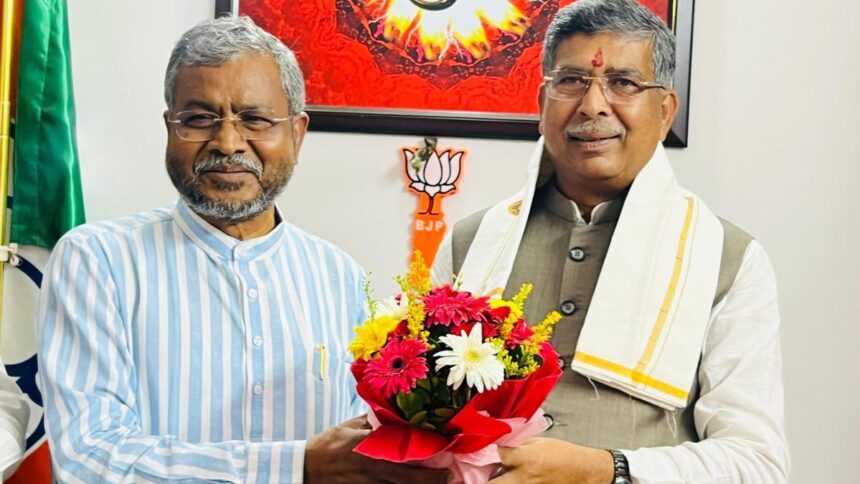
Aditya Sahu is poised to take charge as Jharkhand BJP president, marking a strategic leadership transition after recent electoral challenges.
A Consensus Elevation Reflects BJP’s Push for Organisational Renewal in Jharkhand
The Bharatiya Janata Party in Jharkhand is preparing for a significant organisational transition with Aditya Sahu set to assume charge as the state party president. The elevation, expected to be formalised following routine scrutiny of nominations, comes after Sahu emerged as the sole candidate for the post, signalling broad internal consensus. For the party, the change is not merely procedural; it represents a conscious attempt to recalibrate leadership and rebuild organisational momentum in a politically complex state where electoral outcomes in recent years have fallen short of expectations.
Sahu’s rise has been shaped by a steady trajectory within the party. A Rajya Sabha member with experience in organisational roles, he was appointed working president of the Jharkhand BJP in October 2025, a move widely viewed as preparatory. That assignment placed him at the centre of cadre coordination, district-level outreach, and internal restructuring efforts. His impending elevation to the top organisational post reflects the party’s assessment that continuity combined with focused renewal is required to regain traction across constituencies.
The transition also separates organisational leadership from legislative strategy. The outgoing state president, Babulal Marandi, continues as Leader of the Opposition in the Jharkhand Assembly. This division of responsibilities is intended to sharpen focus on both fronts: legislative scrutiny and narrative-building inside the House, and grassroots mobilisation outside it. Party leaders believe this alignment can reduce role overload and allow each wing to operate with clarity of purpose.
For the BJP, Jharkhand presents a unique political terrain. The state’s electorate is shaped by strong tribal identities, significant OBC populations, labour constituencies tied to mining and industry, and a history of competitive multiparty politics. In this context, leadership symbolism matters. Sahu’s OBC background is being read within party circles as a signal of intent to broaden outreach and strengthen representation among social groups whose support is crucial to electoral success. The choice underscores a strategy that blends social inclusion with organisational discipline.
Senior leaders in the state unit have rallied behind the transition, describing it as a moment to refocus on cadre morale, booth-level management, and issue-based engagement. The uncontested nature of the nomination is being highlighted as evidence of unity after a period when the party’s internal debates were amplified by electoral disappointment. With organisational elections also underway to select members of the party’s national council from Jharkhand, the leadership change is part of a broader reset designed to streamline decision-making and prepare for long-term contests.
Political Context, Strategic Challenges, and the Road Ahead for the State Unit
Aditya Sahu’s appointment comes at a time when Jharkhand’s political landscape is undergoing subtle shifts. Governance debates around employment, land rights, mining policy, welfare delivery, and centre–state relations have sharpened, while regional forces continue to assert their influence. For the BJP, translating national narratives into local resonance has been a persistent challenge. The party’s leadership believes that organisational coherence and consistent outreach are prerequisites to closing this gap.
One of Sahu’s immediate tasks will be to strengthen district and mandal structures. Party insiders point to the need for regular cadre training, data-driven booth management, and clearer communication channels between the state unit and the grassroots. These operational priorities are expected to be accompanied by an emphasis on social coalitions that cut across caste and community lines, particularly in constituencies where margins have been narrow.
The leadership transition also reflects lessons drawn from recent elections. While the BJP retains a strong national footprint, Jharkhand’s electoral dynamics demand sustained local engagement and leadership visibility. The separation of organisational and legislative roles is designed to ensure that the party’s messaging is consistent across platforms—inside the Assembly through structured opposition and outside through community engagement, issue articulation, and mobilisation.
Sahu’s parliamentary experience is expected to be an asset as the party aligns state-level priorities with national policy positions. As a Rajya Sabha MP, he has navigated federal debates and intergovernmental coordination, skills that could help bridge centre–state narratives. At the same time, the challenge will be to ensure that central themes are adapted to Jharkhand’s specific socio-economic realities rather than applied uniformly.
Another dimension of the transition is generational balance. While veteran leaders bring institutional memory and credibility, the party has also been seeking to empower younger organisers and district leaders. Sahu’s elevation is being framed as an opportunity to integrate experience with fresh energy, encouraging internal mobility and performance-based responsibility. Success on this front could influence how effectively the BJP rebuilds trust among workers and voters alike.
Looking ahead, the party’s priorities include consolidating its base in urban and semi-urban centres while deepening presence in tribal belts. This will require nuanced messaging on development, welfare delivery, and identity-sensitive governance. Organisational discipline, coalition-building, and sustained outreach—rather than episodic campaigns—are expected to be central to the strategy.
As Aditya Sahu prepares to assume the presidency, expectations within the party are calibrated but clear. The mandate is to unify ranks, professionalise operations, and craft a compelling state-specific narrative that can translate organisational gains into electoral outcomes. In a state where political fortunes can pivot quickly, the effectiveness of this leadership reset will be measured by the BJP’s ability to reconnect with voters and reassert itself as a competitive force.